Modern high-fidelity audio systems have achieved a level of technical performance that would have been unimaginable to the pioneers of the mid-20th century. With near-perfect linearity, vanishingly low total harmonic distortion, and impeccable transient response, today’s equipment is capable of extreme acoustic neutrality. Yet, despite this hardware perfection, a fundamental obstacle remains: the human ear itself.
Human hearing is inherently non-linear, a biological reality that means our perception of bass and treble frequencies fluctuates significantly based on the sound pressure level (SPL) at which we listen. When a recording is played back at volumes lower than the mastering engineer’s original reference level—typically 83 dB SPL—the music loses its intended tonal balance. This article explores the science behind this phenomenon, the history of its failed analog solutions, and how modern digital signal processing (DSP) allows us to finally restore the mastering engineer’s vision at any volume.
The Disconnect Between Hardware and Biology
Every high-fidelity system is designed to attenuate sound uniformly across the frequency spectrum. If you turn your volume knob down by 10 dB, your speakers output 10 dB less at 20 Hz, 1 kHz, and 20 kHz. However, the human auditory system does not mirror this linearity.

Research, most notably the Fletcher-Munson curves of 1933 and subsequent revisions, confirms that as sound pressure levels decrease, the human ear’s sensitivity to low and high frequencies drops off much faster than its sensitivity to midrange frequencies. Consequently, a piece of music mixed at a reference level of 83 dB will sound "thin," "hollow," or "lacking in sparkle" when played back at a domestic level of 72 dB. The midrange holds its ground, but the tactile, foundational bass and the ethereal "air" in the treble recede into the noise floor of the room.
For the audiophile who prides themselves on "straight wire with gain" transparency, this creates a paradox: to hear the music as the artist intended, one must compromise the very "flat" response they have invested thousands of dollars to achieve.
A Chronology of Loudness Compensation
The Fletcher-Munson Era (1933)
The story begins with Harvey Fletcher and Wilden A. Munson at Bell Laboratories. Their mission was not originally about high-fidelity music, but rather the economics of long-distance telephony. To scale the American telephone network, engineers needed to know exactly how much frequency information was necessary to keep speech intelligible. They mapped the sensitivity of the human ear, discovering that the midrange—the core of human speech—is where we are most sensitive. Below 300 Hz and above 4 kHz, our ears require significantly more acoustic energy to perceive sound as "equally loud" as a 1 kHz tone.

The Golden Age of Analog (1950s–1970s)
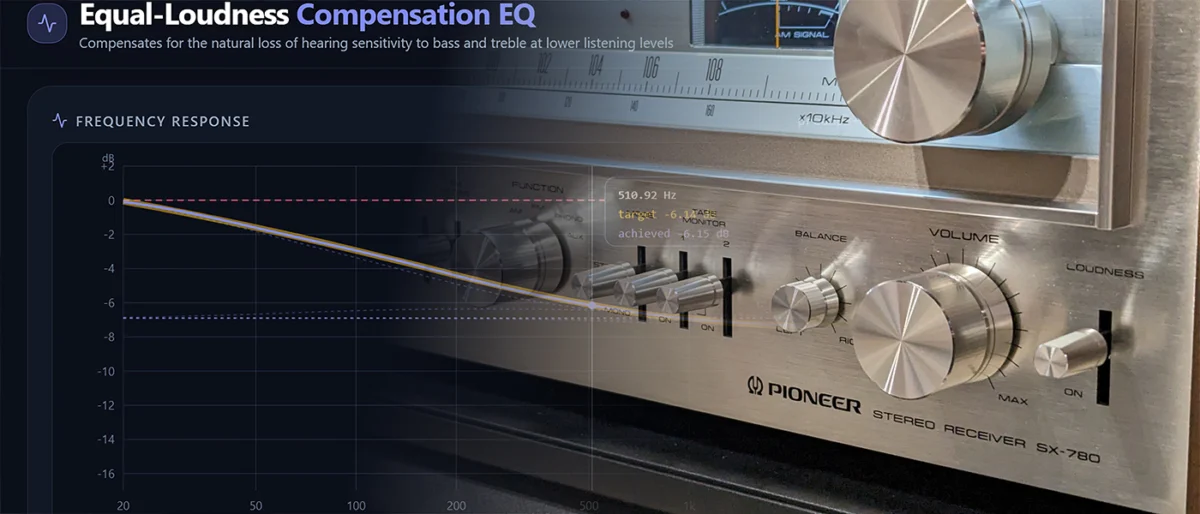
Recognizing this psychoacoustic reality, manufacturers like McIntosh, Fisher, and H.H. Scott integrated "Loudness" controls into their receivers. These circuits used tapped potentiometers and passive RC filter networks to artificially boost bass and treble as the volume was turned down. In the 1970s, the Japanese giants—Pioneer, Sansui, and Kenwood—standardized this as a simple "Loudness" toggle switch.
The Yamaha Evolution
Yamaha attempted a more nuanced approach with their Continuous Variable Loudness control in the 1970s. Rather than a binary "on/off" switch, this allowed users to calibrate their reference volume and then apply variable, proportional compensation as they attenuated the signal. While theoretically superior, these analog solutions were often uncalibrated and imprecise, leading to "boomy" bass and "harsh" treble that alienated serious listeners.
The Audiophile Backlash and the Digital Renaissance
By the 1990s, the "purist" movement in high-end audio led to the total abandonment of loudness controls. Anything that touched the signal path was deemed a "corruption." However, this rejection ignored the underlying scientific truth: without compensation, the listener is not hearing the recording as mastered. Today, with the ubiquity of high-resolution digital streaming and sophisticated DSP, we have entered a new era. We can now implement these curves with mathematical precision that was impossible in the analog age.

Supporting Data: ISO 226:2023 and the Modern Standard
The science behind human hearing has been refined significantly over the last century. Following the original Fletcher-Munson research, subsequent studies by Robinson and Dadson (1956) and various international teams culminated in the ISO 226 standard. The 2023 third edition of ISO 226 represents the current "settled science" regarding equal-loudness contours.
Using this data, it is possible to generate Parametric Equalizer (PEQ) filters that are accurate to within a fraction of a decibel. For example, by applying a 5-band PEQ profile, a user can mathematically invert the ear’s natural sensitivity drop-off at 72 dB, 68 dB, or any other preferred listening level, effectively normalizing the frequency response to match the 83 dB reference.
Unlike the vintage "V-shaped" EQ presets found in modern consumer apps—which often apply arbitrary, heavy-handed boosts—proper ISO 226-compliant DSP is surgical. It applies gain where it is needed and nowhere else, preserving the imaging and soundstage while restoring the tonal foundation that would otherwise be lost.

Implications for the Modern Listening Room
The most significant implication of this shift is that the "correct" way to voice a room is changing. Historically, audiophiles have been forced to position speakers closer to walls or use aggressive toe-in to compensate for perceived lack of bass or treble at low volumes. However, these spatial adjustments are fixed; they affect the sound at 83 dB just as much as they do at 70 dB.
By moving the compensation from the room (speaker placement) to the digital domain (DSP filters), we can optimize our speakers for the best possible imaging, depth, and soundstage at reference levels, and let the DSP handle the tonal balancing at lower levels. This allows for a "best of both worlds" scenario: perfect imaging when you want to listen critically, and full-range, rich, balanced sound when you want to enjoy music at lower, more neighbor-friendly volumes.
The Role of Digital Headroom
A common critique of EQ is the potential for clipping. When we apply a boost to low frequencies, we risk exceeding the digital headroom of our DACs. However, the solution is straightforward: users must apply a negative preamp gain (digital attenuation) equal to the maximum boost required by the filter set. By "pre-dimming" the digital signal, we ensure that the DSP has the necessary "breathing room" to perform the compensation without introducing distortion or inter-sample overs.

Conclusion: A Better Way to Listen
The question "What is your listening level?" is perhaps the most important question an audiophile can answer. It is a data point that encapsulates the acoustics of the room, the efficiency of the speakers, and the personal tolerance of the listener.
We no longer need to rely on the crude, uncalibrated loudness switches of the 1970s, nor must we accept the "thin" sound that plagues low-volume listening. By leveraging the ISO 226:2023 standard, modern DSP, and a basic understanding of our own hearing, we can reclaim the mastering engineer’s original intent.
Whether you are listening late at night in a quiet apartment or in a dedicated home studio, the goal remains the same: to experience the music in its full-range glory. When we finally stop treating the volume knob as a simple gain control and start treating it as a dynamic interface with our own biology, we stop fighting our equipment and start listening to the music as it was meant to be heard.

For those ready to bridge the gap between their equipment and their ears, the tools are now free, the math is settled, and the results are profound. It is time to bring the loudness hero back—not as a gimmick, but as a fundamental component of the high-fidelity experience.