In an era defined by the "all-in-one" philosophy—where high-end audio components are increasingly expected to function as network streamers, DACs, and DSP-equipped hubs—the AVID HIFI Accent stands as a defiant monument to analog purity. Crafted by the British masters of precision playback, the Accent is not merely an amplifier; it is a declaration of intent. By stripping away the ephemeral trends of digital convenience, AVID has produced a high-fidelity instrument designed for the discerning listener who views music reproduction as an act of heritage rather than a data stream.
Main Facts: The Essence of the Accent
The AVID HIFI Accent is a fully discrete, Class AB integrated amplifier that serves as the entry point into the company’s storied amplification lineup. Born from the vision of founder Conrad Mas, the Accent encapsulates the brand’s 1995-established ethos: the minimization of mechanical vibration and electrical noise to reveal the truth of a recording.

Key specifications define its character: 70 watts per channel into 8 ohms, bolstered by a substantial 617 VA toroidal transformer and an impressive 40,000 µF of capacitance. This power supply architecture ensures that the amplifier remains unflappable, even when paired with loudspeakers that present challenging impedance loads. Crucially, the Accent features a built-in Pellar phono stage—a component usually sold as a standalone unit—which positions this amplifier as a centerpiece for the modern vinyl enthusiast.
A Chronology of Craftsmanship
AVID HIFI’s trajectory from specialized turntable manufacturer to a full-system electronics powerhouse has been a decades-long exercise in incremental perfection. The company first cemented its reputation by addressing the microscopic mechanical energy that compromises analog playback.

- 1995: Conrad Mas founds AVID HIFI, focusing on the mechanical isolation of turntables.
- Expansion Phase: Recognizing that the purity extracted from the record groove was being bottlenecked by conventional amplification, AVID pivoted into electronics.
- The Accent Development: Engineers sought to distill the performance of their reference-grade separates into a single, compact chassis. The goal was to remove the potential for signal degradation caused by external cables and connectors between components, effectively "shortening" the signal path.
- The Present: The Accent represents the maturation of this philosophy, proving that a "less is more" approach, when executed with high-grade polypropylene capacitors and premium ALPS potentiometers, can outperform more complex designs.
Technical Specifications and Supporting Data
The engineering behind the Accent is best understood through its measured performance and build quality. It is a dual-mono-inspired design housed in a rigid, vibration-dampening steel chassis, finished with a signature thick aluminum front panel.
Engineering Data
- Topology: Fully discrete Class AB.
- Phono Stage: Integrated Pellar (MM/MC compatible) with adjustable gain (48 dB, 60 dB, 70 dB).
- Frequency Response: 5 Hz – 80 kHz (±1 dB).
- Signal-to-Noise Ratio: 100 dB (A-weighted) at 50 W.
- Physical Footprint: 18.5" x 4.3" x 16.1", weighing in at a substantial 32 lbs (14.5 kg).
The inclusion of the Pellar phono stage is perhaps the most significant data point for the consumer. With selectable sensitivity and external RCA resistance-loading sockets for moving-coil (MC) cartridges, the Accent allows for a level of system-matching that is rare in integrated designs. It effectively eliminates the need for an external phono preamplifier, reducing the "noise floor" of the entire system by removing a pair of interconnect cables from the chain.

Operational Philosophy and Design Language
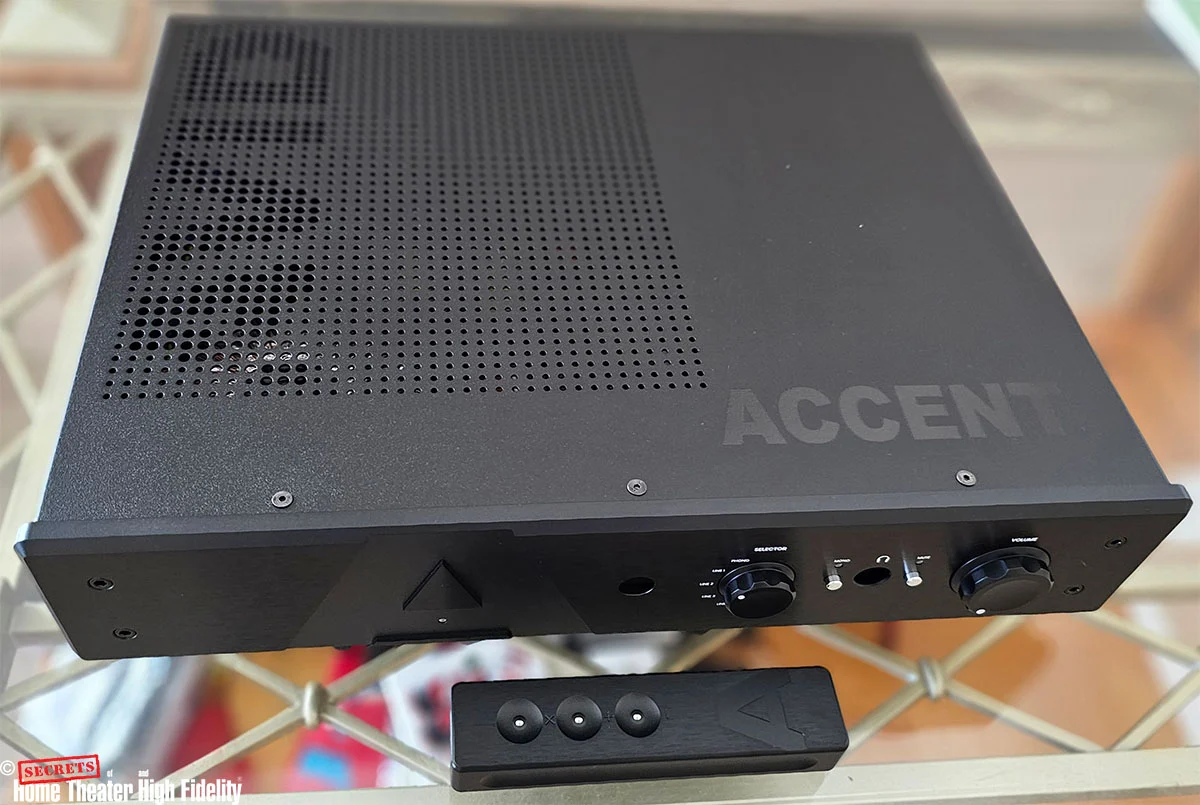
The design of the Accent is an exercise in restraint. The front panel is refreshingly sparse, featuring only a volume knob, an input selector, and two tactile push buttons for Mono and Mute. A small blue LED embedded in the iconic "A" logo serves as the only visual indicator of life.
The power switch, uniquely positioned on the underside of the chassis, underscores the aesthetic choice to keep the front face entirely unblemished. While some may find the lack of a digital screen or remote-controlled input switching—the remote only handles volume and mute—to be a hindrance, the trade-off is a noise-free internal environment. By avoiding the RFI and EMI generated by digital displays and switching logic, AVID has preserved the sanctity of the analog signal.

Sonic Performance: The Listening Experience
Subjective testing reveals that the Accent prioritizes "musical communication" over analytical sharpness. In pairing the amplifier with reference speakers like the Revel Ultima Studio, the character of the Accent becomes clear: it is a rhythmic, coherent, and highly transparent performer.
The Vinyl Revival
The integrated Pellar phono stage is the star of the show. Using Diana Krall’s The Look of Love as a reference, the Accent extracted a level of depth and "air" that one rarely encounters in a sub-$10,000 integrated system. The soundstage was not merely wide; it was three-dimensional, with a sense of decay and harmonic richness that felt distinctly "analog."

Digital and Acoustic Nuance
When fed via high-end streamers, the Accent maintained this composure. On Melody Gardot’s Sunset in the Blue, the amplifier showcased its ability to render the human voice with delicate intimacy. There was no "spotlighting" or artificial brightness; rather, the presentation was organic, allowing the listener to focus on the breath and phrasing of the performance. Large-scale orchestral works, such as John Williams’ Live in Vienna, demonstrated the unit’s ability to maintain separation in complex, dense passages without succumbing to congestion.
Implications for the High-End Market
The AVID HIFI Accent carries a premium price point of $7,595. In a market flooded with $2,000 streamers that claim to "do it all," this price tag invites scrutiny. However, the implications of purchasing an Accent are clear: you are paying for longevity, build quality, and a signal path that is shielded from the obsolescence of digital standards.

This amplifier is not for the person who wants to change their streaming platform every two years. It is for the person who buys a turntable, a set of high-quality speakers, and a collection of records, and wants an amplification solution that will serve them for the next twenty years. The lack of balanced (XLR) inputs and line-level outputs might alienate a segment of the "audiophile power-user" demographic, but for those who value a single, high-performance unit, the tradeoff is well-calculated.
Conclusion: A Masterclass in Focus
The AVID HIFI Accent is a rare breed of audio component in the modern age. By rejecting the siren call of digital integration, it has achieved a level of sonic refinement that many of its more feature-laden competitors cannot match. It is a heavy, robust, and thoughtfully engineered piece of equipment that proves that "entry-level" is a relative term—in AVID’s world, it simply means the beginning of a journey into uncompromised audio.

For the listener who prioritizes the emotional connection to music, who treasures the tactile nature of vinyl, and who demands that their hardware gets out of the way of the performance, the Accent is not just a purchase; it is an investment in the art of listening. While it may not be the "everything" box, it is, in the most critical sense, the only box you need.