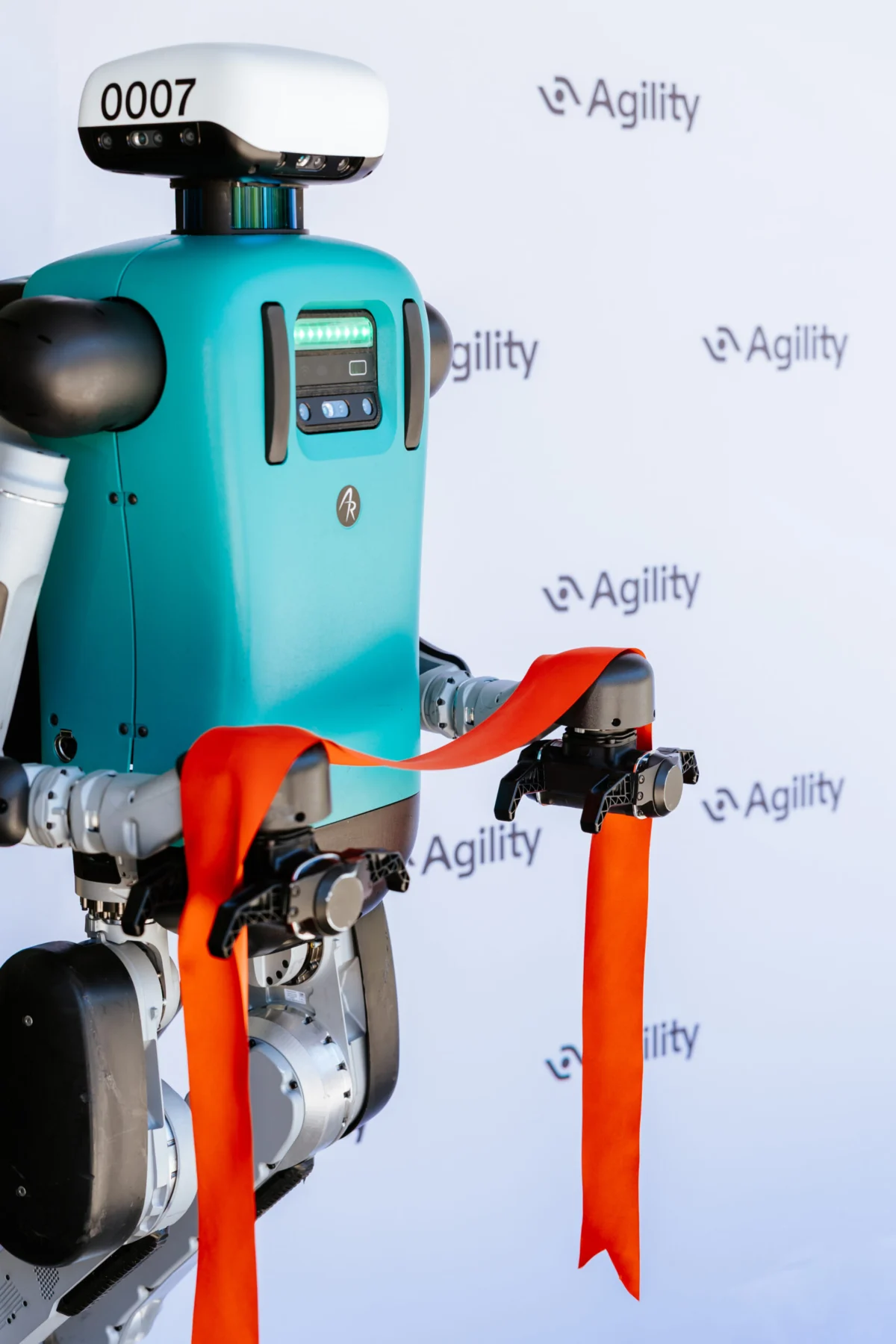
The humanoid robotics landscape is undergoing a seismic shift. In the heart of Fremont, California—a region already synonymous with the cutting edge of automotive and AI innovation—Agility Robotics is establishing a new 60,000-square-foot facility dedicated exclusively to the training and development of its flagship humanoid, Digit.
This move is more than a mere expansion of laboratory space; it is a strategic maneuver in an increasingly crowded and high-stakes market. Just a short drive away, Tesla is preparing its own factories to house the manufacturing of Optimus, the humanoid project that Elon Musk has famously branded as "the biggest product ever." As these two giants of industry position themselves for the next decade of automation, the fundamental question for the sector has shifted from "can we build them?" to "how do we scale them safely and profitably?"
The Commercial Reality: Beyond the Hype
While the industry is currently captivated by the promise of AI-driven androids, Agility Robotics is operating with a pragmatism that sets it apart from the venture-backed frenzy. Unlike many of its contemporaries that remain in the R&D phase, Agility has already crossed the "chasm" into commercial deployment.
Digit is not merely a concept; it is a revenue-generating asset currently integrated into the supply chains of global logistics giants. From Amazon and GXO to the manufacturing floors of Toyota Motor Manufacturing Canada and Schaeffler, Digit has proven its utility by performing the repetitive, often taxing labor of moving totes and bins. The company has secured a staggering $300 million in contract orders, a figure that provides a tangible baseline for a company looking to lead a market that many analysts expect to balloon into a multi-trillion-dollar industry.
A Brief Chronology of Agility’s Rise
Founded in 2015, Agility Robotics emerged from a lineage of academic research focused on bipedal locomotion—the complex physics of keeping a robot upright while navigating uneven human environments.
- 2015: Agility is founded by a team of roboticists dedicated to solving the challenges of walking robots.
- 2019-2022: The company refines the Digit platform, focusing on modularity, safety, and integration into existing warehouse management systems.
- 2023: Agility makes headlines with high-profile partnerships, proving that humanoid robots can work alongside humans in commercial logistics.
- 2024: The company secures significant contract orders, totaling $300 million.
- Late 2025/2026: Agility initiates a reverse-merger process, positioning itself to become the first pure-play humanoid robotics company on the public markets.
- Present: The opening of the 60,000-square-foot Fremont facility marks the transition from prototyping to mass-scale deployment training.
The Strategy of Practical Autonomy
One of the most profound tensions in modern robotics is the integration of generative AI. While Large Language Models (LLMs) and transformer-based architectures have unlocked new levels of "reasoning" for robots, Agility’s leadership remains cautious about where these tools should be applied.
Damion Shelton, Agility’s co-founder and chairman, draws a sharp line between behavioral intelligence and core safety systems. "When you think about self-driving cars, you really don’t want the anti-lock brake controller under AI control," Shelton explained. "The analog with humanoids is that all the safety stuff needs to go through a path that’s not generative AI. You don’t want to get creative with your safety stack."
This philosophy—keeping safety-critical functions deterministic while utilizing AI for task-level autonomy—is what allows Agility to bypass the regulatory hurdles that often stall other autonomous ventures. For Agility, generative AI is a tool for scalability rather than the brain of the robot. As board member and Quicktime inventor Bruce Leak pointed out, the bottleneck in robotics has always been the scarcity of engineers capable of manual programming. By leveraging generative AI to translate complex, intent-based instructions into robotic action, Agility is overcoming the primary barrier to mass adoption.
Official Perspectives: CEO Peggy Johnson on Market Maturity
CEO Peggy Johnson, a veteran of the tech industry, views the proximity to Tesla not as a threat, but as a validation of the market. "It’s great to have them in the same area as us, because really, for a long time, Agility was out there alone," Johnson noted.
For Johnson, the hurdle is no longer just engineering; it is operational compliance. "We have commercialized. We now know what it takes to walk into these facilities and meet their safety bars, their regulatory bars, and plug into their IT infrastructure and warehouse management systems." This operational maturity—the ability to speak the language of enterprise IT and logistics—is precisely what differentiates Agility from the wave of startups like Figure, 1X, and The Bot Company.
Implications: The Road to a Trillion-Dollar Industry
The implications of this robotics expansion are twofold: economic and societal.
1. Economic Scale and the Logistics Pivot
Co-founder and chief robot officer Jonathan Hurst has a clear roadmap for how to reach the trillion-dollar valuation that investors are currently betting on. "Let’s start with the bins and the totes, and then let’s do the picking and the kitting," Hurst said. The strategy is to master the "un-glamorous" tasks—handling cardboard, loading and unloading trailers, and navigating the chaotic floor of a distribution center. By solving these, Agility creates a repeatable, scalable business model that can be deployed across the global supply chain.
2. The Safety and Domestic Threshold
A critical point of divergence between Agility and its competitors is the focus on the home. While media narratives often lean toward the "domestic robot" as the ultimate goal, Agility is explicitly avoiding the consumer market. Industry consensus remains that the home is a chaotic, unpredictable environment that is not yet ready for the current generation of humanoid hardware.
Agility’s current focus is the industrial sector, where environments can be controlled, monitored, and optimized. However, with the upcoming version 5 of the Digit robot, the company is introducing advanced sensing capabilities that will allow it to operate safely in human-centric zones, effectively blurring the lines between "robot-only" areas and human workspaces.
The Competitive Landscape
Agility is entering a defining year. As it moves toward a public listing, it faces a market that is hungry for the next technological revolution but skeptical of "vaporware." The company’s lead over newer AI-first startups is its established track record. While other firms are still training their models in simulation, Agility’s machines have already moved over 100,000 totes in real-world, revenue-generating environments.
This head start in data collection—the "real-world" experience that no simulation can perfectly replicate—is Agility’s greatest moat. As the company scales its Fremont operations, it is not just building robots; it is building the infrastructure of a new labor economy.
Conclusion: A New Era of Human-Machine Collaboration
The arrival of a dedicated facility in Fremont signifies that the humanoid era has officially transitioned from the lab to the factory floor. While Tesla continues to command the spotlight with its brand power and capital-intensive approach, Agility Robotics is steadily building the foundation for a sustainable, industrial-grade humanoid ecosystem.
As the industry matures, the survivors will not necessarily be those with the most advanced AI models, but those who can most reliably integrate into the complex, high-stakes environments of modern global commerce. With over 30 customers in active negotiations and a clear vision for the next generation of its hardware, Agility Robotics is positioning itself not just as a participant in the humanoid race, but as the architect of the standard by which all other commercial robots will be measured.
The promise of a robot in every factory is no longer a question of "if," but of "how soon." For Agility, that future is being written one bin, one tote, and one warehouse at a time.