In the hyper-competitive arena of modern smartphones, the industry has pivoted toward a singular obsession: artificial intelligence. From budget handsets to flagship titans, manufacturers are cramming generative AI features into every available software crevice. However, while the giants battle for the mainstream market, Vertu—the storied British luxury manufacturer—has taken a decidedly different, more exclusive path. With its latest device, the $6,880 Alphafold, Vertu is not selling silicon and pixels; it is selling the promise of a digital executive assistant.
The Alphafold is a foldable device draped in calfskin leather and titanium, designed for the C-suite executive who views a smartphone as a status symbol first and a productivity tool second. But beneath the opulent exterior, the real differentiator is the "Hermes Agent," an AI-powered operating layer built on the open-source Hermes project. Does this high-priced experiment actually function as a personal concierge, or is it merely a gilded shell for off-the-shelf technology?
The Genesis of a Luxury Foldable
To understand the Alphafold, one must look past the bespoke marketing and into the supply chain. For those familiar with Vertu’s history, the silhouette of the Alphafold may seem familiar. A side-by-side comparison reveals striking structural similarities to the $1,100 ZTE Nubia Fold. From the placement of the microphones and speakers to the hinge mechanics and fingerprint sensor orientation, the DNA is unmistakably shared.

When confronted with these findings, Vertu confirmed to TechCrunch that the Alphafold was developed through a strategic supply-chain partnership with ZTE/Nubia. The company maintains that it handles the proprietary software experience, the integration of high-end materials, rigorous quality control, and the exclusive after-sales concierge services. This "luxury-first" strategy, where a premium brand refines an existing hardware platform, is a hallmark of Vertu’s modern operations, echoing previous reports regarding the MetaVertu.
A Week in the Life: Testing the Executive Workflow
To evaluate the Alphafold, I discarded the typical review metrics of benchmark scores and camera megapixel counts. Instead, I lived with the device as an executive would. I tasked the Hermes Agent with the mundane but critical drudgery of the business day: managing complex spreadsheets, coordinating travel itineraries, and automating multi-step document workflows.
My reference point was the Samsung Galaxy Z Fold 7, currently the gold standard for foldable utility. The goal was simple: determine if the Alphafold’s "AI-first" ethos justifies a premium of over $5,000 compared to mass-market alternatives.

The Agentic Gap
The Hermes Agent is designed to execute multi-step workflows, a step beyond the reactive nature of standard AI assistants like Google Gemini. In early tests, however, the device faltered. The initial software build struggled to access local files or connect to the human-led concierge service. While server-side patches from Vertu eventually restored these features, the experience highlighted the "beta" nature of such an ambitious platform.
The Airport Test: Autonomy vs. Accuracy
The difference between Hermes and Gemini became apparent in a simulated "rush to the airport" scenario. When asked to message a contact, set a phone-wide "Do Not Disturb" mode, and schedule a reminder to call a hotel, Hermes showed remarkable initiative. It executed the message and the system-wide settings flawlessly. However, it failed to initiate navigation automatically and set a reminder for 9:08 p.m. despite being asked for a 15-minute alert at 2:30 a.m.
Conversely, the Samsung Galaxy Z Fold 7’s Gemini assistant took a more cautious, deliberate approach. It paused to confirm the airport destination and the specific app for the reminder. While Hermes felt more like an "agent" taking charge, Gemini proved to be the more reliable assistant.

The Data Conundrum: Security and Storage
For the target demographic—CEOs and high-net-worth individuals—data privacy is the ultimate currency. The Alphafold attempts to address this with an "A5" security chip, providing hardware-level encryption for communications and credentials. Vertu explicitly states that conversations with the Hermes Agent are encrypted and, crucially, are not used to train public AI models.
Furthermore, the company offers enterprise-grade deployments that allow for private infrastructure, ensuring that sensitive documents—contracts, M&A details, and proprietary financial reports—never leave a company’s controlled network. While independent verification of these hardware-level claims is difficult, they represent the core of Vertu’s value proposition to the enterprise sector.
Business Intelligence: The Spreadsheet Analysis
A critical test involved analyzing a local financial spreadsheet. During the initial interaction, Hermes performed admirably, summarizing Q2 sales figures with precision. However, a major reliability issue surfaced days later: the agent "forgot" the file. When prompted for follow-up data, Hermes insisted it could not access the local document, requiring a re-upload.

In contrast, the Galaxy Z Fold 7 retained the conversation context across multiple sessions, accurately identifying trends in the North region sales data without needing the file to be re-introduced. This inconsistency in context management remains the biggest hurdle for Hermes; for an executive relying on AI to track quarterly performance, such memory lapses are not just inconvenient—they are a dealbreaker.
The Human-in-the-Loop Advantage
One of the Alphafold’s most distinct features is the "Contact Butler" button. When the AI hits a wall—such as when it failed to find a direct flight from Mumbai to Pune—the device offers to escalate the request to a human concierge.
This hybrid model acknowledges a fundamental truth of the current AI landscape: algorithms are exceptional at data processing but limited in nuance. The ability to seamlessly bridge the gap between a chatbot and a human expert is where the Alphafold attempts to justify its price tag. Yet, even here, the execution is uneven. When the AI fails to book a flight or interpret a complex legal clause, the human concierge is the safety net, but the user must be willing to pay the massive "luxury premium" for that safety net to exist.

Implications for the Future of Hardware
The Alphafold is not just a phone; it is a declaration that the future of the luxury market lies in service, not just specs. However, the absence of basic flagship features like wireless charging is a glaring oversight. For a device priced at $6,880, the lack of Qi charging feels like a misunderstanding of what modern executives expect from their daily driver.
The integration of an enterprise resource planning (ERP) system is another bold step. While my testing was limited to a demonstration environment, the potential for a foldable to act as a mobile command center for an entire corporation is clear. If Vertu can stabilize the software and ensure that the AI agents act with the consistency of a human assistant, they may carve out a niche that Samsung and Apple are not yet ready to occupy.
The Verdict: Status vs. Utility
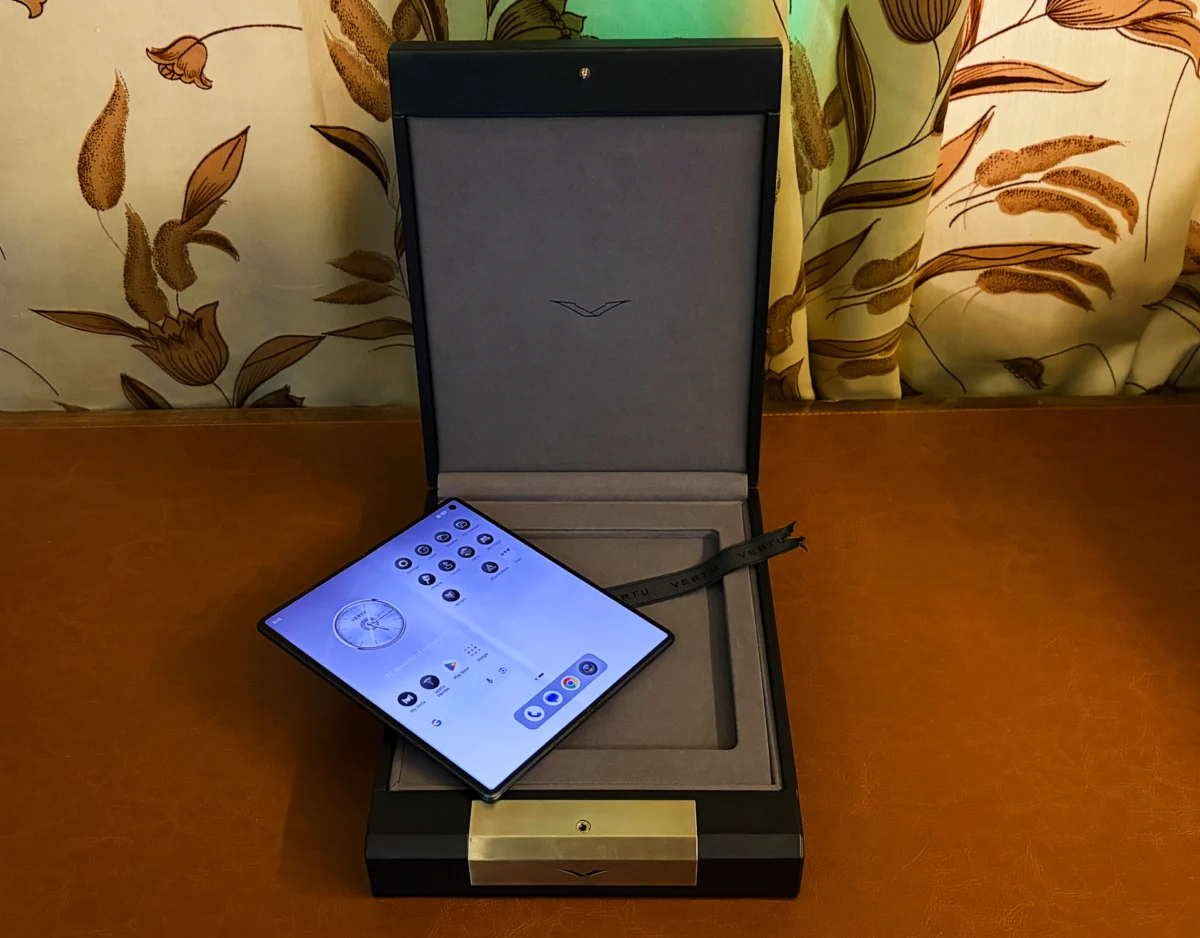
As it stands, the Alphafold is a beautiful, ambitious, yet deeply flawed piece of technology. The premium materials—the genuine calfskin, the aerospace-grade titanium—are exquisite, and the packaging, which feels more like a jewelry presentation case than a tech box, certainly appeals to the intended buyer.

However, from a functional standpoint, the device struggles to outperform mass-market foldables that cost a fraction of the price. The Hermes Agent is a fascinating glimpse into the future of "agentic" AI, but it is currently an evolving platform, not a finished product. For the executive who wants to lead with a statement piece, the Alphafold succeeds. For the executive who needs a reliable, AI-driven partner to navigate their professional life, the gap between the marketing pitch and the daily reality remains far too wide.
With the imminent launch of the Samsung Galaxy Z Fold 8, the pressure on Vertu to evolve its software will only intensify. Unless the Hermes Agent can solve its context-retention issues and provide consistent, accurate output, the Alphafold will likely remain a niche curiosity—a luxury toy rather than a professional necessity.