
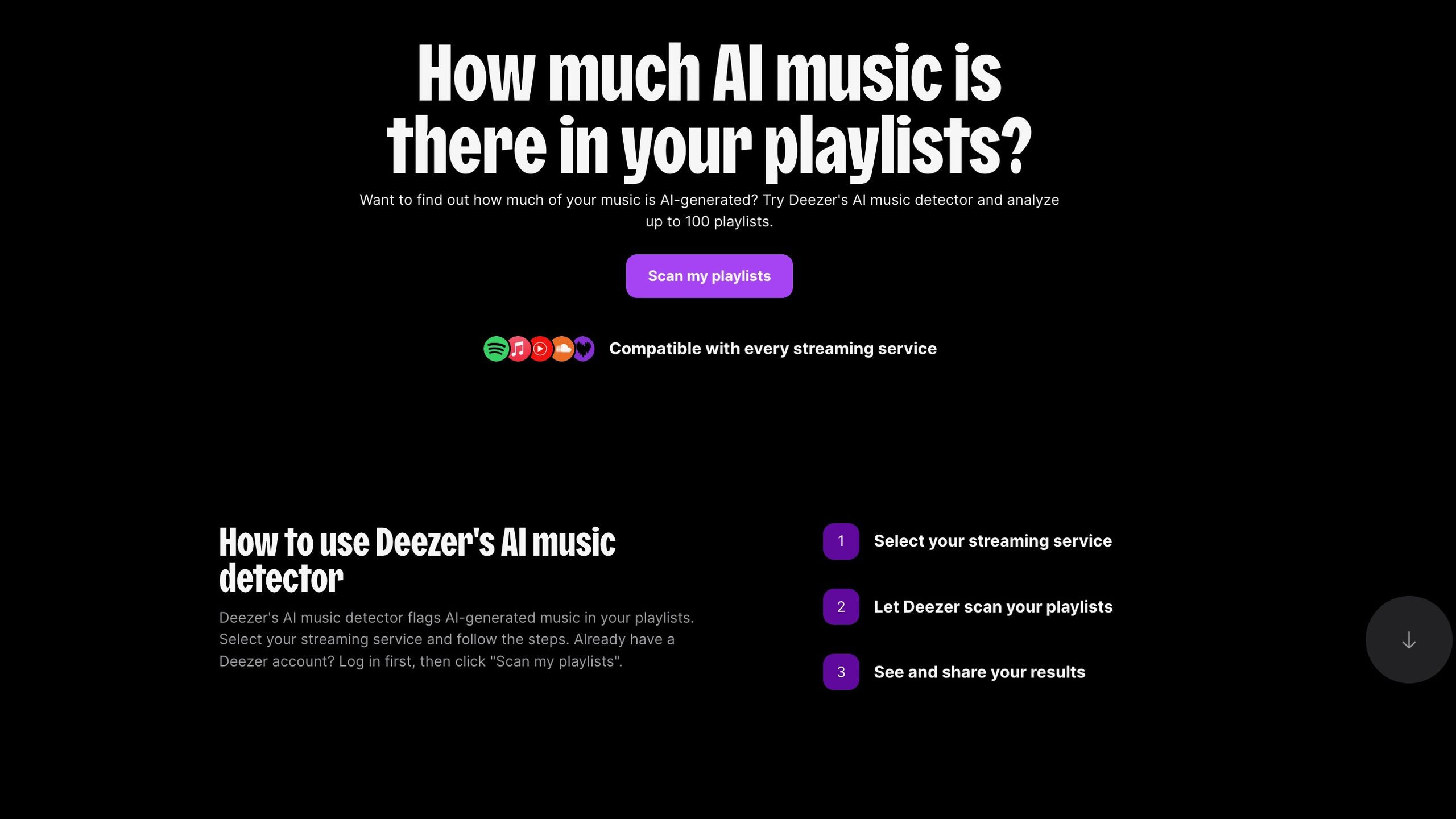
The rapid democratization of generative artificial intelligence has brought the global music industry to a critical crossroads. As tools capable of generating radio-ready songs in seconds become widely accessible, streaming platforms are facing an unprecedented deluge of synthetic audio. In a bold bid to address this phenomenon, French music streaming pioneer Deezer has launched a public AI music detector.
The web-based tool allows users across 20 of the world’s most popular music streaming services—including giants like Spotify, Apple Music, and Tidal—to scan their personal libraries and discover exactly what percentage of their curated playlists consists of machine-generated content.
By shifting the technology from an internal gatekeeping mechanism to a public-facing diagnostic tool, Deezer is attempting to pull back the curtain on the changing composition of modern streaming libraries. The launch marks a pivotal moment in the ongoing debate over digital music ownership, the dilution of artist royalty pools, and the definition of creative authenticity in the digital age.
Main Facts: How the AI Music Detector Works
Deezer’s newly launched AI music detector is designed as an accessible, cross-platform web portal. It allows music fans to audit their digital collections regardless of their primary streaming provider.
Cross-Platform Integration
To use the tool, listeners navigate to Deezer’s dedicated, free AI detection website. From there, they can securely connect their accounts from 20 different streaming services, including:
- Spotify
- Apple Music
- Tidal
- Deezer (native integration)
Once authorized, the tool scans the user’s playlists, analyzing the acoustic signatures and metadata of saved tracks against Deezer’s proprietary database of identified AI music.
The Auditing Process and Limitations
The user experience differs depending on whether the auditor is a Deezer subscriber or a user of a competing platform:
- For Competitor Platforms (Spotify, Apple Music, Tidal, etc.): The tool scans the connected playlists and generates a high-level summary, revealing the exact percentage of the library that is AI-generated. However, due to API limitations and competitive barriers, the free tool does not flag or identify the specific tracks or artists that are machine-made.
- For Deezer Users (and Migrated Accounts): If a user decides to transfer their external playlists and library over to Deezer’s ecosystem, the platform provides full transparency. A Deezer representative confirmed that migrated users can view their library with specific albums and tracks explicitly tagged as containing AI-generated material.
Immediate Algorithmic Action
For tracks hosted natively on Deezer, the detection of AI music triggers an immediate quarantine from the platform’s recommendation engines. Identified synthetic tracks are systematically removed from:
- Algorithmic Recommendations (such as personalized mix flows).
- Editorial Playlists curated by Deezer’s in-house music experts.
This strategic demotion is designed to prevent AI-generated tracks from passively accumulating streams—and consequently, royalty payouts—at the expense of human creators.
Chronology: The Evolution of Deezer’s Battle Against Synthetic Audio
The public release of the AI music detector is the culmination of a multi-year technical and strategic initiative by Deezer to police its catalog.
[Early 2025] ----------------> [Late 2025 (Nov)] -------------> [Present Day]
Deezer deploys                 Deezer & IPSOS publish          Public AI Detector launched;
internal AI detection;         eight-country consumer          cross-platform scans
13.4M tracks flagged           survey on AI music              made available to all
Phase 1: Internal Deployment (Early 2025)
At the start of 2025, Deezer became the first major music streaming service to deploy a dedicated, systematic internal AI detection architecture. Developed by Deezer’s research and development divisions, this system analyzed incoming audio uploads for the unique structural, mathematical, and spectral anomalies characteristic of generative AI models.
Throughout 2025, this internal firewall identified and flagged more than 13.4 million synthetic tracks attempting to enter or already residing within Deezer’s catalog.
Phase 2: Gauging Public Sentiment (November 2025)
To understand how consumers perceived this growing digital shift, Deezer partnered with global market research firm IPSOS to conduct an extensive eight-country survey. Released in November 2025, the study sought to measure public awareness of AI music, the ability of listeners to identify synthetic tracks, and consumer demand for transparency. The findings revealed a massive gap between listener awareness and the reality of streaming catalogs, providing the strategic justification for a public-facing tool.
Phase 3: Public Launch and Cross-Platform Auditing (Present)
Recognizing that the influx of AI music was an industry-wide issue rather than a platform-specific one, Deezer decided to externalize its proprietary detection technology. The launch of the free, cross-platform web tool represents a transition from defensive database management to active consumer advocacy, aiming to educate the broader public on how deeply AI has integrated into their daily listening habits.
Supporting Data: Measuring the Synthetic Deluge
The scale of generative AI’s integration into modern music streaming platforms is reflected in both upload volumes and economic projections.
Daily Music Upload Composition on Deezer:

[██████████████████████░░░░░░░░░░░░░░░░░░░░░░░░░░]
  AI-Generated: 44% (75,000 tracks/day)
  Human-Created: 56% (95,000 tracks/day)
The Scale of Daily Uploads
According to Deezer’s internal telemetry, the volume of AI-generated music has reached unprecedented heights:
- Daily Submissions: Deezer currently receives approximately 75,000 AI-generated tracks every day.
- Catalog Percentage: These 75,000 synthetic submissions account for an astonishing 44% of all daily music uploads to the platform.
- Cumulative Flagging: Over 13.4 million tracks were identified as AI-generated over the course of 2025 alone.
The Consumer Transparency Gap
The data compiled by Deezer and IPSOS highlights why a technological intervention is necessary:
- 97% of listeners surveyed across eight countries admitted they were entirely unable to distinguish between a fully AI-generated song and a human-made track by ear.
- 73% of respondents stated they believe streaming platforms should clearly tag and label AI-generated music, indicating a strong public demand for transparency.
Economic Threats to Human Creators
The economic ramifications of unmonitored generative AI are severe. A comprehensive joint study conducted by the International Confederation of Societies of Authors and Composers (CISAC) and management consulting firm PMP Strategy painted a stark picture of the financial future for human artists:
Projected Impact of Generative AI on Human Creators (by 2028):
┌──────────────────────────────────────┬────────────────────────────────┐
│ Metric                               │ Value / Percentage             │
├──────────────────────────────────────┼────────────────────────────────┤
│ Creator Revenue at Risk              │ 25% (Nearly one-quarter)       │
├──────────────────────────────────────┼────────────────────────────────┤
│ Projected Annual Industry Losses     │ €4 Billion (~$4.3 Billion USD) │
└──────────────────────────────────────┴────────────────────────────────┘
Without active intervention, the rapid market penetration of generative AI could redirect billions of dollars away from traditional songwriters, instrumentalists, and performers.
Official Responses and Strategic Actions
The launch of the AI detector has been accompanied by strong statements from Deezer’s leadership, framing the initiative as a necessary defense of artistic integrity and economic fairness.
Executive Commentary
Alexis Lanternier, CEO of Deezer, emphasized the eye-opening nature of the tool and the platform’s responsibility to its users:
"A vast majority of people want to know if AI music is being recommended to them, and our data show that nearly half of the users joining Deezer from another platform have AI tracks in their playlists. We’re expecting our AI music detector to be an eye-opening experience for listeners around the world."
Lanternier’s comments underscore a key strategic objective: using transparency as a competitive differentiator. By exposing the presence of synthetic music on rival services, Deezer positions itself as a clean, human-first alternative.
Preserving the Royalty Pool
Deezer has repeatedly characterized its detection and demotion efforts as a crucial "first step" in preserving the global royalty pool. Under standard streaming models, royalties are distributed from a massive central pool based on overall stream share (the pro-rata model).
When automated bots or casual users generate millions of generic AI tracks—such as low-fidelity study beats, white noise, or ambient soundscapes—and stream them continuously, they extract micro-payments from this shared pool. This process directly dilutes the payouts received by professional human musicians who rely on these royalties for their livelihoods.
By stripping AI music of algorithmic visibility, Deezer ensures that synthetic tracks cannot easily gain the passive, algorithm-driven streams that drive automated payouts.
Implications: Redefining the Value of Human Creativity
Deezer’s public release of an AI music detector is more than a novel marketing campaign; it is a disruptive move that could reshape the broader digital music ecosystem.
The Royalty Dilution Crisis and "Functional Music"
At the heart of the AI debate is the battle over "functional music." A significant portion of the 75,000 daily AI uploads consists of ambient tracks, sleep aids, and instrumental background music. Historically, these genres have been highly lucrative for independent creators.
Because AI can generate thousands of these tracks in minutes, the market has become oversaturated. If a streaming platform’s algorithms treat a human-composed lullaby and an AI-generated white noise track equally, the economic scale tips heavily in favor of the machine. Deezer’s aggressive filtering represents a structural attempt to protect human-made functional music from being entirely displaced by free, infinite synthetic alternatives.
The Shift Toward "Artist-Centric" Payment Models
Deezer’s AI detection strategy aligns closely with its broader push toward an "artist-centric" royalty model. Developed in collaboration with major music companies like Universal Music Group (UMG), this model seeks to reward active fan engagement rather than passive algorithmic streams. Under this framework:
- Tracks by professional artists receive a "double boost" in royalty calculations.
- Functional sound design and non-musical noise are demonetized or paid at a much lower rate.
- AI-generated tracks are actively deprioritized.
The public AI detector serves as the consumer-facing validation of this model, proving to listeners why such structural payment reforms are necessary.
The Competitive Dilemma for Streaming Giants
Deezer’s initiative places significant pressure on industry leaders like Spotify and Apple Music. These platforms have historically taken a more cautious approach to AI music:
- Spotify has removed specific instances of AI music (particularly those involving unauthorized voice cloning, such as the famous AI-generated Drake and The Weeknd track), but it has stopped short of systematically banning or labeling all AI-generated instrumentals.
- Apple Music has maintained strict quality controls but has not deployed a public diagnostic tool.
If consumers begin utilizing Deezer’s tool to discover that substantial portions of their Spotify or Apple Music playlists are synthetic, it could spark a broader demand for platform transparency. Competitors may soon find themselves forced to implement similar labeling systems, algorithmic quarantine policies, or face reputational damage among purist music communities.
The Philosophical Question: What is "Real" Music?
Ultimately, Deezer’s detector highlights a deeper philosophical shift. As the IPSOS data proves, the vast majority of consumers can no longer rely on their ears to distinguish human art from machine output. If a piece of music evokes an emotional response, does it matter if it was generated by an algorithm?
By introducing a systematic detection tool, Deezer argues that the origin of art does matter—not just for the sake of emotional authenticity, but to ensure the financial survival of the human creators who inspire the very models used to replace them.