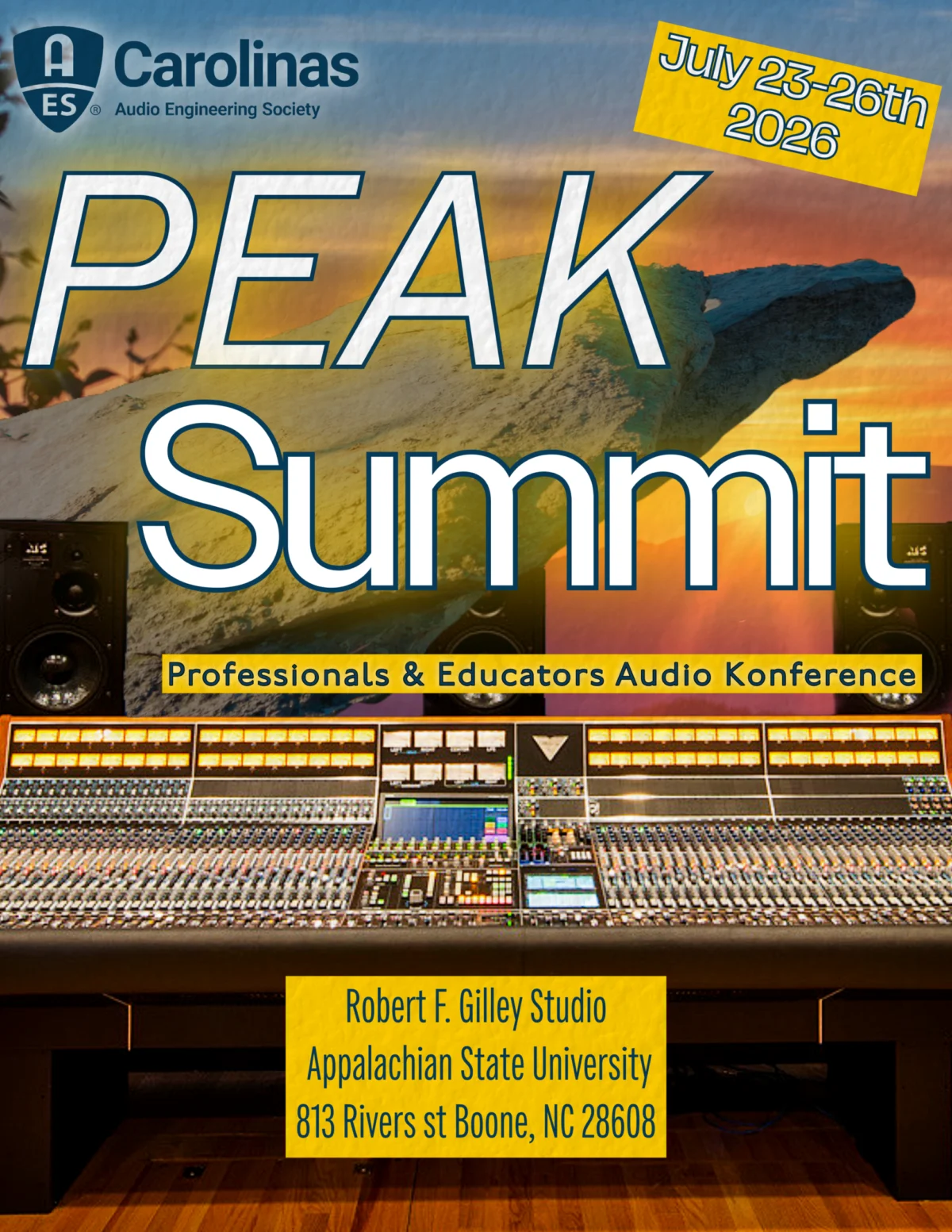
BOONE, NC – The landscape of professional audio is one of constant flux, where the boundaries between analog warmth and digital precision are perpetually redrawn. In an effort to bridge the gap between industry veterans, academic leaders, and the manufacturers who drive innovation, the Audio Engineering Society (AES) Carolinas Section has officially announced the return of the Professionals & Educators Audio Konference (PEAK) Summit.
Scheduled to take place from July 23 to July 26, the summit will be hosted at the prestigious Appalachian State University in Boone, North Carolina. This three-day intensive event is designed to be more than a mere trade show; it is a collaborative ecosystem intended to foster "vertical learning," hands-on technical mastery, and the kind of intimate networking that is often lost in the cavernous halls of global conventions.
I. Main Facts: A Confluence of Industry and Academia
The PEAK Summit serves as a specialized regional hub for the Audio Engineering Society, an organization that has remained the global gold standard for audio standards and professional development since 1948. By centering the event in the Carolinas, the AES aims to tap into the rich musical and technical heritage of the American Southeast, bringing high-level manufacturing resources directly to the doorsteps of those who use them daily.
The Venue: Robert F. Gilley Studio
The summit’s primary operations will be headquartered at the Robert F. Gilley Recording Studio, located within the Broyhill Music Center at Appalachian State University. As one of the premier recording facilities in the region, the Gilley Studio provides an ideal backdrop for high-fidelity critical listening and technical workshops. The facility’s integration into the university’s Hayes School of Music underscores the event’s commitment to education—ensuring that the next generation of engineers is learning on the same equipment utilized in world-class studios in Nashville, Los Angeles, and London.
Strategic Partnerships
A hallmark of the PEAK Summit is the caliber of its corporate backing. This year, API (Automated Processes, Inc.) has stepped forward as the Summit Partner Sponsor. Known for the legendary "API sound" that has defined American rock and roll for decades, the company’s involvement ensures a high level of technical pedigree.
Joining them is Solid State Logic (SSL), serving as the Pinnacle Partner. SSL’s presence is particularly significant this year, as they will be providing their Oracle console for dedicated hands-on training sessions. Furthermore, industry titans such as DPA Microphones, Shure, and AEA (Audio Engineering Associates) will be providing an array of transducers for real-world testing, shoot-outs, and demonstrations.
II. Chronology of the Event: From Social Networking to Midnight Sessions
The structure of the PEAK Summit is meticulously curated to transition attendees from social integration to deep technical immersion.
July 23: The Kick-Off
The summit begins not in a classroom, but in a setting reflective of the Appalachian culture. Sponsored by API, the official Kick-Off event will take place on the evening of July 23 at a local brewery in close proximity to the university studios. This initial gathering is designed to break down the barriers between manufacturers and end-users, allowing for informal dialogue before the rigorous technical schedule begins.

July 24-25: Core Programming and Vertical Learning
The middle days of the summit constitute the "meat" of the conference. Mornings and afternoons are divided into several tracks:
- Manufacturer Workshops: Small-group sessions where engineers can learn the intricacies of specific hardware and software directly from the creators.
- Educator Talks: Dedicated forums for professors and instructors to discuss the evolution of audio curricula in an age of AI and remote collaboration.
- Build-Your-Own Workshops: Practical sessions where attendees can engage in soldering and gear maintenance, a vital yet often overlooked skill in the modern "in-the-box" era.
- Vendor Lounge: An intimate space for one-on-one consultations, allowing professionals to discuss specific studio needs with brand representatives without the rush of a traditional expo.
The "AES Night Club" Experience
As the sun sets over the Blue Ridge Mountains, the summit shifts into its most unique phase: the AES Night Club. Recognizing that the best audio work often happens after hours, the Gilley Studio remains active late into the night. These sessions involve live musicians, allowing engineers and producers to test recently released products in a real-world session environment. This "midnight oil" approach provides a rare opportunity to see how new microphones or preamps perform under the pressure of a live recording date.
July 26: Synthesis and Departure
The final day focuses on the synthesis of the weekend’s findings. Closing panels and final gear shoot-outs allow attendees to compare notes and finalize the connections made during the previous days. The event concludes in the early afternoon, allowing participants to travel home with fresh insights and new professional contacts.
III. Supporting Data: The Importance of Regional Engagement
The decision to host a regional summit like PEAK reflects a broader trend in the professional audio industry. While massive international shows provide a broad overview of the market, data from industry analysts suggests that regional, "boutique" events offer a higher Return on Investment (ROI) for both manufacturers and attendees.
The "Vertical Learning" Model
Traditional trade shows are often "horizontal"—attendees see a little bit of everything but master very little. The PEAK Summit utilizes a "vertical" model. By limiting the number of attendees and focusing on a handful of high-end partners like SSL and API, the summit ensures that an engineer doesn’t just "see" a console; they learn its signal flow, its automation nuances, and its sonic characteristics over the course of several days.
Impact on Audio Education
According to recent surveys of audio educators, one of the greatest challenges in academia is keeping pace with rapid hardware and software cycles. The PEAK Summit addresses this by providing a direct pipeline from the manufacturer to the educator. By training the trainers, the AES Carolinas Section ensures that the regional talent pool remains competitive on a global scale.
IV. Official Perspectives: Bridging the Gap
While official statements emphasize the technical benefits, the underlying sentiment among organizers is one of community.
Representatives from the AES Carolinas Section have noted that the PEAK Summit was born out of a necessity to provide localized high-level training that doesn’t require a cross-country flight to California or New York. "Boone provides a sanctuary for sound," one organizer remarked. "When you remove the distractions of a major metropolitan area, you can truly focus on the nuance of a microphone’s off-axis response or the harmonic distortion of a transformer."

Manufacturers also see the value in this intimate setting. For a company like SSL, bringing a flagship console like the Oracle to a university setting is an investment in the future. It allows them to receive direct feedback from power users and to observe how educators explain complex routing concepts to students. This feedback loop is essential for iterative product design.
V. Implications: The Future of the Audio Workforce
The PEAK Summit arrives at a critical juncture for the audio industry. As home studios become increasingly sophisticated, the role of the "professional" studio and the "professional" engineer is being redefined. The implications of this event extend far beyond a three-day weekend in North Carolina.
Strengthening the Regional Economy
By positioning the Carolinas as a hub for audio excellence, the summit encourages local talent to remain in the region rather than migrating to traditional industry hubs. This helps sustain a local economy of recording studios, live sound companies, and integration firms that serve the Southeast’s vibrant music scene.
Redefining Professional Standards
The focus on "shoot-outs" and critical listening sessions reinforces the importance of objective quality in an era where "good enough" is often the baseline for digital content. By exposing attendees to the pinnacle of analog and digital gear—such as AEA’s ribbon microphones or API’s discrete circuitry—the summit recalibrates the "ears" of its participants, setting a higher standard for the industry at large.
The Hybrid Future
Ultimately, the PEAK Summit highlights the necessity of a hybrid approach to professional development. While online tutorials and digital forums are valuable, they cannot replace the tactile experience of turning a physical knob or the communal experience of hearing a master recording through a world-class monitoring system in a tuned room.
As July 23 approaches, the audio community looks toward Boone, not just for a conference, but for a revitalization of the craft. In the quiet heights of the Appalachian Mountains, the loudest voices will be those of innovation, education, and the pursuit of sonic perfection.
About the AES Carolinas Section:
The AES Carolinas Section is a regional chapter of the Audio Engineering Society, dedicated to the promotion of audio science and its practical application. Through workshops, summits, and networking events, the section serves professionals and students across North and South Carolina.
About Appalachian State University’s Hayes School of Music:
The Hayes School of Music prepares students for professional lives as musicians, composers, educators, and audio engineers. Its Robert F. Gilley Recording Studio is a cornerstone of its music technology program, offering students access to industry-standard equipment in a professional environment.