
The Quad ESL-63 remains one of the most revered loudspeakers in high-fidelity audio history. Since its introduction, it has served as a benchmark for transparency, phase accuracy, and coherent sound reproduction. However, beneath its elegant, minimalist exterior lies a highly complex engineering marvel—a delayed transmission line system designed to mimic a point-source radiator.

Recent technical discussions within the audio engineering community, specifically on platforms like DIYAudio, have reignited interest in the granular operation of the ESL-63’s panel segments. By analyzing the interplay between the transmission line, stator capacitance, and the mechanical load of the air, experts are peeling back the layers of Peter Walker’s masterpiece to understand exactly how it achieves its legendary performance.
The Core Controversy: Understanding Panel Segmentation
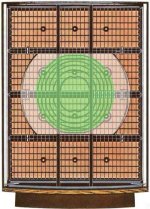
At the heart of the debate is the functional role of the various panel segments. The ESL-63 utilizes a series of concentric rings driven through a delay line, a design choice intended to create a spherical wavefront.

Initial discussions among hobbyists and engineers centered on the classification of these segments. A primary point of confusion involved which segments operate as "full range" and which function exclusively as bass drivers.
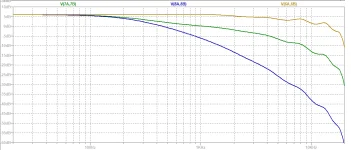
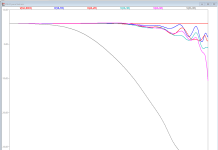
According to recent technical discourse, the center of the panel—often visualized as the "green" zone in design schematics—is connected directly to the transformer outputs, meaning it operates as a true full-range element. As one moves outward through the "white" mid-bass zones and into the outer bass panels, the signal is subjected to progressive delays. The consensus emerging from current technical simulation models, such as those referencing the work of Hans Polak, is that the majority of the panel operates full-range, albeit with a slight high-frequency roll-off of approximately 5dB in the peripheral sections. The outer bass panels, however, are explicitly low-passed to handle the lowest octaves, preventing edge effects and ensuring the integrity of the point-source radiation pattern.
Chronology of the Technical Investigation
The recent investigative push began with a desire to clarify the schematic operation of the bass segments.
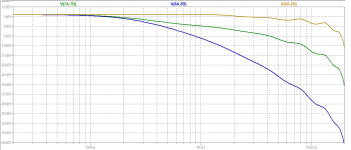
- Mid-June 2025: User wout31 initiated a discussion attempting to categorize the rings by frequency bandwidth, distinguishing between delay rings and bass segments.
- Clarification phase: Experts such as esl 63 challenged these initial assumptions, arguing that the segmentation is not merely a binary "bass vs. mid" split, but a sophisticated transition of full-range segments with varying degrees of passive filtering.
- Simulation and Validation: Jan Didden, a prominent contributor to the field of high-end audio design, utilized Hans Polak’s modeling software to measure frequency responses at various points along the transmission line. These simulations confirmed that while the center is wideband, the peripheral segments act as a filter network that shapes the speaker’s total power response.
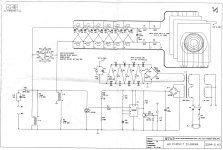
- Practical Application: The discussion moved from theory to practice, with engineers like Jan Didden and bolserst exploring the use of "dummy loads"—transmission line assemblies with capacitors representing segment capacitances—to replicate the electrical environment of the speaker for direct-drive amplifier development.
Supporting Data: Transmission Lines and Electrical Impedance
One of the most enlightening aspects of this investigation is the role of the transmission line itself. As pointed out by MarcelvdG, the line is not simply a delay mechanism. It is a damped transmission line that functions as a low-pass filter to mitigate edge effects, a concept originally detailed by Peter Baxandall in the Loudspeaker and Headphone Handbook.

The Air Load Question
A critical technical question posed during this inquiry was: How does the physical air load on the diaphragm impact the frequency response of the transmission line assembly?
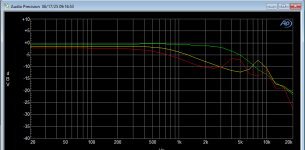
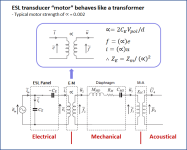
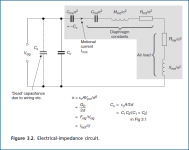
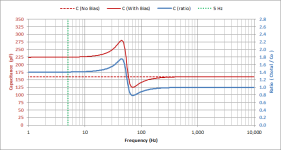
bolserst provided a definitive technical rebuttal to the idea that air load significantly alters the electrical response. The electrical impedance of an ESL-63 is dominated by the shunt electrical capacitance of the stators. Because the "motor strength" of the electrostatic panel is relatively low, the mechanical and acoustical parameters (the "motional impedance") are reflected through the system in such a way that they remain orders of magnitude higher than the source impedance.

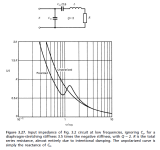
Essentially, the air load only manifests in the electrical impedance at very low frequencies, specifically near the diaphragm’s resonant frequency. Above 100Hz, the stator-to-stator capacitive impedance completely dwarfs any motional contributions. This simplifies the design of high-performance amplifiers, as the load is primarily capacitive rather than a complex, fluctuating inductive-resistive load like that found in traditional dynamic cone drivers.
Practical Engineering and Structural Integrity
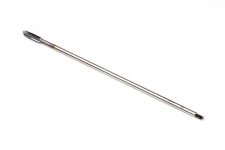
Beyond the electrical theory, the discussion pivoted to the mechanical construction of the ESL-63. A recurring grievance among restorers and DIY enthusiasts is the "wacky" method of securing the top and bottom plates to the side profiles using self-tapping screws.
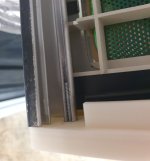
Many have suggested replacing these with M4 machine taps and bolts to ensure a more robust, long-term connection. However, as wout31 noted, the issue is not just the screw type—it is the structural stability of the plastic end-caps and the profile extrusions themselves. Advanced modifications, such as those found in the "ESL Plus Ultimate" custom builds, involve internal steel reinforcements that provide the rigidity necessary to handle the mechanical stresses of the panels without compromising the speaker’s aesthetic or acoustic transparency.

Implications for Future Design and Restoration
The implications of these technical findings are two-fold: for those developing direct-drive amplifiers and for those restoring vintage units.
1. Direct Drive Amplification
For engineers designing direct-drive amplifiers for the ESL-63, the confirmation that the load is primarily capacitive and that the air load has a negligible effect on the transmission line response is a massive advantage. It allows for a more predictable amplifier design, as the "work" being done by the speaker does not reflect back into the electrical circuit in a way that would cause non-linear distortion or massive phase shifts.
2. Restoration Best Practices
For restorers, the realization that the transmission line is a precision-tuned network emphasizes the importance of using original or precisely matched components. Replacing the internal inductors or capacitors with "audiophile-grade" parts that do not strictly adhere to the original electrical values could jeopardize the very delay-line characteristics that make the ESL-63 a point-source radiator. Furthermore, the focus on structural integrity—moving beyond self-tapping screws to more robust fastening methods—is a crucial step for ensuring that these units continue to perform at their peak for decades to come.
Conclusion: A Living Legacy
The Quad ESL-63 remains a testament to the vision of Peter Walker. What might appear to be a static piece of vintage audio equipment is, upon closer inspection, a dynamic and highly sophisticated system that continues to challenge and educate the modern audio community.
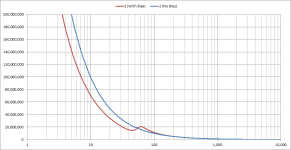
By reconciling the theoretical models of the transmission line with real-world measurements of panel impedance and mechanical behavior, the community is moving closer to a unified understanding of the ESL-63. Whether through the lens of Hans Polak’s simulations or the historical insights of Peter Baxandall, the speaker continues to be a focal point for the intersection of physics and music. As engineers continue to refine their models and restorers apply these findings to their craft, the legacy of the "63" remains not just preserved, but understood with a level of depth that would have surely impressed its original creators.
The ongoing discourse serves as a reminder that in the world of high-end audio, the pursuit of truth is as vital as the pursuit of sound. As long as there are enthusiasts willing to measure, model, and debate the intricacies of the transmission line, the Quad ESL-63 will remain the king of electrostatic transparency.


