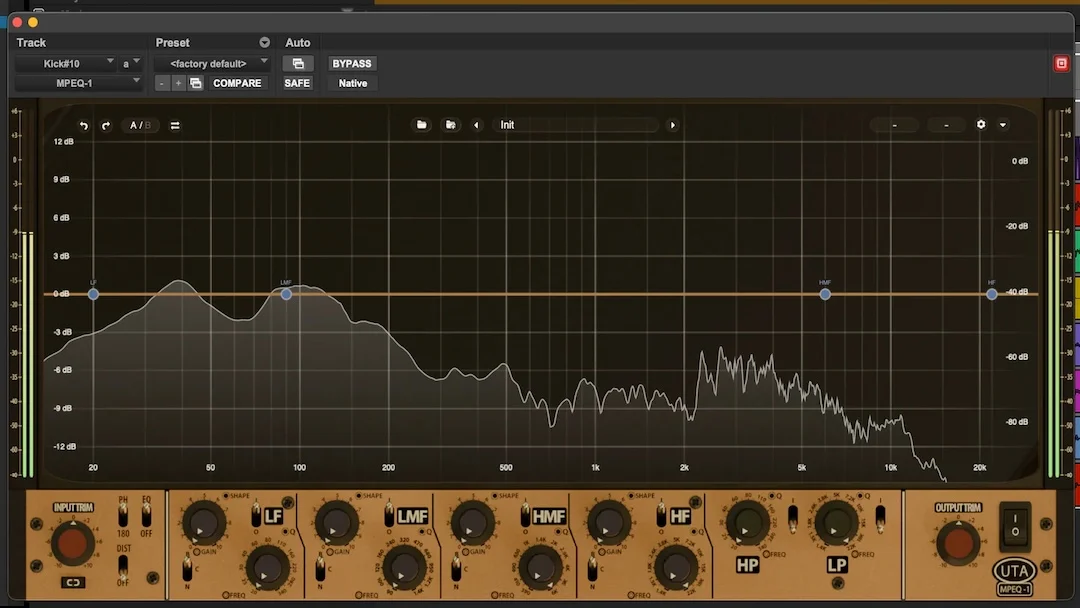
NASHVILLE, TN — In a move that signals a significant milestone for boutique audio engineering, Undertone Audio (UTA) has officially announced the release of the MPEQ-1 Super-Parametric Saturation Equalizer plug-in. Marking the company’s first foray into the digital software market, the MPEQ-1 plug-in is a meticulous recreation of their acclaimed hardware unit, designed to bring the complex harmonic character and unparalleled flexibility of UTA’s analog consoles into the modern Digital Audio Workstation (DAW).
The announcement, made in the heart of Nashville’s recording district on June 24, 2026, represents more than just a software port; it is the culmination of years of research into how analog phase relationships and harmonic saturation can be modeled within a 64-bit float digital environment.
Main Facts: A New Standard for Digital Equalization
The MPEQ-1 Super-Parametric Saturation Equalizer plug-in is modeled after the flagship hardware channel strip that has become a staple in high-end studios worldwide. Known for its "Super-Parametric" capabilities, the original hardware allowed engineers to manipulate the shape of the EQ curve in ways that traditional parametric equalizers could not. The new plug-in iteration retains these capabilities while introducing features that were physically impossible to implement in the analog domain.
Key Specifications and Features:
- Four Super-Parametric Bands: Each band offers a wide range of frequency overlaps and unique "Q" controls that allow for surgical precision or broad, musical strokes.
- Independent Saturation per Band: A groundbreaking feature in the digital version, allowing users to apply harmonic distortion to specific frequency ranges without affecting the entire signal.
- Vari-Phase Mode: An emulation of the hardware’s unique ability to adjust phase response, providing a tool for corrective phase alignment or creative tonal shaping.
- Dual Interface Design: Users can choose between a photorealistic recreation of the hardware front panel or a modern graphic interface with draggable nodes.
- Digital-Only Enhancements: Includes full preset management, automation of all parameters, instant A/B comparison, and an integrated high-resolution spectrum analyzer.
The plug-in is priced at $149, positioning it as an accessible entry point for home producers while maintaining the professional standards required by elite mixing and mastering engineers.
Chronology: From Custom Consoles to Code
The journey of the MPEQ-1 began long before the first line of code was written for the plug-in. To understand the significance of this release, one must look back at the history of Undertone Audio and its founder, Eric Valentine.
The Analog Origins (2010–2020)
Undertone Audio was born out of necessity. Eric Valentine, a world-renowned producer known for his work with artists like Queens of the Stone Age and Third Eye Blind, sought a console that offered the musicality of vintage Neve and EMI desks but with the flexibility of modern designs. Working with legendary designer Larry Jasper, Valentine developed a custom console that featured a radical new EQ circuit.
This circuit, which would eventually become the MPEQ-1 hardware, was "Super-Parametric." It allowed the user to not only choose the frequency and gain but also to alter the very geometry of the filter curve—adjusting the relationship between the boost/cut and the bandwidth (Q) in a non-linear fashion.
The Hardware Success (2021–2024)
As the MPEQ-1 hardware gained a cult following, it became known as a "desert island" EQ. However, its high price point and the physical limitations of hardware (lack of recall and single-instance use) led to a growing demand for a digital version. For years, UTA resisted, citing that digital technology had not yet reached a point where it could accurately replicate the "Vari-Phase" and saturation characteristics of their circuitry.
The Development Phase (2025–2026)
In early 2025, UTA partnered with specialized DSP developers to begin the arduous task of "component-level modeling." Unlike many "black box" emulations that simply match frequency response, the MPEQ-1 project aimed to model the interaction between the transformers, the Class-A amplifiers, and the unique phase shifts inherent in the hardware. By mid-2026, the team achieved a breakthrough in "dynamic saturation modeling," leading to the final product revealed this week.
Supporting Data: The Science of "Super-Parametric"
The term "Super-Parametric" is not merely marketing jargon; it refers to the specific way the MPEQ-1 handles filter shapes. In a standard parametric EQ, the Q (bandwidth) remains relatively static as you increase gain. In the MPEQ-1, the Q is interactive.
Harmonic Saturation Analysis
One of the most significant data points regarding the MPEQ-1 plug-in is its approach to saturation. In the hardware unit, saturation occurs globally as the circuitry is pushed. In the digital version, UTA has decoupled the saturation from the global output.
Data from internal testing shows that the plug-in can generate:
- 2nd Order Harmonics: Providing the "warmth" typically associated with tube gear.
- 3rd Order Harmonics: Adding the "punch" and "edge" associated with tape and high-end transistors.
Because this can be applied on a per-band basis, an engineer can, for example, add grit to the low-mids of a snare drum to give it body, while keeping the high-frequency "air" pristine and clean. This multi-band saturation approach is a significant departure from traditional channel strip emulations.
The Vari-Phase Advantage
Phase shift is usually considered a byproduct of analog EQ—something to be managed or avoided. However, the MPEQ-1 treats phase as a creative tool. The "Vari-Phase" mode allows the user to rotate the phase of the signal across the frequency spectrum. This is particularly effective when mixing multi-mic setups, such as drum kits or layered guitar cabs, where small phase adjustments can result in massive changes to the perceived "thickness" of a sound.
Official Responses: A Vision for the Future
The release of the MPEQ-1 has been met with enthusiasm from both the developer side and the professional community.
Eric Valentine, CEO of Royer Labs and the driving force behind Undertone Audio, emphasized that the goal was never to simply copy the hardware. "Engineers have been asking us when we would release a plug-in version of the MPEQ-1 and our answer was always: only when we could do something genuinely new," Valentine explained. "The MPEQ-1 has always been about expanding what an equalizer can do. By combining the EQ’s flexible architecture with independent saturation, the plugin gives engineers and producers a level of tonal control that simply wasn’t possible before."
Valentine further noted that the digital realm allowed them to solve the "recall problem" that plagues analog purists. "In the studio, I love the sound of the hardware, but if a client wants a 0.5 dB change on a vocal EQ three weeks later, resetting the hardware is a nightmare. This plug-in offers that same sonic soul with the convenience of a modern workflow."
Industry veterans have also weighed in. Nashville-based mix engineer Sarah Thorne stated, "The ability to automate the Vari-Phase control during a chorus to ‘widen’ a sound is a game-changer. You can’t do that with a physical knob in real-time without introducing noise or mechanical errors. This is a rare case where the software might actually be more powerful than the original box."
Implications: Changing the Boutique Landscape
The entry of Undertone Audio into the software market has several long-term implications for the audio industry.
1. The Democratization of Boutique Sound
Historically, the "UTA sound" was reserved for those who could afford multi-thousand-dollar hardware units or time in world-class studios. By releasing a $149 plug-in, UTA is following a trend set by other boutique manufacturers like Kush Audio and Chandler Limited. This shifts the competitive landscape, forcing larger software companies to innovate beyond simple "legacy" emulations.
2. Hybrid Workflow Integration
As 2026 continues to see a rise in "hybrid" setups—where engineers use a mix of outboard gear and "in-the-box" processing—the MPEQ-1 plug-in serves as a bridge. Its "Full Recall" and "Automation" features allow for a level of precision that traditional analog workflows lack, potentially leading more engineers to rely on high-fidelity emulations for complex mixing tasks while reserving hardware for the initial tracking stages.
3. The Future of DSP Development
The success of the MPEQ-1’s per-band saturation model may spark a new trend in EQ design. For decades, EQs and Distortions were separate entities in the signal chain. UTA’s integration suggests a future where "spectral saturation" becomes a standard feature in digital equalization, blurring the lines between corrective processing and creative sound design.
Conclusion: A New Chapter for Undertone Audio
The MPEQ-1 Super-Parametric Saturation Equalizer plug-in is more than just a new tool; it is a statement of intent from Undertone Audio. By successfully translating their complex analog philosophy into a digital format, they have provided the modern producer with a versatile, high-fidelity instrument that honors the past while embracing the future.
The plug-in is available immediately for download from the Undertone Audio website. The $149 purchase price includes a comprehensive factory preset library curated by Eric Valentine himself, along with a commitment to free updates as DAW environments continue to evolve. As the industry moves further into the late 2020s, the MPEQ-1 stands as a testament to the fact that the soul of analog audio is not found in the hardware itself, but in the mathematical and musical principles that define how we shape sound.