BERLIN, GERMANY — In the rapidly evolving landscape of digital audio workstations (DAWs) and artificial intelligence-driven composition, the quest for the "human touch" has never been more fervent. On June 24, 2026, Berlin-based software developer UJAM—the brainchild of legendary film composer Hans Zimmer and visionary producer Pharrell Williams—announced the release of Retrocraft. This comprehensive multi-effect plug-in is designed to consolidate the complex, often fragmented process of analog emulation into a single, streamlined interface.
As modern production moves toward clinical digital perfection, Retrocraft represents a strategic pivot back to the "golden age" of recording. By integrating saturation, modulation, and environmental textures, UJAM aims to provide producers with a toolkit that captures the organic unpredictability of vintage hardware without the prohibitive costs or maintenance requirements of physical gear.
Main Facts: A Unified Approach to Vintage Textures
Retrocraft is positioned not merely as a single effect, but as a "character engine" designed to transform sterile digital signals into rich, harmonically complex audio. The plug-in targets a common pain point for modern producers: the "signal chain bloat" that occurs when trying to replicate the sound of a vintage recording studio. Traditionally, achieving a convincing "old-school" sound required a daisy-chain of separate plug-ins—a tape emulator, a console saturator, a vintage EQ, and perhaps a vinyl noise generator.
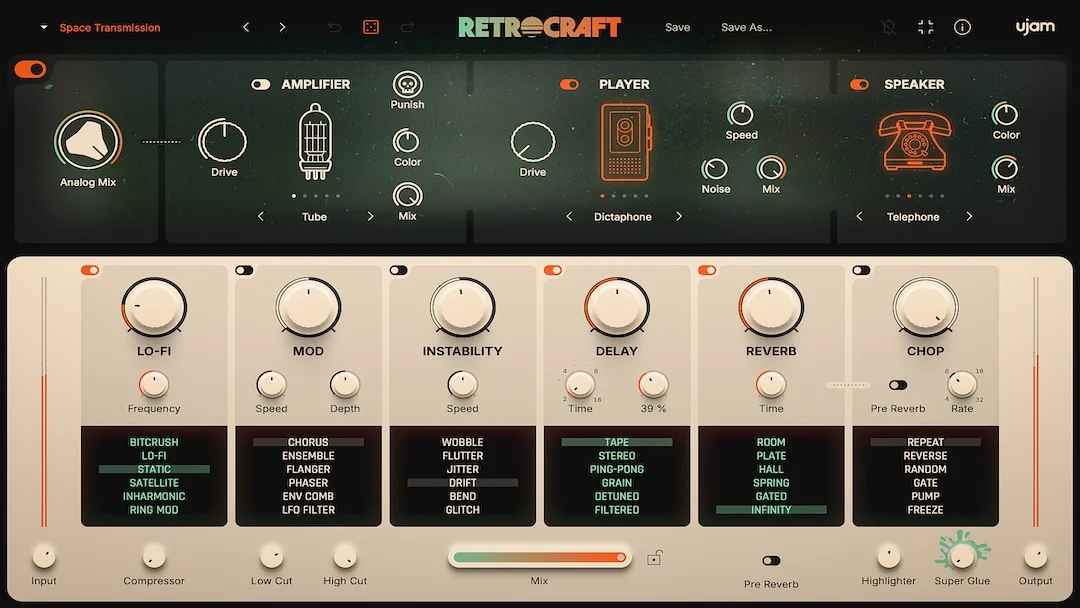
UJAM’s solution is to house these disparate elements under one roof. The core of Retrocraft is its character-shaping engine, which offers a curated selection of classic analog equipment and playback emulations. Key features include:
- Amp Coloration and Speaker Modeling: Emulations ranging from high-end studio preamps to lo-fi megaphone and radio speakers.
- Integrated Creative Modules: Six distinct processors including LoFi (bit-crushing), Modulation (chorus/flange), Instability (wow and flutter), Delay, Reverb, and a "Chop" rhythmic gate.
- Extensive Preset Library: 100 professionally crafted presets for vocals and instruments, plus 56 "basic" presets designed to showcase specific algorithmic behaviors.
- Cross-Platform Compatibility: Support for VST2, VST3, AU2, and AAX formats, ensuring integration with all major DAWs on both macOS and Windows.
The introductory pricing is set at $49 through August 2, 2026, after which it will retail at its standard MSRP of $99.
Chronology: The Evolution of UJAM and the Road to Retrocraft
The release of Retrocraft marks a significant milestone in UJAM’s decade-plus history. To understand the significance of this 2026 release, one must look at the trajectory of the company and the broader industry trends that necessitated such a tool.
2010–2018: The Foundations of Accessibility
UJAM was founded with the mission to make music creation accessible to everyone, regardless of technical background. Early successes focused on "Virtual Musician" instruments—Virtual Guitarist, Virtual Drummer, and Virtual Bassist—which used sophisticated MIDI-to-audio algorithms to allow non-players to compose professional-grade parts.
2019–2024: The Shift to Creative FX
As the market for virtual instruments became saturated, UJAM pivoted toward the "Finisher" series—a line of multi-effect units designed for rapid creative exploration. This period saw the company moving away from just "making the sound" to "shaping the soul" of the audio. The demand for "vibe-centric" processing grew as home recording became the industry standard.
2025–Early 2026: The AI Integration and the Retro Backlash
By 2025, the music industry was grappling with the rise of generative AI. While AI could write melodies and mix tracks with mathematical precision, many producers felt the results were "too perfect" and lacked "soul." This created a massive market correction. Producers began seeking tools that introduced "errors"—harmonic distortion, pitch instability, and noise floor—to counteract the clinical nature of digital and AI-assisted production.
June 24, 2026: The Launch
Retrocraft was developed over an 18-month cycle, specifically designed to address this "analog-hunger." The development team in Berlin collaborated with Hans Zimmer’s Remote Control Productions to ensure the algorithms met the standards of high-end cinematic scoring while remaining simple enough for bedroom producers.
Supporting Data: The Technical Architecture of Retrocraft
Retrocraft’s power lies in its modular internal signal flow. Unlike traditional "one-knob" effects, Retrocraft allows for deep customization within its six primary modules.
The Character Engine
At the heart of the plug-in is the "Character" selector. This uses physical modeling rather than simple impulse responses (IRs). This allows the software to react dynamically to the input gain. If a user pushes a vocal track harder into the "Tube Amp" setting, the harmonic saturation scales non-linearly, mimicking the behavior of real vacuum tubes.
The Six Creative Pillars
- LoFi: Focuses on digital artifacts. It allows for sample-rate reduction and bit-depth manipulation, essential for genres like Lo-Fi Hip Hop and Synthwave.
- Modulation: Offers vintage-modeled chorus, phasing, and flanging. These are based on late-70s bucket-brigade device (BBD) circuits.
- Instability: This module simulates the mechanical failures of tape machines and turntables. Users can adjust "Wow" (slow pitch fluctuations) and "Flutter" (rapid fluctuations), as well as "Age" (frequency loss).
- Delay: A synchronized or free-running delay with vintage-voiced filters.
- Reverb: Focuses on "Ambiance" rather than long, lush halls. It emulates small rooms, plates, and spring reverbs typical of mid-century recordings.
- Chop: A rhythmic tool that adds movement by gating the signal, allowing for modern rhythmic textures to be applied to vintage tones.
Performance and Optimization
Despite the complexity of running six simultaneous effects, UJAM has optimized Retrocraft for low-latency performance. In internal benchmarks, the plug-in consumes approximately 40% less CPU than a traditional signal chain of six equivalent individual plug-ins, thanks to a unified processing kernel.
Official Responses: Insights from the Creators
In a press statement accompanying the launch, the leadership at UJAM emphasized the philosophy of "Creative Friction."
"We live in an age where you can record a pristine 32-bit float signal in your bedroom," said a spokesperson for UJAM. "But the music we love—the records Pharrell produces or the scores Hans composes—often relies on the limitations of the past. Retrocraft is about bringing those beautiful limitations back into the digital realm. It’s about making things sound ‘expensive’ by making them sound a little bit ‘broken.’"
Hans Zimmer, co-founder of UJAM, has often spoken about the "clinical trap" of modern computers. While not issuing a direct quote for this specific press release, his influence is visible in the plug-in’s "Instability" and "Ambience" modules, which mirror the techniques used at Remote Control Productions to add depth to orchestral samples.
Pharrell Williams, also a co-founder, has historically championed "texture" in his production. Industry analysts suggest that Retrocraft’s "Chop" and "LoFi" modules are a direct nod to the Neptunes-era sound, characterized by dry, punchy, and uniquely textured percussion.
Implications: How Retrocraft Shapes the Future of Music Production
The release of Retrocraft has several long-term implications for the music technology industry and the creative community.
1. The Consolidation of the "Channel Strip"
Retrocraft signals a move away from "plugin-mageddon." For years, producers have been overwhelmed by having hundreds of niche tools. By creating an "all-in-one" vintage channel strip, UJAM is betting on a future where workflow speed is more valuable than having an infinite number of options. This could force other developers to rethink their "single-purpose" plugin strategies.
2. Democratization of Boutique Sounds
The $49 entry point is significant. In the past, the "Zimmer sound" or high-end analog saturation was gate-kept by expensive hardware or high-priced subscription bundles. Retrocraft puts these "pro-level" textures into the hands of independent creators, further leveling the playing field between home studios and commercial facilities.
3. The "Authenticity" Paradox
As we move further into the late 2020s, the irony of using cutting-edge, 2026-era DSP (Digital Signal Processing) to emulate a 1960s tape machine becomes more pronounced. Retrocraft represents the peak of this paradox—using the most advanced tech available to sound as "un-technical" as possible. This highlights a permanent shift in aesthetic values: in the digital age, "quality" is no longer defined by fidelity, but by "vibe."
4. Educational Impact
For new producers, Retrocraft serves as an educational tool. By seeing how saturation, instability, and modulation interact in one interface, beginners can learn the fundamentals of "vibe-based" mixing without getting lost in the technical weeds of signal routing.
In conclusion, UJAM’s Retrocraft is more than just another saturation plug-in. It is a calculated response to the hyper-digital world of 2026, offering a bridge to the past for a generation of producers looking to find their soul in the machine. Whether it’s adding a subtle "vinyl" crackle to a vocal or completely mangling a synth line through a modeled megaphone, Retrocraft provides the tools to ensure that the future of music still sounds human.