LAS VEGAS, NV – As the professional audiovisual industry gathered at the Las Vegas Convention Center for InfoComm 2026, the primary narrative on the show floor was clear: the airwaves are more crowded than ever. In an era where the wireless spectrum is being squeezed by the expansion of mobile broadband and the proliferation of IoT devices, the demand for robust, high-density wireless audio solutions has reached a fever pitch.
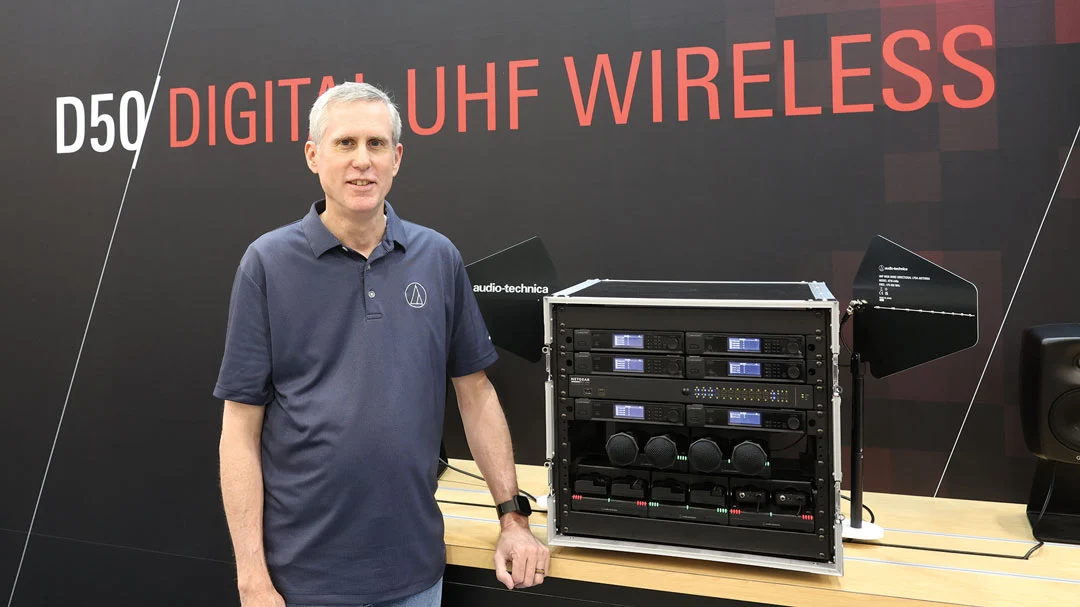
Responding to this global challenge, Audio-Technica (A-T) has officially unveiled its new flagship solution for high-stakes environments: the D50 Digital UHF Wireless System. Designed specifically for integrators and end-users operating in the most congested RF (Radio Frequency) landscapes, the D50 represents a significant leap forward in spectral efficiency, audio fidelity, and network integration.
Main Facts: A New Benchmark for Wireless Density
The D50 Digital UHF Wireless System is not merely an incremental update to Audio-Technica’s portfolio; it is a ground-up reimagining of what a digital wireless system can achieve in a professional environment. The system’s primary objective is to maximize the utility of every megahertz of available spectrum while minimizing the physical footprint required in the equipment rack.
At the heart of the D50 system is its remarkable density. In a standard 1U rack space, the D50 can support up to eight channels of Dante-enabled audio. This is a critical development for modern facility designs where rack space is at a premium and the demand for high channel counts is increasing.
Key features of the D50 include:
- Massive Tuning Bandwidth: Up to 224 MHz (region-dependent), allowing for unprecedented flexibility in finding clean airwaves.
- High-Density Mode: A specialized operating mode that allows for up to 63 simultaneous frequencies within a single 8 MHz TV channel.
- Advanced Diversity Modes: A switchable antenna system that combines traditional antenna diversity with Maximal Ratio Combining (MRC) true diversity to ensure signal stability in multipath environments.
- Professional Audio Quality: Support for 96 kHz digital audio, providing the transparency and dynamic range required for high-end theatrical and musical applications.
- Enterprise-Grade Security: AES256 encryption is standard, making the system suitable for government and corporate environments where confidentiality is non-negotiable.
Chronology: The Evolution of the RF Challenge
To understand the significance of the D50’s launch at InfoComm 2026, one must look at the trajectory of the wireless audio industry over the past decade.
For years, the professional audio community has been navigating a "shrinking" spectrum. Legislative auctions of the 600 MHz and 700 MHz bands to telecommunications giants left wireless microphone users with significantly less room to operate. By the early 2020s, the industry had largely transitioned to digital wireless systems, which offered better efficiency than their analog predecessors.
However, by 2024 and 2025, even those digital systems were being pushed to their limits as corporate campuses, universities, and theater districts became saturated with wireless devices. Audio-Technica’s engineering teams spent years researching advanced modulation schemes and filter designs to address this specific "RF crunch."
The development of the D50 was a multi-year effort focused on three pillars: density, reliability, and ease of deployment. The unveiling this week in Las Vegas marks the culmination of that research, positioning Audio-Technica as a leader in the next generation of UHF technology. The D50 arrives at a time when the "new normal" for a standard corporate boardroom or university lecture hall involves not just two or four microphones, but often dozens of wireless endpoints operating simultaneously.
Supporting Data: Technical Specifications and System Scalability
The technical architecture of the D50 is built to satisfy both the audio engineer and the IT professional. The system is available in several configurations to meet varying budgetary and physical requirements.
Receiver Configurations
For large-scale installations, the full-rack receiver offers the maximum channel density. However, Audio-Technica has also introduced a compact half-rack receiver for smaller or more modular deployments.
- Two-Channel Version: Utilizing "Audio-Technica Link," this version is optimized for simpler setups that do not require full Dante networking but still demand high-quality digital transmission.
- Four-Channel Version: This Dante-enabled half-rack unit supports 96 kHz audio, full network redundancy, and can be powered via PoE+ (Power over Ethernet). This makes it an ideal choice for modern "clean-room" installations where reducing the number of power cables is a priority.
Spectral Efficiency and High-Density Mode
The standout statistic of the D50 is its High-Density (HD) mode. In standard operating modes, wireless systems require significant "guard bands" between frequencies to prevent intermodulation distortion. The D50’s advanced digital filtering and linear transmitter design allow it to pack 63 channels into an 8 MHz TV channel. This represents a level of efficiency that was nearly unthinkable in the analog era, effectively future-proofing the system against further spectrum loss.
Transmitter Versatility
The D50 ecosystem includes a comprehensive range of transmitters to suit different use cases:
- Handheld Transmitters: These are compatible with Audio-Technica’s acclaimed Artist Elite interchangeable capsules, allowing users to tailor the sonic characteristics of the microphone to the performer or speaker.
- Bodypack Transmitters: Compact and rugged, these are designed for theater performers and presenters who require a discreet profile.
- Gooseneck Base Transmitters: Specifically designed for corporate boardrooms and legislative chambers, these bases provide a stable, wireless solution for table-top conferencing.
Official Responses: Insights from the Field
Mark Donovan, Audio-Technica U.S. Director of Commercial Applications, was present at the InfoComm launch to provide context on the system’s design philosophy. Donovan emphasized that the D50 was built with the "integrator’s headache" in mind.
"We recognize that the RF environment isn’t just getting crowded; it’s getting unpredictable," Donovan noted during a presentation at the A-T booth. "Our goal with the D50 was to provide a system that doesn’t just survive in these environments but thrives. By integrating tools like onboard spectrum analysis and our Wireless Manager software, we are giving the user a complete ‘command center’ for their wireless landscape."
Industry analysts at the show have also weighed in on the D50’s Dante integration. By supporting 8 channels in a single rack space with Dante networking, Audio-Technica is aligning itself with the "Audio-over-IP" (AoIP) movement that has become the standard for large-scale AV installations. The inclusion of 96 kHz support is seen as a direct response to the demands of the "Pro" in Pro AV, ensuring that there is no compromise in audio quality when moving from a wired to a wireless signal chain.
Implications: How the D50 Changes the Landscape
The introduction of the D50 has wide-ranging implications across multiple sectors of the AV industry.
Corporate and Government Security
In the corporate and government sectors, the primary concern is often not just sound quality, but security. With the D50’s AES256 encryption, Audio-Technica is targeting high-level meeting spaces where sensitive information is discussed. The ability to manage these systems via the network (Wireless Manager software) allows IT departments to monitor the health and security of the system without having to physically enter the room.
Higher Education
Universities often face the challenge of managing hundreds of wireless microphones across a single campus. The D50’s high-density mode and PoE+ power options significantly simplify large-scale deployments. A campus tech manager can now deploy four channels of wireless in a lectern using a single Ethernet cable for both power and data, while the spectral efficiency ensures that a microphone in Room A does not interfere with a microphone in Room B across the hall.
House of Worship and Theater
For the performing arts, the D50 offers the reliability of "MRC" true diversity. In a theater environment, where actors are moving rapidly through "dead zones" and around metal scenery, the ability of the receiver to intelligently combine the best signal from multiple antennas is the difference between a flawless performance and a catastrophic dropout. The 224 MHz tuning range also means that touring productions can travel from city to city with a much higher confidence that they will find open frequencies.
The Future of RF Management
Perhaps the most significant implication of the D50 is what it says about the future of the UHF band. While some manufacturers have looked toward the 1.9 GHz or 5 GHz bands to escape UHF congestion, Audio-Technica’s investment in the D50 proves that there is still immense potential in the UHF band if the technology is sophisticated enough. By squeezing more performance out of less space, the D50 provides a roadmap for how the industry will continue to operate as the airwaves become increasingly contested.
Conclusion
The debut of the Audio-Technica D50 Digital UHF Wireless System at InfoComm 2026 marks a pivotal moment for the brand and the industry. By combining extreme spectral efficiency, high-density channel counts, and professional-grade audio networking, A-T has delivered a solution that directly addresses the most pressing challenges of modern AV integration. As RF environments continue to evolve, the D50 stands ready as a robust, scalable, and secure platform for the next decade of wireless audio.