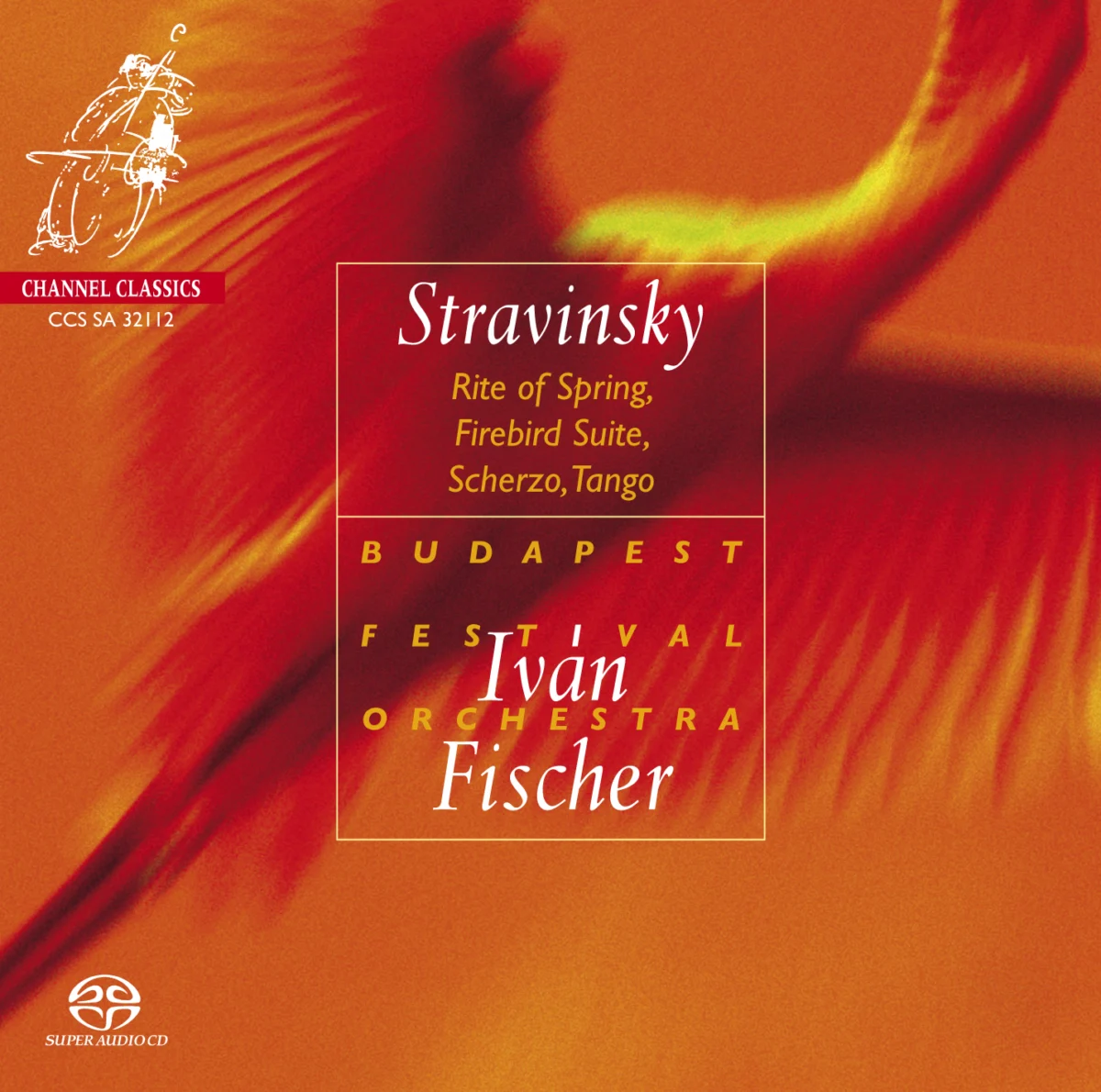
Welcome to Dodd’s Discoveries, a recurring editorial series where NativeDSD Senior Music Reviewer Bill Dodd curates the finest high-fidelity recordings for the discerning listener. In this installment, we shift our focus away from the bombastic, orchestral staples of the early 20th century to explore the sophisticated, precise, and emotionally resonant world of Igor Stravinsky’s neoclassical period. As part of this feature, NativeDSD is proud to offer the spotlighted album at an exclusive 40% discount for a limited time.
The Main Event: Rediscovering Stravinsky’s Neoclassical Gems
When the average listener thinks of Igor Stravinsky, the mind immediately gravitates toward the "Big Three": The Rite of Spring, The Firebird, and Petrushka. These works are, by any metric, cultural monoliths. They have defined the trajectory of 20th-century music, spawning hundreds of recordings, exhaustive critical analyses, and standing-room-only performances worldwide. Their bold narratives and massive orchestral requirements make them the "blockbusters" of the classical repertoire.
However, there exists a secondary, equally vital canon within Stravinsky’s output: his neoclassical works. Among these, Apollon Musagète, Dumbarton Oaks, and the Concerto in D stand as pillars of musical architecture. While they may lack the sheer sonic violence of The Rite of Spring, they possess a structural elegance and refined emotional depth that many musicians find far more compelling.
In this latest Dodd’s Discovery, we explore a stunning new recording featuring the Camerata Salzburg, under the baton of Giovanni Guzzo. This album serves as a masterclass in how these works should be approached, captured with breathtaking clarity by engineer Jared Sacks.
Chronology: From the Avant-Garde to the Neoclassical Shift
To understand why this specific recording is a landmark release, one must first understand the historical arc of Stravinsky’s career.
The Explosive Beginnings (1910–1913)
Stravinsky burst onto the international scene under the patronage of Sergei Diaghilev and the Ballets Russes. The period between 1910 and 1913 yielded the aforementioned "Big Three." These works were designed to shock, utilizing expanded tonal palettes and rhythmic complexity that pushed the limits of the orchestra.
The Neoclassical Pivot (1920–1950)
Following the upheaval of the First World War and the Russian Revolution, Stravinsky underwent a radical stylistic shift. Moving away from the "maximalism" of his early ballet scores, he began to look backward—not to copy, but to reinterpret the forms of the 18th century. This was not a regression, but an evolution.
Works like the Concerto in D (1946) and Dumbarton Oaks (1938) reflect a composer who had mastered the art of economy. During this era, Stravinsky famously recorded his own works for CBS Records. These recordings became the "gold standard," codifying the precise, metronomic, and crystalline performance style that Stravinsky demanded of his conductors.
The Modern Era of Audiophile Preservation
For decades, listeners relied on those original mono or early stereo pressings to understand the "Stravinsky sound." Today, the Camerata Salzburg’s new release represents a bridge between that historical legacy and modern sonic capabilities. By applying 21st-century recording techniques to these mid-century masterpieces, we are finally hearing the inner voices of these compositions with the clarity they deserve.
Supporting Data: Why "Neoclassical" Isn’t "Cold"
A recurring barrier to the appreciation of Stravinsky’s neoclassical works is the term "neoclassical" itself. Many casual listeners perceive the label as a synonym for "cold," "angular," or "mechanical."
Bill Dodd, reflecting on his own musical journey, admits, "I was in my 20s before I discovered the richness of Stravinsky’s 1920–1950 works. While they are structured and possess a definite, driving rhythm, they are fundamentally not cold."
The Anatomy of the Recordings:
- Apollon Musagète: Perhaps the pinnacle of Stravinsky’s melodic grace. It is a work of serene beauty that strips away the clutter of the Romantic era, focusing on the purity of the string orchestra.
- Dumbarton Oaks: A chamber concerto that pays homage to Bach’s Brandenburg Concertos. It is playful, intellectual, and rhythmically infectious.
- Concerto in D: A work of wit and poise. It demonstrates how Stravinsky could synthesize complex counterpoint with the light-heartedness of the divertimento form.
The Camerata Salzburg demonstrates that these works require a specific type of virtuosity. It is not about brute strength, but about balance, articulation, and the ability to find the "soul" within the structure.
Official Responses and Technical Excellence: The Jared Sacks Factor
The success of this album is not solely attributable to the musicianship of the Camerata Salzburg; it is equally due to the production philosophy of Jared Sacks. In the audiophile world, Sacks is synonymous with transparency.
For this project, the recording captures the acoustic space of the venue with such precision that listeners report a "you are there" sensation. By eschewing excessive compression and artificial reverb, Sacks allows the textures of Stravinsky’s orchestration to bloom naturally.
"Jared Sacks has outdone himself in capturing sound so real that you will start looking for the players," notes Dodd. In high-resolution audio, this is the ultimate compliment. It means that the recording doesn’t just represent the music; it preserves the physical event of the performance.
Implications: The Future of Classical Music Discovery
What does the success of this release mean for the classical music industry? It signals a shift in consumer demand. Listeners are no longer satisfied with "standard" recordings of standard repertoire. There is an increasing hunger for:
- High-Fidelity Restoration: Re-evaluating historical works through the lens of modern, high-resolution engineering.
- Curated Curation: The role of the "human filter"—like Bill Dodd—is becoming more important than ever in an age of infinite digital streaming options.
- The "Discovery" Model: By pairing critical analysis with immediate, discounted access, platforms like NativeDSD are successfully turning casual browsers into dedicated listeners.
The Author’s Perspective: Bill Dodd
Bill Dodd’s career as a Senior Music Reviewer is built on a foundation of diverse musical exposure. From his early days as a morning radio personality in San Francisco to his deep-seated love for everything from Miles Davis to Led Zeppelin, Dodd brings a unique "non-academic" perspective to classical music. His ability to draw parallels between the structural precision of Stravinsky and the improvisational brilliance of Dave Brubeck is what makes his recommendations resonate with such a wide audience.
For Dodd, music is not meant to be analyzed in a vacuum; it is meant to be felt. His commitment to this series is an invitation for listeners to expand their horizons beyond the comfort zone of "The Rite of Spring" and into the refined, rewarding world of Stravinsky’s later years.
Conclusion: Take Advantage of the Discovery
The beauty of the Dodd’s Discoveries series lies in the accessibility of high-art music. We encourage you to experience the Camerata Salzburg’s interpretation of these neoclassical masterpieces. Whether you are a long-time admirer of Stravinsky or a newcomer looking for an entry point into his more refined works, this album offers the perfect synthesis of performance and engineering.
Don’t miss out on this limited-time opportunity. The albums featured in this review are currently available at a 40% discount on the NativeDSD store. Click the link below to visit the Dodd’s Discoveries hub, read the full review, and secure your high-resolution copy of this essential collection.
[Visit NativeDSD to View the Collection and Access Your Discount]
Bill Dodd is the Senior Music Reviewer at NativeDSD. He resides in Portland, Oregon, where he continues to explore the intersection of high-fidelity audio and musical history. His eclectic background in broadcasting and his lifelong passion for the piano inform his unique approach to music journalism.