We are currently standing on the precipice of a sensory revolution. For decades, our digital interactions have been dominated by sight and sound—high-resolution displays and immersive audio have become the benchmarks of quality. Yet, the third pillar of human perception, the sense of touch, has long been relegated to the background. This is changing. As we integrate haptics—the science of touch—into our everyday devices, we are moving from a world of passive observation to one of active physical feedback.
From the humble vibration of a smartphone to the sophisticated tactile nuances of modern gaming controllers, the "haptic wave" is cresting. With the recent introduction of the Universal Haptics Protocol (UHP) 1.0 and advanced hardware like the TITAN Haptics VH Module, the industry is finally moving toward a unified language of touch.
The Etymology and Evolution of Touch
To understand where we are going, we must look at where we began. The term "haptic" is derived from the Ancient Greek haptikos, meaning "able to come into contact with" or "pertaining to the sense of touch." It is a concept that has intrigued thinkers for centuries.
As early as 1685, English mathematician Isaac Barrow utilized the Neo-Latin term hapticē to define the "science of touch." By 1892, German psychologist Max Dessoir formally proposed the term Haptik to categorize the scientific study of touch, positioning it alongside Optik (optics) and Akustik (acoustics). Despite this early intellectual foundation, the practical application of haptics remained a niche pursuit for much of the 20th century.
Early Milestones in Tactile Engineering
The transition from theory to mechanical application began in earnest during the 1940s. At Argonne National Laboratory, engineers faced the daunting task of handling radioactive materials from a distance. They developed remote manipulators that utilized mechanical linkages, allowing operators to "feel" resistance when a gripper encountered an object. This was perhaps the first high-stakes implementation of active force-feedback.
Simultaneously, the aviation industry was grappling with the dangers of pilot isolation. In the late 1940s, as flight controls transitioned from mechanical linkages to powered systems, pilots lost the natural aerodynamic buffeting that warned them of a stall. To compensate, engineers developed "stick shakers"—devices that would deliberately vibrate the control column when the angle of attack became dangerous. This served as a crucial, life-saving tactile warning system, proving that touch could convey critical data more effectively than an alarm or a gauge.
The Fragmented Path to Modern Haptics
For a long time, the promise of haptics in the consumer space was hindered by a lack of standardization and hardware limitations. A poignant example is the Logitech iFeel MouseMan, released in 2000. Utilizing technology from the Immersion Corporation, this peripheral allowed users to feel "bumps" when crossing hyperlinks or hitting the edge of a window.
While the concept was revolutionary, it failed to achieve widespread adoption. The primary culprit? A lack of industry-wide software support. Without a common protocol, developers were forced to build bespoke solutions for every device, leading to a fragmented ecosystem where clever hardware sat idle due to a lack of software compatibility. It was a lesson in the necessity of standards: hardware is only as capable as the ecosystem that supports it.
The Technological Leap: From ERMs to LMRs
For many years, the standard for haptic feedback was the Eccentric Rotating Mass (ERM) motor—essentially a small motor with an off-center weight. While effective at creating a buzz, ERMs are sluggish. They take time to spin up and slow down, making them incapable of the crisp, nuanced sensations required for modern immersion.

The industry eventually shifted toward Linear Resonant Actuators (LRAs), which use electromagnetic forces to move a mass back and forth. Apple’s Taptic Engine is the most famous iteration of this technology, successfully convincing millions of users that their glass trackpads were physically clicking.
However, even LRAs have frequency limitations. This is where companies like Toronto-based TITAN Haptics are pushing the envelope. Their Linear Magnetic Ram (LMR) technology replaces mechanical springs with a magnetic suspension system. This innovation allows for a significantly wider frequency range, enabling actuators to reproduce everything from the soft pitter-patter of rain to the heavy, concussive recoil of a firearm. As CEO Tim Szeto explains, a modern haptic actuator is essentially a loudspeaker for the sense of touch—it doesn’t just vibrate; it plays textures.
Official Industry Response: The UHP 1.0 Specification
The most significant development in the sector is the arrival of the Universal Haptics Protocol (UHP) 1.0, announced in September 2026 by the Haptics Industry Forum (HIF). This specification serves as a common language for describing haptic effects, identifying device capabilities, and controlling playback across different platforms.
By standardizing how software "talks" to hardware, the UHP 1.0 removes the barriers that caused early products like the iFeel MouseMan to fail. With industry giants like Logitech and iRacing involved, the protocol ensures that a "tactile click" feels the same whether it is triggered on a high-end steering wheel, a smartphone, or a VR controller. TITAN Haptics, with Tim Szeto chairing the HIF working group, has been instrumental in this standardization, ensuring that the technology is not just powerful, but universally applicable.
The VH Module: A Case Study in Integration
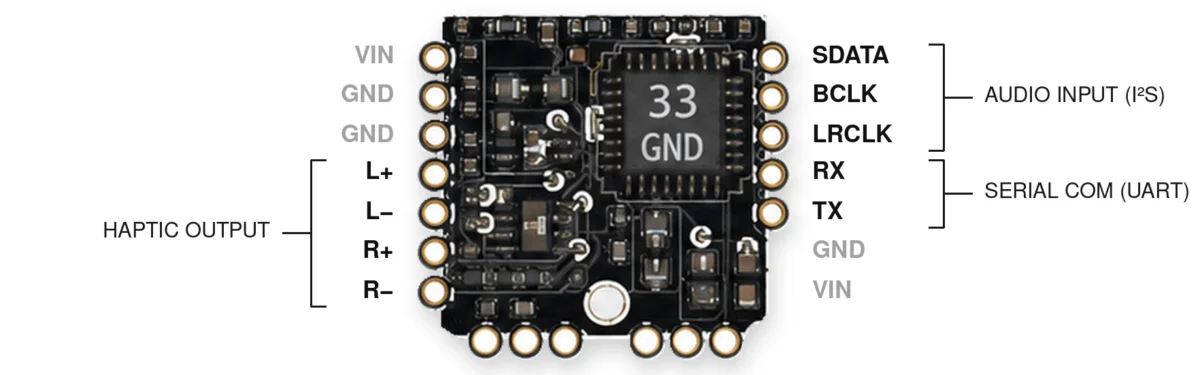
TITAN’s recently released VH Module exemplifies how these standards are being put into practice. Measuring a mere 10.8 x 10.8 mm, this tiny component serves as a complete haptic processing and drive subsystem.
Key Technical Features:
- Onboard DSP: The module features dedicated digital signal processing to filter and equalize haptic signals.
- Audio-to-Haptics: Perhaps the most exciting feature, this allows the module to process existing audio streams in real-time. Instead of developers needing to author separate haptic tracks for every explosion or footstep, the module converts the sound of the game world into physical sensations.
- Vector Haptics API: For more granular control, the API allows developers to build complex effects using "primitives"—simple building blocks like pulses, ticks, and frequency sweeps. These are stored as compact data, making the system highly efficient for mobile and embedded applications.
- Multi-Channel Support: The module supports two independent channels, allowing for sophisticated, layered sensations—such as an engine rumble in one hand and a weapon recoil in the other.
Implications for the Future
The implications of high-fidelity, standardized haptics are profound. We are moving toward a reality where digital interfaces feel "physical."
Beyond Gaming
While gaming is the obvious front-runner, the applications are vast:
- Automotive: With the shift to touchscreens in vehicles, haptic feedback provides the tactile confirmation needed to operate controls without taking one’s eyes off the road.
- Medical Training: Surgeons using robotic systems can finally "feel" the resistance of tissue, bridging the gap between digital simulation and physical reality.
- Accessibility: For the visually impaired, sophisticated haptic displays can provide real-time spatial awareness and navigational cues that go far beyond standard audio alerts.
- XR and Metaverses: In virtual and augmented reality, the "haptic barrier" is the final frontier. To achieve true presence, users must be able to feel the objects they interact with.
Conclusion: The Wave of the Future
We are currently living through the "transistor moment" of haptics. Just as the industry moved from bulky vacuum tubes to integrated circuits, we are moving from simple, crude buzzing motors to sophisticated, frequency-agile magnetic actuators governed by universal standards.
The success of these technologies depends on the delicate balance of subtlety and power. As Tim Szeto noted, designing a haptic experience is an art form—much like music. It requires an understanding of contrast, timing, and precision. With the UHP 1.0 providing the foundation and hardware like the VH Module providing the tools, the industry is finally ready to deliver on the promise that was made decades ago. The future isn’t just something we will see or hear; it is something we are finally going to be able to touch.