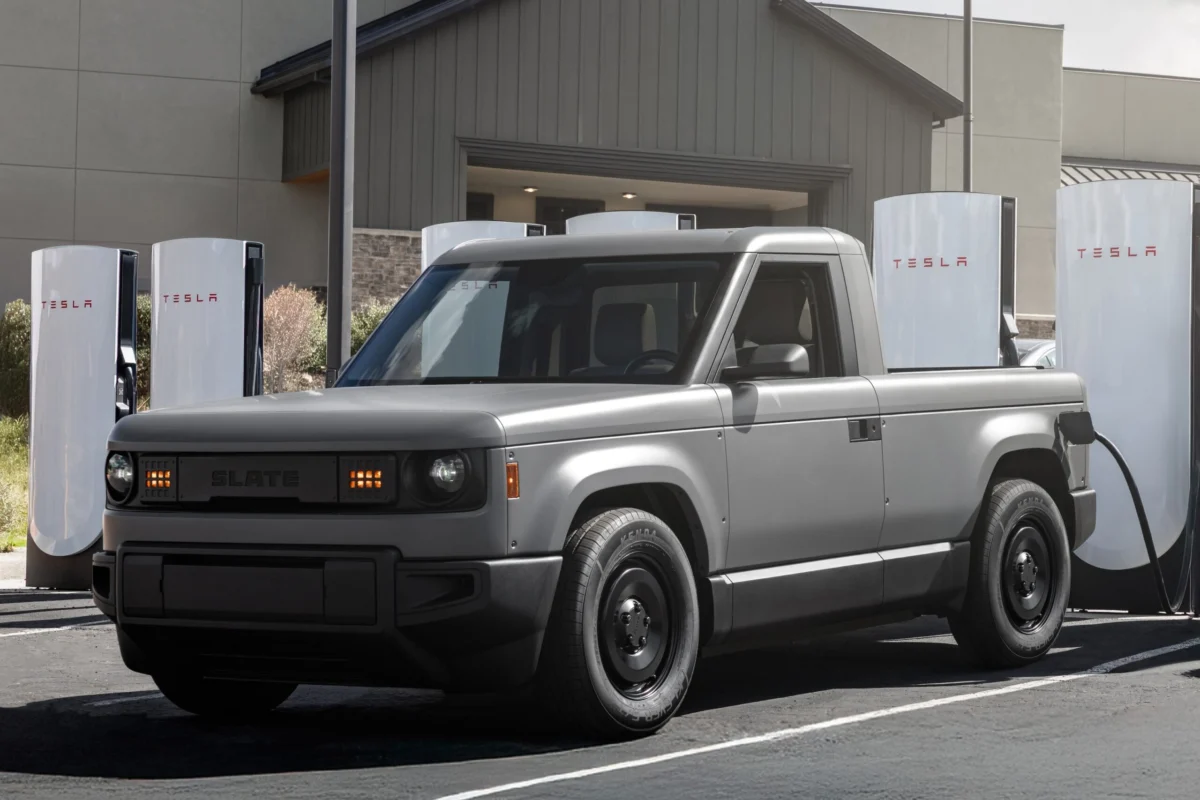
In a bold move that seeks to redefine the accessibility of electric vehicles (EVs) in the United States, Slate Auto—the enigmatic startup backed by billionaire Jeff Bezos—has officially unveiled the pricing for its highly anticipated electric truck. Breaking the psychological barrier of the $25,000 price point, the startup announced a starting MSRP of $24,950.
This pricing strategy, aggressive by any industry standard, positions Slate as a potential catalyst for a long-awaited shift in the automotive landscape: the democratization of the electric pickup. By targeting a price tag nearly half the cost of the average new vehicle sold in America today, Slate is aiming to capture a demographic largely ignored by legacy automakers: budget-conscious buyers and fleet operators who have been priced out of the current EV market.
The Core Offering: Affordability Meets Modular Utility
The $24,950 starting price is the headline, but the vehicle’s true innovation lies in its "bare-bones" philosophy. To reach such an accessible price point, Slate has stripped the vehicle of the luxury amenities that have driven EV prices skyward. The truck arrives with hand-crank windows, a total absence of a traditional infotainment system, and a standard, unpainted gray composite body.
Instead of traditional paint shops—which can cost manufacturers hundreds of millions of dollars to install and operate—Slate plans to offer customizable vinyl wraps, allowing owners to personalize their vehicles at a fraction of the cost.
Furthermore, the company announced a significant upgrade to its base model performance. Originally slated for a 150-mile range, the production version will now boast approximately 205 miles on a single charge. This pivot ensures the truck remains competitive for daily commuting and utility tasks, despite its budget-focused design.
A Chronology of Disruption: From Stealth to Sales
The journey of Slate Auto has been marked by a deliberate, high-stakes strategy of secrecy followed by meticulous product teasing.
- Early 2025: The company emerges from stealth mode, with reporting from TechCrunch revealing the startup’s secret backing by the Bezos family office, alongside notable investors like Guggenheim Partners CEO Mark Walter and former Amazon executive Diego Piacentini.
- Mid-2025: The startup begins to socialize the concept of a modular, transformer-like vehicle. The vision is clear: a base two-seater pickup that can be converted into a five-seater SUV for a starting price of $29,950.
- Late 2025 to Early 2026: Slate begins releasing “Slate University” content—a series of instructional videos designed to empower owners to perform their own conversions and basic maintenance, reinforcing the company’s "do-it-yourself" ethos.
- June 2026: Reports surface regarding a strategic partnership with online retail giant Carvana, involving warrants for share purchases. This signals a departure from traditional dealership models in favor of a direct-to-consumer, digital-first sales experience.
- Present Day: Slate opens official pre-orders, cementing its entry into the competitive American automotive market.
Competitive Landscape and Market Implications
Slate’s entry comes at a precarious time for the EV sector. With the second Trump administration having moved to dismantle the $7,500 federal EV tax credit and loosen emissions regulations, the momentum for electric adoption has slowed across the industry. Major players like Ford and GM have significantly delayed or downsized their electric ambitions in response to shifting political winds and consumer demand.
However, Slate’s strategy appears to be immune to some of these headwinds. By aiming for the "lowest end" of the market, the company is competing directly with the Chevrolet Bolt (starting around $29,000) and the Nissan Leaf (around $32,000). While Ford has teased a $30,000 electric truck, it is not expected to hit the market until 2027. This leaves a significant window for Slate to establish brand loyalty.
The collaboration with Carvana is equally significant. By leveraging an existing, robust logistics network for used-car sales, Slate may bypass the massive capital expenditure required to build a nationwide dealership network, a move that echoes the strategies of Tesla, Rivian, and Lucid, but with a retail partner that already boasts deep consumer trust.
The Engineering of Savings: How They Did It
Slate’s cost-cutting measures represent a "back-to-basics" engineering approach that contrasts sharply with the "tech-first" trend in EVs. By eschewing complex software suites and high-end aesthetics in favor of durable, composite materials, the company has effectively optimized its bill of materials.
The modularity of the vehicle—where the transition from a pickup to an SUV is handled by the user rather than the factory—is a masterclass in logistics. By designing the vehicle to be "accessorized over time," Slate shifts the burden of assembly to the consumer, lowering the initial barrier to entry while creating a long-term ecosystem for parts, accessories, and modular upgrades.
Official Responses and Investor Backing
The company has maintained a degree of professional silence regarding its internal operations, preferring to let the vehicle’s specs and the "Slate University" tutorials speak for the brand. However, the financial backing behind the startup is robust. Having raised approximately $1.4 billion across three funding rounds, the company is well-capitalized to withstand the "valley of death" that claims many automotive startups.
Key investors—including Slauson & Co., General Catalyst, and Mark Walter’s TWG Global—are reportedly betting on the "Model T" theory: that the market is starving for a utilitarian, affordable, and honest machine. By focusing on the working-class and entry-level markets, Slate is gambling that simplicity, rather than high-tech gimmickry, is the key to mass adoption.
Implications for the Future of Transportation
The success or failure of Slate Auto will be a litmus test for the American EV market. If the company succeeds, it will prove that there is a viable, profitable path for EVs that does not rely on government subsidies or luxury-tier pricing.
However, the hurdles remain significant. The absence of federal tax credits means the vehicle must stand on its own merits as a value proposition. Furthermore, the reliance on a direct-sales model through Carvana will be closely watched by regulators and industry analysts alike. If Slate can navigate the manufacturing scale-up challenges that have bankrupted so many of its predecessors, it may well force legacy automakers to pivot their entire strategy toward the budget segment.
As it stands, Slate Auto is offering more than just a truck; it is offering a statement. In a world where vehicles have become increasingly expensive, complex, and digital, Slate is betting that the future of transportation might actually look a lot like the past: simple, functional, and accessible to everyone.
Disclaimer: When you purchase through links in our articles, we may earn a small commission. This does not affect our editorial independence.
About the Reporter
Sean O’Kane has spent a decade covering the transportation industry’s evolution, from the rise of Tesla to the collapse of various EV startups. Formerly of Bloomberg News and The Verge, O’Kane specializes in the intersection of business, consumer technology, and the industrial manufacturing of the vehicles that move the world. He can be reached at [email protected].