The electronic music landscape was redefined in the Baltic region this summer as Swedish House Mafia, the legendary electronic supergroup, made their long-awaited debut at the Tallinn Song Festival Grounds (Tallinna Lauluväljak) in Estonia. The event was not merely a concert; it was an engineering masterclass that pushed the boundaries of live sound reinforcement. Facing a venue renowned for its architectural brilliance—and its notorious acoustic challenges—the production team turned to Martin Audio’s flagship Wavefront Precision (WPL) line array system to deliver an immersive, high-fidelity experience to thousands of fans.
The Challenge of an Architectural Icon
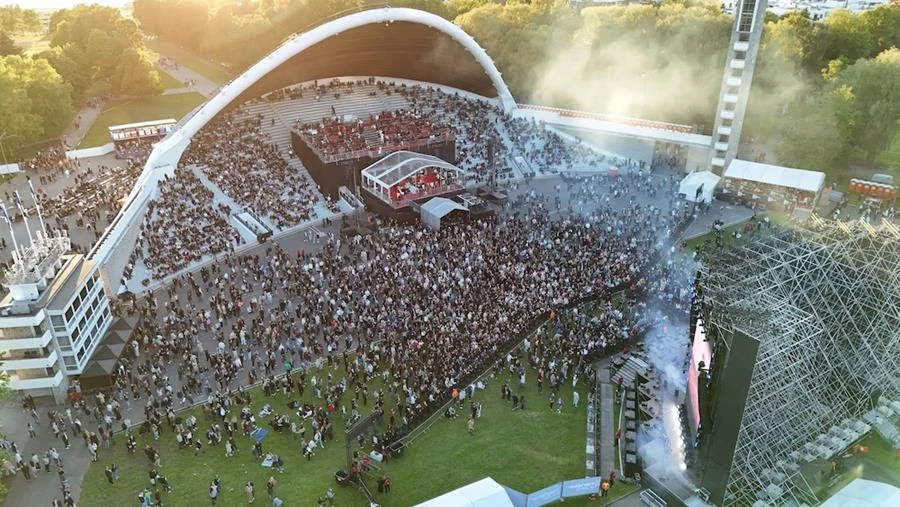
Completed in 1960, the Tallinn Song Festival Grounds is a masterpiece of post-war modernist architecture. Its signature feature is a massive, curved concrete canopy designed by Henno Sepmann. While this structure was engineered to amplify the voices of 10,000 choir singers, it presents a daunting paradox for modern, high-power amplified music.
The concrete arch acts as a massive acoustic reflector. When a modern, high-output PA system is introduced, the sound waves hit the canopy and bounce back toward the audience with significant intensity, resulting in a delayed, muddy acoustic signature that can ruin the clarity of a performance. For the Swedish House Mafia production, the challenge was compounded by the group’s request for a 270-degree stage configuration—a first for this venue—which required the sound to be projected across a much wider and more complex area than traditional frontal stages.
A Chronology of Deployment and Precision
The preparation for this event began weeks in advance, with local supplier and Martin Audio distributor Audiosky spearheading the technical design. The process involved a meticulous blend of acoustic modeling and physical site adjustments.
The Planning Phase
Audiosky, having worked at the venue multiple times, understood that the traditional stage placement would be insufficient. The first tactical move was to shift the stage position further out from the concrete screen, mitigating the primary reflection point. Simultaneously, Martin Audio product specialist Ben Tucker joined the team to conduct extensive simulations using the company’s proprietary DISPLAY software.
The Load-In and Configuration
The deployment phase required extreme logistical coordination. The team opted for a sophisticated, multi-layered approach to ensure that the sound field remained consistent across the entire 270-degree arc.
- The Main Hangs: 18 WPL enclosures were deployed on both the left and right sides to manage the long-throw requirements.
- The Outhangs: Positioned further upstage to accommodate the unique 270-degree stage geometry, 14 WPL cabinets were assigned to each side.
- The Delay System: To maintain clarity at the rear of the field, 12 WPC elements were deployed on each side, supplemented by nine Martin Audio W8VDQ point-source cabinets for front-fill coverage, ensuring those in the immediate proximity of the stage felt the full impact of the performance.
Supporting Data: The Anatomy of the Low-End
Swedish House Mafia’s sound is defined by its deep, visceral sub-bass. To capture this, the production team orchestrated one of the most formidable subwoofer deployments in the history of the Tallinn Song Festival Grounds. The system utilized over 100 subwoofers in a complex, carefully phase-aligned configuration.
The design utilized a mixture of airborne and ground-stacked units to manage the 105-meter throw distance required to reach the back of the venue. The aerial component included 16 SXHF218 subwoofers flown behind the main hangs and 16 W8LS subs behind the outhangs. These were tuned using delay-gain steering, a technique that allows engineers to "pull" the sound energy downward, focusing the bass into the audience rather than letting it dissipate into the sky.
On the ground, the sheer scale of the operation was revealed: 72 SX218 subwoofers were arranged in three massive blocks, each containing 24 cabinets. By reversing the center cabinets in these stacks, the team created a cardioid pattern. This configuration not only provided immense low-end pressure for the crowd but also prevented "back-spill," keeping the stage area relatively clean for the performers.
Official Perspectives: The Technical Verdict
The success of the deployment was a source of pride for those involved. Tiit Terask, COO of Audiosky, noted that the results were unprecedented for the venue. "This acoustic screen was designed so that the voices of 10,000 singers would reflect beautifully, and it certainly looks magnificent," Terask observed. "But if you place a high-output amplified sound system in front of it, the reflections off that screen are extremely challenging. By moving the stage and using the Martin Audio WPL system, we achieved the best acoustic results we have ever seen at this venue."
Ben Tucker, who managed the system optimization, highlighted the importance of the software-driven "Hard Avoid" technique. "We pointed the top box of the main PA at the absolute furthest listener, and then used the software processing to transition into a ‘Hard Avoid’ area straight up the rear wall and on the entire concrete canopy roof," Tucker explained. This technique allowed the team to adhere to strict noise management standards while ensuring the sound stayed focused exactly where it was needed.
Tucker also emphasized the difficulty of the venue’s geometry, specifically the large, prominent VIP section situated right in the center. By blending the main PA and the delay systems with meticulous DSP weighting, the team eliminated the "dead zones" and "hot spots" that usually plague large outdoor festival grounds.
Implications for Future Touring
The Swedish House Mafia show at the Tallinn Song Festival Grounds serves as a benchmark for future large-scale concerts in challenging architectural spaces. The deployment proved that high-performance line arrays, when coupled with advanced predictive software and innovative subwoofer steering, can overcome even the most daunting acoustic environments.
For the Baltic region, this event set a new standard. The audience experienced a level of audio consistency that is rarely achieved in outdoor amphitheaters of this scale. As Terask noted, whether a fan stood in the center or migrated toward the outhangs, the audio profile remained identical.
The success of the WPL deployment also highlights the shift toward "system-as-a-whole" thinking. Rather than treating subwoofers, delays, and main arrays as isolated components, the modern approach integrates every element into a single, cohesive, software-managed entity. This synergy not only protects the integrity of the artist’s sound but also ensures that the production complies with modern noise-pollution regulations, which are becoming increasingly stringent for festivals globally.
Ultimately, the marriage of Swedish House Mafia’s high-energy sound and Martin Audio’s precision engineering transformed a historic architectural landmark into a cutting-edge concert venue. It was a victory for technical innovation and a clear demonstration of how modern audio tools can bridge the gap between 20th-century architecture and 21st-century performance requirements. As the industry looks toward the next generation of live events, the lessons learned in Tallinn—the importance of physical placement, the necessity of cardioid sub-arrays, and the power of predictive DSP—will undoubtedly become the gold standard for production crews worldwide.