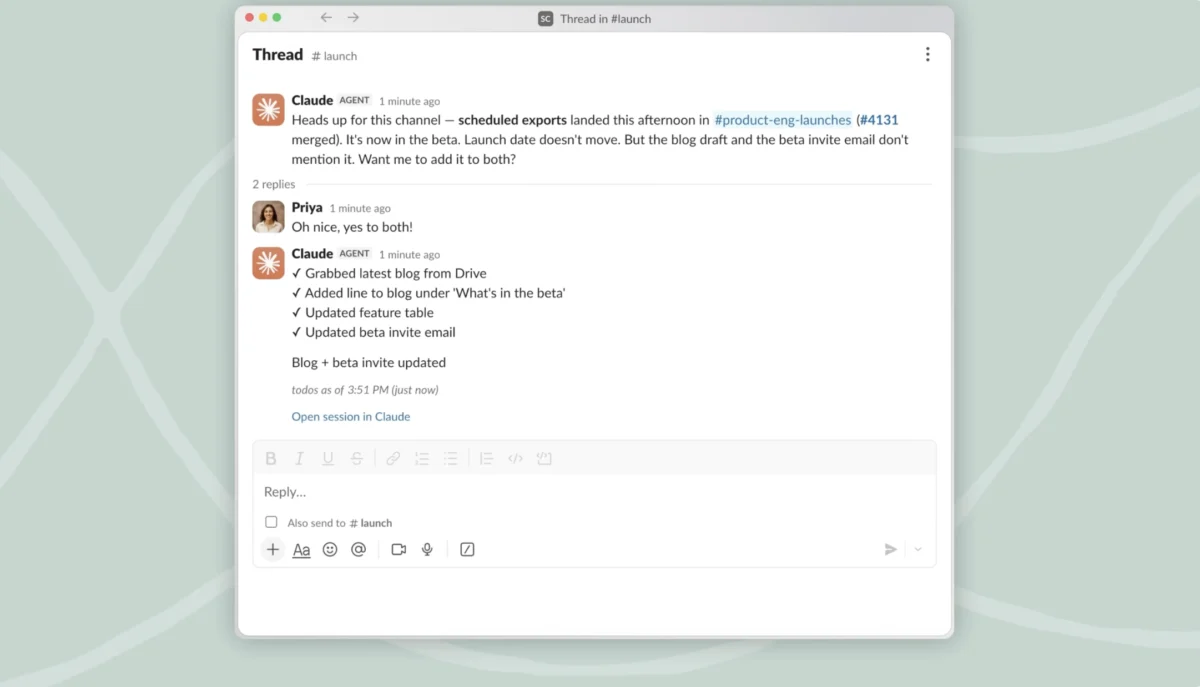
In a significant leap forward for workplace automation, Anthropic has unveiled "Claude Tag," a research-preview feature that promises to fundamentally alter how teams interact with artificial intelligence. By evolving from a reactive chatbot into an "always-on" persistent teammate, Claude Tag marks a departure from the transactional nature of current AI assistants, offering a fluid, context-aware experience directly within Slack.
Available now to Claude Enterprise and Claude Team customers, this new capability allows users to tag @Claude to delegate complex tasks, solicit real-time insights, and maintain project continuity. Unlike previous iterations of the integration, which functioned primarily as a search-and-response tool, Claude Tag operates as a collaborative peer, capable of learning from channel history and proactively surfacing relevant information.
The Evolution of the AI Teammate
To understand the significance of Claude Tag, one must look at the trajectory of Anthropic’s Slack integrations over the past year. Previously, users relied on direct messages to @Claude or tagged the bot for isolated queries. While useful, these interactions were siloed; the AI lacked the "memory" required to understand the nuances of a project’s lifecycle.
The recent introduction of Claude Code—which bridges the gap between Slack mentions and web-based coding environments—hinted at the direction Anthropic was heading. Claude Code allowed for complex tasks to be offloaded to an autonomous agent that could post updates back to a thread. However, Claude Tag goes further. It treats the Slack channel itself as a living document, absorbing context as it unfolds.
"As Claude follows along with its channel, it learns ever more about the work," Anthropic stated in its release documentation. This "always-on" nature ensures that the AI is not just a tool, but an active participant in the workflow.
Chronology: From Static Tools to Active Agents
The transition toward persistent agents has been marked by several key milestones:
- Initial Integrations: Anthropic first established a foothold in the workplace by allowing users to query Claude directly within Slack DMs, providing a quick way to draft emails or summarize text without leaving the interface.
- The Coding Bridge: With the launch of Claude Code, Anthropic proved that its models could handle multi-step technical workflows, pushing code updates and documentation back into Slack threads.
- The Context Barrier: Despite these successes, a major hurdle remained: the "forgetfulness" of models. Once a session ended or a new thread was started, the context was often lost.
- The Launch of Claude Tag: The current research preview addresses this by anchoring Claude’s identity to specific channels, allowing it to maintain a persistent state and cross-reference information across an entire organization (subject to strict administrative permissions).
How Claude Tag Works: Mechanics of Collaboration
The core innovation of Claude Tag is its "shared identity" model. Within a Slack channel, every member interacts with the same Claude instance. This means that if User A assigns a task, User B can see the progress, offer feedback, or pick up the thread exactly where the AI left off.
Administrative Scoping and Security
Anthropic has built robust guardrails to ensure that this persistent memory doesn’t lead to data leaks. System administrators maintain granular control over:
- Tool Access: Defining which external APIs or internal databases Claude can interact with.
- Channel Scoping: Ensuring that a Claude instance assigned to a marketing channel cannot access sensitive financial or legal data from another part of the company.
- Permission Levels: Determining which organizational channels the AI is authorized to "read" to gather context.
Ambient Mode: The Proactive Assistant
Perhaps the most striking feature of Claude Tag is its "ambient mode." Rather than waiting for a direct mention, Claude can now observe the flow of conversation, identify potential bottlenecks, and intervene when necessary. If a task has been neglected or if new information from another department clarifies an ongoing issue, Claude can proactively flag the topic, ensuring that the team remains synchronized.
The Competitive Landscape of Enterprise AI
Anthropic is entering a crowded, high-stakes market. As companies shift from "AI experimentation" to "AI deployment," the value of an LLM is no longer just its reasoning capability, but its integration into the enterprise data stack.
Microsoft and the Graph
Microsoft remains the most formidable incumbent in this space. Through Microsoft 365 Copilot and the underlying Microsoft Graph, the company has spent years indexing the entire digital footprint of an organization—emails, calendar events, documents, and chats. Anthropic’s move to make Claude "always-on" is a direct challenge to the ubiquity of Copilot.
The Role of Data Foundations
The battle for context is also driving the rise of specialized data companies. Snowflake and Databricks are increasingly framing their platforms as the "brains" behind the AI. By storing the structured data that powers organizational decision-making, they provide the back-end support that agents like Claude Tag require to be truly effective.
Glean and the Intelligence Layer
Similarly, firms like Glean are building an "intelligence layer" that acts as a bridge between the model and the enterprise’s vast, often chaotic, internal data. By creating a unified search and understanding mechanism, these platforms ensure that when an AI speaks, it is speaking from a position of factual accuracy regarding the company’s internal operations.
Implications for the Modern Workplace
The deployment of Claude Tag carries profound implications for the nature of professional collaboration.
1. The Death of the "Status Update"
If Claude Tag can track progress, summarize discussions, and flag overdue tasks, the need for routine status meetings may diminish. By working in "public view," the AI creates a transparent record of activity, potentially reducing the administrative burden that currently consumes a significant portion of the workday.
2. Contextual Continuity
For global teams operating across time zones, Claude Tag serves as a bridge. A developer in Tokyo can wake up to find that the Claude instance in their channel has already categorized feedback from a designer in New York, integrated it into the latest code sprint, and summarized the remaining blockers. The "always-on" nature of the agent provides a sense of continuity that human team members often struggle to maintain.
3. The Human-AI Hybrid
Anthropic’s vision is clearly aimed at making the AI feel like a "real colleague." This shift from tool to teammate necessitates a change in how we manage staff. If an AI is participating in threads, managers must consider the implications of AI influence on team culture, decision-making biases, and the potential for over-reliance on automated agents.
Challenges Ahead
Despite the promise, the research preview faces significant challenges. Chief among them is the risk of "hallucinated coordination"—the possibility that the AI might misinterpret a Slack conversation as an instruction, leading to unauthorized actions. Additionally, the "ambient mode" requires a delicate balance; if an AI is too intrusive, it risks becoming a nuisance rather than an asset, cluttering channels with unnecessary updates.
Furthermore, there is the question of organizational culture. Integrating a "persistent" AI into the workspace changes the psychological dynamic of the office. Employees may feel monitored, or conversely, they may begin to outsource critical thinking to the agent. Anthropic will need to monitor how teams adopt these tools to ensure that Claude Tag enhances human productivity rather than simply masking human inaction.
Conclusion
Claude Tag represents a pivotal moment in the enterprise AI race. By embedding the model directly into the flow of communication and granting it the ability to learn from organizational context, Anthropic is moving beyond the "chat" interface toward a future of agentic workflows.
For the average enterprise, the question is no longer whether they should use AI, but how they will manage the persistent, active agents that are about to join their Slack channels. As the technology moves out of research preview and into general adoption, the office of the future looks less like a series of folders and files, and more like a continuous, AI-augmented conversation.
The "always-on" era has begun, and for Anthropic, the stakes have never been higher. As they continue to refine Claude Tag, the industry will be watching closely to see if this "teammate" can truly deliver on the promise of seamless, intelligent collaboration.