In the heart of London’s bustling Strand, beneath the historic concrete foundations of 180 Studios, a quiet revolution in digital perception is once again taking place. Ryoji Ikeda, the Japanese electronic composer and visual artist whose work has long defined the vanguard of minimalist digital art, is bringing his monumental installation, data-cosm [n°1], back to the capital. Following a rapturous reception upon its debut in 2025, the piece returns due to unprecedented public demand, offering a sensory odyssey that bridges the chasm between the microscopic subatomic and the vast, silent reaches of the cosmos.
The Main Facts: A Convergence of Science and Synthesis
data-cosm [n°1] is not merely an exhibition; it is an exercise in data-driven immersion. Commissioned by 180 Studios, the work represents the latest evolution in Ikeda’s lifelong project: the translation of raw, unvarnished scientific data into audiovisual architecture.
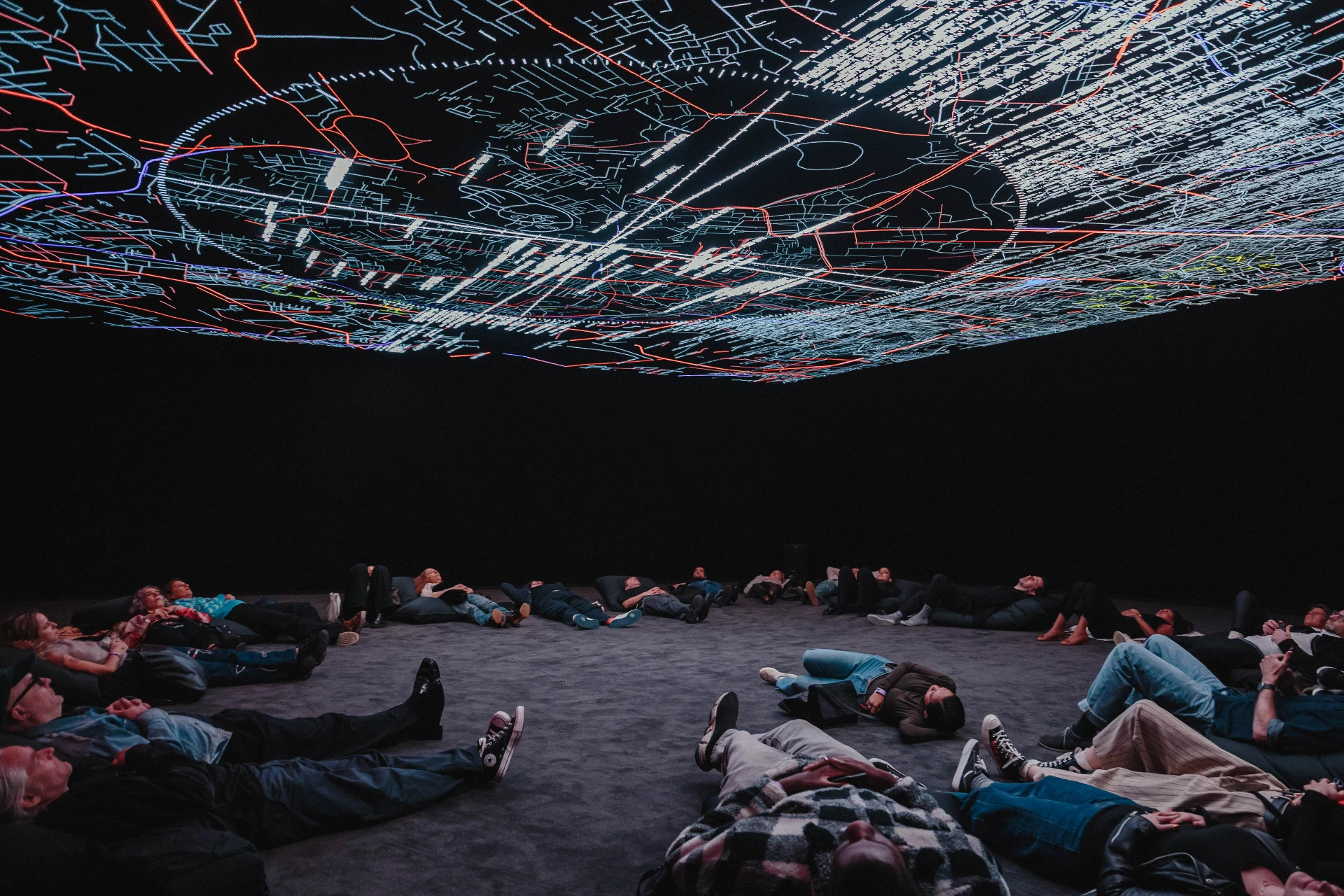
The installation is designed as a total sensory environment. Visitors are invited to abandon the traditional vertical posture of the gallery-goer, instead lying on the floor beneath a gargantuan LED ceiling. As the screen ignites with intricate, high-definition visualizations, the audience is submerged in a soundscape that pulses with the rhythm of the universe. The work draws from vast datasets—ranging from the chaotic dance of particle physics to the celestial movements of astrophysics—to create a landscape that is simultaneously mathematical and ethereal.
The installation is scheduled to run from October 14, 2026, through December 20, 2026. Given the capacity constraints of the immersive space and the anticipated influx of visitors, 180 Studios has opened ticket sales through their official portal, urging attendees to secure their slots well in advance.
Chronology: From data-verse to data-cosm
To understand the weight of data-cosm [n°1], one must look at the lineage of Ikeda’s career. For decades, the artist has been obsessed with the "datafication" of reality.
The data-verse Era (2019–2021)
Before the current iteration, Ikeda achieved global acclaim with his data-verse trilogy. Premiered at the Audemars Piguet commission at Art Basel, the trilogy sought to visualize the collective "data-verse" of the human experience. It was a project of immense scope, interrogating how scientific measurements—from the speed of light to the frequency of brain waves—could be rendered as aesthetic objects. The trilogy was a turning point, solidifying Ikeda’s reputation as an artist who does not merely represent data, but who allows the data to speak for itself.
The 2025 Premiere
In 2025, the unveiling of data-cosm [n°1] marked a shift in scale. Where data-verse was an intellectual inquiry into the fabric of our digital lives, data-cosm feels like a return to the primordial. It moved away from the "human" data of the trilogy toward the "universal" data of the physical world. The 2025 debut was met with critical acclaim, noted for its ability to strip away the noise of the modern world and replace it with the cold, precise beauty of physical constants.
The 2026 Revival
The return of the installation this October is a rare occurrence for a high-profile digital work. Often, immersive installations are ephemeral, destined for the archives once their initial run concludes. However, the decision by 180 Studios to bring data-cosm [n°1] back suggests a shift in how the public engages with "algorithmic art." It is no longer just a trend; it is becoming a cultural cornerstone.
Supporting Data: The Architecture of the Infinite
What makes Ikeda’s work so compelling is the absolute transparency of his methodology. He does not use "generative AI" in the common sense of the term; he uses curated, authentic scientific data.
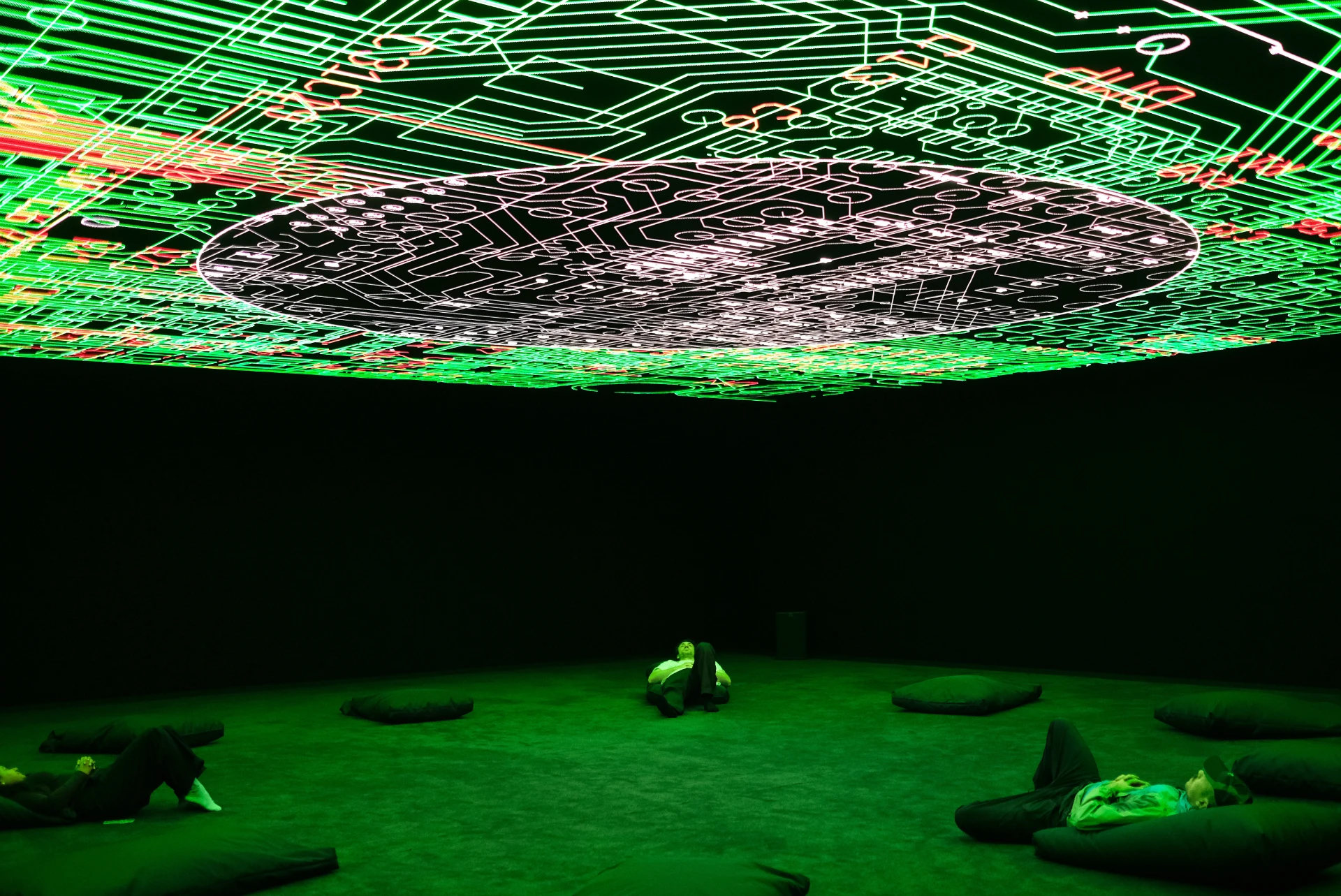
- The Datasets: The installation utilizes information sourced from major scientific institutions, including NASA, CERN, and the Japan Aerospace Exploration Agency (JAXA). By taking raw telemetry and sensor readings, Ikeda creates a "reconstructed" reality.
- The Visual Language: The LED ceiling is not just a screen; it is a display of binary logic. The imagery fluctuates between monochromatic strobes, point-cloud constellations, and cascading streams of text. These are the "building blocks" of Ikeda’s universe—the zeroes and ones that underpin both the internet and the physics of the stars.
- The Acoustic Physics: Ikeda’s soundscapes are equally precise. He employs extreme frequency ranges—some barely audible, others physically felt through the floor—to create a visceral connection to the sound. The audio is synchronized to the microsecond with the visual output, ensuring that the experience is a unified whole rather than a composite of sound and image.
Official Perspectives and the Immersive Experience
For the curators at 180 Studios, data-cosm [n°1] represents the pinnacle of their programming mission: to provide a platform for artists who are fundamentally reshaping the relationship between technology and the human spirit.
In internal discussions, the production team has noted that the installation requires a specific "readiness" from the audience. "This is not passive viewing," one representative noted. "It requires a surrender of the ego. When you lie down and the entire ceiling becomes a shifting, microscopic map of particle decay, you lose the sense of where the room ends and your own consciousness begins."
The artist himself has maintained a characteristically stoic approach to his work. Ikeda has often described his role as a "translator." He does not view himself as an inventor of images, but as a discoverer of patterns. By highlighting the hidden symmetries in nature—the way a spiral galaxy shares the same mathematical structure as a subatomic particle interaction—he invites the viewer to see the world as a singular, unified system.
Implications: The Future of Digital Minimalism
The success of data-cosm [n°1] speaks to a broader cultural fatigue with the "over-designed" digital world. In an era where digital content is often loud, cluttered, and hyper-personalized, Ikeda’s work offers a stark, necessary contrast. It is empty of sentimentality, yet deeply moving.
The Cultural Impact
The return of this installation suggests that audiences are increasingly seeking "contemplative tech." We are moving past the novelty phase of VR and AR into a space where technology is used to facilitate meditation and deep focus. Ikeda’s success implies that there is a massive, underserved appetite for art that respects the viewer’s intelligence while challenging their physical perception.
The Evolution of the "Data-Art" Genre
As the discourse around artificial intelligence and digital ethics intensifies, Ikeda’s methodology remains a benchmark for integrity. He does not hide the mechanics of his art; he displays them. He shows us the data, the code, and the calculation. By making the "black box" of modern technology transparent, he offers a form of digital honesty that is increasingly rare.
Visitor Information: Engaging with the Infinite
For those planning to visit 180 Studios, the experience is best approached with an open mind and a willingness to disconnect from the frantic pace of the outside world.
- Location: 180 Studios, 6 Surrey Street, London, WC2R 2ND.
- Accessibility: The exhibition space is designed to be fully accessible, though the immersive nature of the LED floor-and-ceiling setup involves significant light exposure.
- Operational Hours:
- Wednesday: 12:00 – 17:00
- Thursday–Sunday: 12:00 – 21:00
- Ticketing: Due to the high demand and the immersive nature of the installation, entry is strictly timed. Visitors are strongly encouraged to book in advance via the official 180 Studios website.
As the autumn of 2026 settles over London, data-cosm [n°1] stands as a beacon of clarity. It is a reminder that while the world may be complex, chaotic, and often overwhelming, there is a fundamental order to the universe—a mathematical beauty that remains, even when we aren’t looking. Ryoji Ikeda has provided us with the perfect vantage point to see it.