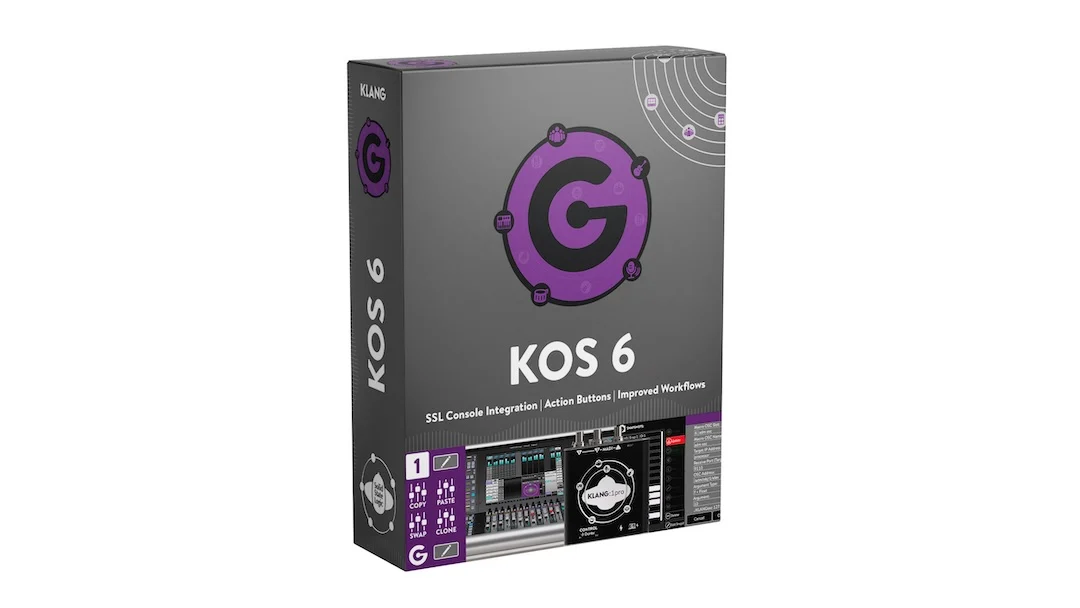
AACHEN, GERMANY — In a move that further solidifies its position at the vanguard of live sound innovation, Klang:technologies has officially announced the release of KOS 6, the latest major firmware update for its immersive in-ear monitor (IEM) mixing ecosystem. Announced on June 16, 2026, the update represents a significant leap forward in workflow integration, hardware compatibility, and cross-platform interoperability.
The KOS 6 update is not merely a refinement of existing tools but a comprehensive overhaul designed to meet the demands of modern touring environments, where speed, precision, and spatial clarity are paramount. By bridging the gap between high-end console surfaces and compact processing hardware, Klang:technologies is effectively democratizing immersive monitoring for a broader range of applications, from stadium tours to intimate house-of-worship settings.
Main Facts: A New Standard for Monitor Mixing
The release of KOS 6 brings a suite of powerful features to the Klang ecosystem, centered around the philosophy of "Total Control." The primary highlights of the release include:
- Hardware Support for Klang:1 and :1pro: The firmware provides the essential backbone for the company’s newest compact processors. These devices were designed to offer the same 3D binaural processing power as their larger predecessors but in a form factor suited for smaller racks and portable setups.
- Native SSL Live Integration: In a landmark collaboration, KOS 6 allows for direct control of Klang parameters from the surface of SSL Live consoles. This eliminates the need for engineers to toggle between multiple screens or external laptops, streamlining the mixing process during high-pressure live performances.
- Dante Patching Simplified: For users of the Klang:1pro, the requirement for external Dante Controller software has been removed for basic patching. Dante routing can now be managed directly within the Klang:app, a feature that significantly reduces setup time and technical overhead.
- ADM-OSC Support: By implementing the Audio Definition Model (ADM) via Open Sound Control (OSC), Klang has opened the door for real-time spatial data exchange with external immersive systems and digital audio workstations (DAWs).
- Enhanced Workflow Tools: New "Action Buttons" and "Batch Snapshot Editing" have been introduced to the Klang:app, focusing on reducing the number of clicks required to perform complex tasks.
Chronology: The Path to KOS 6
To understand the significance of KOS 6, one must look at the trajectory of Klang:technologies over the last decade. Founded in Aachen, Germany, the company revolutionized the IEM market by introducing the world’s first truly immersive 3D in-ear mixing system. Before Klang, performers were limited to traditional stereo or mono mixes, which often felt "inside the head" and led to significant ear fatigue.
2014–2018: The Proof of Concept
Klang entered the market with the Klang:fabrik and Klang:vier, proving that binaural processing could be applied to live monitors with negligible latency. The industry’s interest was piqued, particularly among high-profile monitor engineers who sought to give their artists a more "natural" stage sound.
2018–2022: The DiGiCo Era
The acquisition of Klang by DiGiCo in 2018 marked a turning point. This partnership led to the deep integration of Klang processing into DiGiCo SD and Quantum series consoles. It was during this period that the industry saw the release of the DMI-Klang and the Klang:konductor, the latter of which became the flagship processor for the world’s largest tours.
2023–2025: Expanding the Reach
Recognizing that immersive audio should not be exclusive to top-tier tours, Klang began developing the :1 and :1pro compact processors. These were teased in early 2026 as the "next generation" of accessible immersive tech.
June 16, 2026: The KOS 6 Milestone
The release of KOS 6 acts as the connective tissue for these new hardware offerings. It represents the culmination of years of feedback from monitor engineers who demanded more autonomy from external software and better integration with a wider variety of console manufacturers.
Supporting Data: Technical Deep Dive
The technical improvements in KOS 6 are aimed at solving specific "pain points" in the live sound signal chain.
SSL Live Integration and Console Workflow
The most significant data point for professional engineers is the native SSL Live integration. Historically, while DiGiCo users enjoyed deep integration, users of other high-end consoles like Solid State Logic (SSL) had to rely on the Klang:app running on a separate tablet or computer.
With KOS 6, the SSL environment now hosts an interface for:
- Remote Management: Labeling and monitoring of Klang:kontroller units.
- Routing: Direct configuration of audio paths to and from the Klang processor.
- Tone Shaping: Per-channel and per-mix EQ control, including Klang’s proprietary "Tone Filters," are now accessible via the SSL touchscreens and encoders.
The Dante Revolution within Klang:app
For the Klang:1pro, the integration of Dante patching is a technical milestone. Dante (Digital Audio Network Through Ethernet) is the industry standard for audio networking, but it usually requires the "Dante Controller" software to bridge connections. By embedding this functionality into the Klang:app, Klang has created a "single pane of glass" for the engineer. This is particularly vital in the corporate AV and house-of-worship sectors, where technical staff may not have extensive experience with complex network routing.
ADM-OSC: The Language of Spatial Audio
The inclusion of ADM-OSC support is a forward-looking move toward industry standardization. ADM is a metadata model that describes the spatial properties of audio. By supporting OSC—a protocol for networking sound synthesizers and other multimedia devices—Klang allows its processors to "talk" to object-based mixing systems like those used in broadcast and cinema. This ensures that a spatial mix created on stage can be easily translated or tracked for a live broadcast or a 3D recording.
Official Responses: A Vision for the Future
While official press statements from the Aachen headquarters emphasize technical specifications, the underlying message is one of user-centric design.
"Our goal with KOS 6 was to remove the ‘tech barrier’ between the engineer and the artist," a senior developer at Klang:technologies noted during the launch event. "By introducing features like Batch Snapshot Editing, we are giving hours of time back to the monitor engineer. Instead of clicking through 50 snapshots to adjust a single vocal gain, they can now do it in seconds. This allows them to focus on the art of the mix rather than the mechanics of the software."
Industry experts have also weighed in on the SSL partnership. "The addition of SSL Live integration is a massive win for the industry," said one veteran monitor engineer currently on tour. "It shows that Klang is committed to being an open platform. You shouldn’t have to change your favorite console just to give your artist the best possible monitoring experience."
Implications: How KOS 6 Changes the Industry
The release of KOS 6 has wide-ranging implications for the live sound industry, affecting everyone from the technical director to the performer on stage.
For the Monitor Engineer
The primary benefit is cognitive load reduction. In the high-stakes environment of a live show, every second spent looking away from the stage is a risk. Native console integration and "Action Buttons" (which allow for custom shortcuts on the main menu) mean that adjustments are faster and more intuitive. The Batch Snapshot Editing feature also minimizes the risk of human error during show preparation, ensuring consistency across an entire setlist.
For the Performer
Performers using the Klang:1 or :1pro will benefit from the same high-fidelity immersive algorithms used by global superstars. Immersive IEMs provide a sense of space that mimics natural hearing, which has been clinically shown to reduce the volume levels required for a performer to "hear themselves." This leads to better vocal performances, tighter timing, and long-term hearing protection.
For the Rental and Integration Markets
The compact nature of the :1 series, supported by KOS 6, makes immersive audio a viable "add-on" for smaller rental houses. Previously, the cost and rack space required for an immersive setup were prohibitive for small-to-mid-sized tours. Now, a 1U rack space can house a world-class spatial mixing engine that integrates seamlessly with existing Dante networks.
The Future of Standardization
By adopting ADM-OSC, Klang is signaling its support for a unified spatial audio future. As more manufacturers adopt these open standards, we move closer to a world where spatial metadata can travel from the stage to the broadcast truck, and ultimately to the consumer’s spatial-audio-enabled headphones, without losing the creative intent of the original mix.
Conclusion
KOS 6 is more than a firmware update; it is a statement of intent from Klang:technologies. By focusing on integration, accessibility, and workflow efficiency, the company is ensuring that immersive audio is no longer a luxury "extra," but a standard component of the modern professional audio signal chain. As the industry continues to move toward object-based audio and 3D soundscapes, KOS 6 provides the robust, flexible foundation required to lead that charge.
The update is available now as a free download for all eligible Klang processors and Klang:kontrollers, ensuring that the existing user base can immediately benefit from these advancements. As the summer touring season of 2026 kicks into high gear, KOS 6 is poised to become the new benchmark for monitor mixing excellence.