LAS VEGAS, NV — As the doors of the Las Vegas Convention Center swung open for InfoComm 2026 on June 18, the professional audiovisual industry found itself at a crossroads of artificial intelligence, immersive spatial design, and extreme portability. While the sprawling main show floor remains the visual centerpiece of the event, the true pulse of the audio sector is beating within the 26 specialized Demo Rooms.
This year’s configuration represents a significant shift in how manufacturers engage with integrators and end-users. Moving beyond static displays, the 2026 demo rooms emphasize "real-world application" over "spec-sheet bragging," offering attendees a chance to experience complex ecosystems in controlled acoustic environments. From AI-driven vocal separation to battery-powered line arrays, the innovations on display suggest an industry focused on reducing "human entanglement" and increasing the versatility of professional sound.
The Core Objectives: Main Facts of InfoComm 2026
The 2026 audio showcase is defined by three primary pillars: Intelligence, Integration, and Independence.
- Intelligence: Manufacturers like L-Acoustics and Huddly are utilizing "Agentic AI" and machine learning to handle the tedious aspects of audio engineering, such as zone creation and background noise suppression.
- Integration: The focus has shifted from standalone components to unified workflows. Brands like Harman and Martin Audio are demonstrating how lighting, control, and sound now exist within a single, seamless software environment.
- Independence: A surge in high-performance, battery-powered solutions (from Harmonic Design and QSC) indicates a growing market for premium audio in locations without traditional power infrastructure.
A Chronological and Categorical Tour of the Demo Suites
To navigate the 26 rooms effectively, industry analysts have categorized the demonstrations into four distinct "innovation hubs" that reflect the current state of the market.
1. The AI and Automation Pioneers
In Room N106, Huddly is redefining the meeting space. Their "Agentic AI" approach removes the need for manual programming or preset creation. By allowing the hardware to "think" for itself, the system dynamically adjusts to participants, effectively ending the era of the "clunky" conference call.
Similarly, L-Acoustics (N107) is showcasing "Source Intelligence." This platform uses real-time machine learning to separate human voices from ambient noise, a breakthrough for clear communication in reverberant spaces. They are also demonstrating "L-Acoustics DJ," a tool that democratizes immersive sound by converting standard stereo signals into 3D soundscapes without requiring a specialist engineer.
2. High-Output Installation and "Secret" Launches
BassBoss (N101) set the tone early with a "top-secret" installation product. The Austin-based company is doubling down on "cinema-quality sound" for high-energy venues, emphasizing flown solutions that can withstand the rigors of modern nightlife and sports arenas.
HK Audio (N102) is celebrating its largest North American presence to date. Their focus remains on the "long-throw" capabilities of the Linear 5 and Linear 9 systems, paired with Ashly Audio amplification. This highlights a trend toward European manufacturers aggressively expanding their footprint in the U.S. commercial market.
In N206, Danley Sound Labs is hosting the public debut of the "Exodus" series. This modular system utilizes proprietary Cohearix Lens Technology. By applying Synergy Horn tech to large-format stadium settings, Danley aims to solve the "interference" issues common in massive venue installations.
3. Portability and the "Power-Tool" Revolution
One of the most talked-about trends this year is the use of standard power-tool batteries to drive professional PA systems. Harmonic Design (N105) is leading this charge with the BS10 Battery Speaker. Meanwhile, Q-Sys (N115) is demonstrating the QSC CB10, a battery-powered system designed for everything from pop-up cafes to live street performances.
KV2 Audio (N222) is focusing on environmental independence. Their ESD Series has achieved IEC 60 529 (IP55) certification, meaning these high-fidelity speakers can now be permanently installed in harsh outdoor environments without fear of mechanical or electrical failure.
4. Immersive Ecosystems and Experiential Marketing
Yamaha (N220) is pushing the boundaries of "Object-Based Sound" with their Sound xR platform. Using the DME Series DSP, users can precisely place sound images within a 3D space, a feature increasingly demanded by museums and high-end retail.
MayCo (N224) has transformed their suite into a masterclass in experiential marketing. By combining Modulo Pi media servers with real-time motion tracking and projection mapping, they are demonstrating how audio and visuals can react dynamically to the movement of an audience.
Supporting Data: Technical Specifications and New Standards
The shift toward high-fidelity, high-output, and high-efficiency is backed by impressive technical data across the board:
- Theory Professional (N212): Their SR-221.3 "rock concert-in-a-box" features dual 21-inch, 3,600W low-frequency drivers. The goal is to provide a single-point source capable of filling a medium-sized venue with 130dB+ of sustained, clear audio.
- Bose Professional (N116): The new ShowTime STS118E subwoofer is being positioned as a "bridge" product—equally capable in indoor theaters and outdoor festival environments, supported by their updated ControlSpace Designer software.
- Eastern Acoustic Works (N117): EAW’s new NT208L Line Array is paired with the Online Array Assistant (OAA). This browser-based software allows technicians to calculate pick-points and angles via a smartphone, reducing setup time by an estimated 40%.
- dBTechnologies (N120): Their IS Series focuses on "spatial coherence." By using a distributed multi-source configuration, they are achieving +/- 3dB consistency across entire listening areas, a feat previously reserved for only the most expensive touring rigs.
Official Responses: The Philosophy of Workflow
Industry leaders are using these demo rooms to communicate a shift in corporate philosophy.
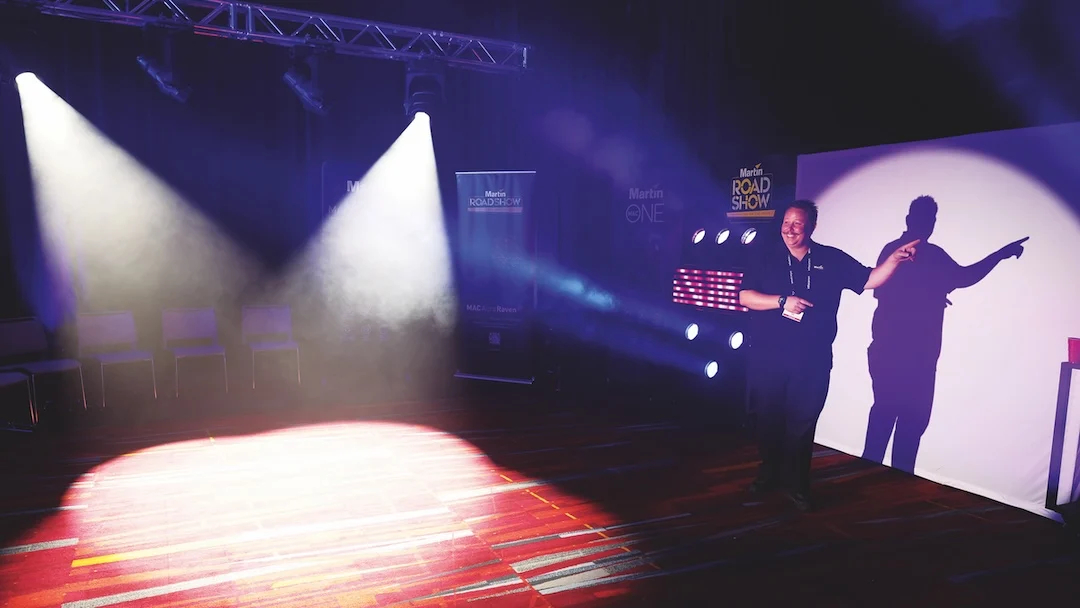
Harman (N110) opted not to focus on individual specs, but on the "unified workflow." A spokesperson for the Martin Roadshow Experience noted, "The industry is tired of fighting with incompatible protocols. Our goal with the P3 control platform and the Macula remote follow spot is to show that lighting and audio should be one conversation, not two."
Adamson (N204) is placing a similar emphasis on infrastructure. By showcasing their MS8.2 Milan-focused network switches alongside the VGt large-format line source, they are signaling that the network is just as important as the driver in 2026.
1 Sound (N108) founder Lou Mannarino emphasized the "human element" of the demo. By leading sessions personally, Mannarino is highlighting the "Panorama 85" system’s ability to handle mono, stereo, and sub-frequencies within a single aesthetic footprint, targeting architects who previously viewed large speakers as "eyesores."
Market Implications: What InfoComm 2026 Tells Us
The 2026 demo rooms provide a roadmap for the next five years of AV integration.
The Democratization of the "Expert"
The heavy integration of AI (L-Acoustics, Huddly, EAW) suggests that the industry is moving toward a model where high-end results no longer require a high-end specialist on-site for every event. Automated "vocal separation" and "auto-angling" software are lowering the barrier to entry for houses of worship and smaller corporate entities.
The Death of the "Black Box" Subwoofer
The emergence of cardioid subwoofers (K-array’s KSCARDIO412P and RCF’s TT+ Audio GTS 16C) indicates that "noise abatement" is no longer a luxury. As cities pass stricter noise ordinances, the ability to steer bass energy away from neighbors and back toward the audience is becoming a mandatory feature for touring and permanent installs alike.
The "Hospitality-First" Approach
As seen in the Martin Audio (N112) and Electro-Voice (N228) rooms, there is a massive pivot toward hospitality. The AV industry is recognizing that restaurants, "eatertainment" venues, and boutique hotels are the fastest-growing segments. Products are becoming smaller, more "architecturally friendly," and easier for non-technical staff to operate via tablet-based DSP interfaces.
Final Outlook
InfoComm 2026 confirms that the "Audio Wars" are no longer about who can be the loudest. Instead, the winners are those who can be the smartest, the most integrated, and the most adaptable. As attendees leave the N-hall demo rooms, the message is clear: the future of sound is not just heard—it is experienced, automated, and infinitely scalable.