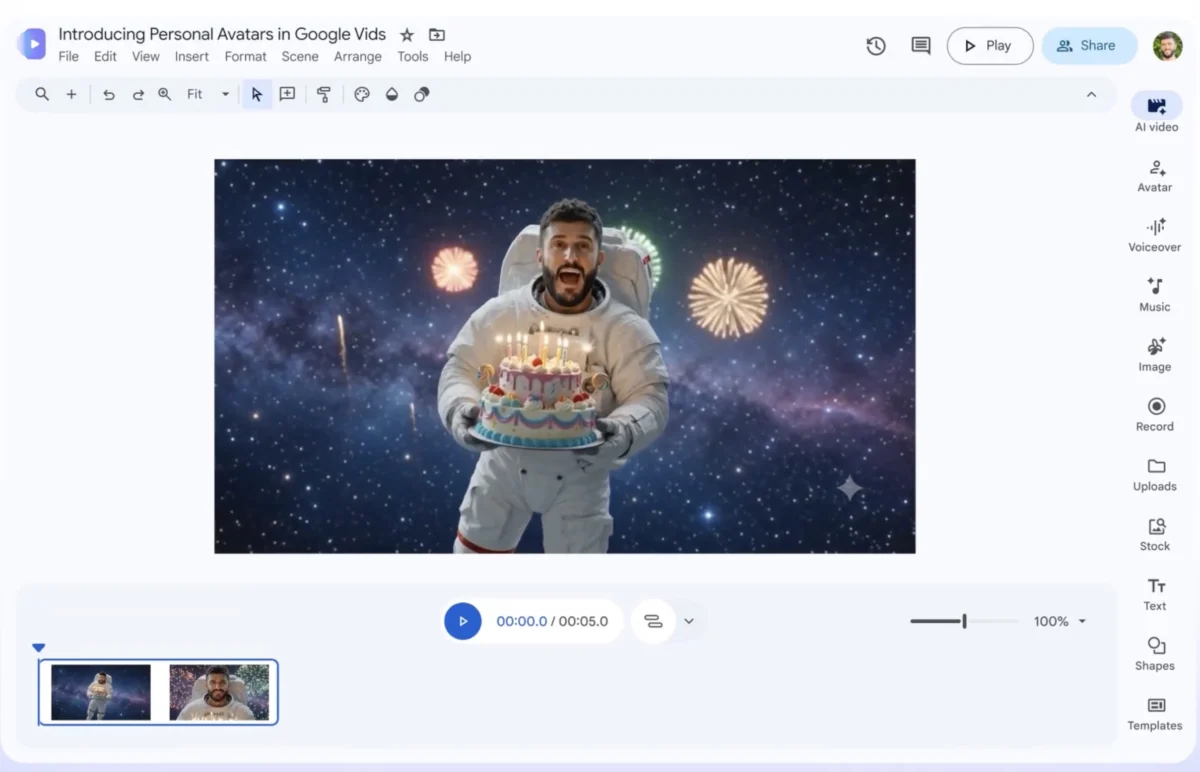
As the landscape of generative AI shifts from experimental novelty to practical enterprise utility, Google is doubling down on its commitment to the workplace. Following the high-profile exit of OpenAI’s Sora from the public stage, Google has seized the opportunity to redefine the narrative around AI-driven video production. On July 16, 2026, the tech giant announced a significant expansion to Google Vids, its collaborative video creation platform, introducing custom digital avatars and the integration of its multimodal powerhouse, Gemini Omni.
These updates mark a pivotal transition for the platform: Google Vids is shedding its skin as a simple presentation aid to emerge as a sophisticated, all-in-one video production suite. By leveraging the same technology that allows users to interact with Gemini in real-time, Google is effectively democratizing high-end video production for the average office worker.
Main Facts: A New Era for Google Vids
The core of the July 16 announcement lies in two major technical leaps. First, the introduction of Personal Avatars. By uploading a single selfie and a short audio sample, users can now generate a lifelike digital twin capable of speaking on their behalf. This functionality is designed to streamline the creation of corporate updates, training modules, and internal communications, allowing executives and managers to "record" video content without the need for a studio, lighting setup, or even a change of clothes.
Second, the integration of Gemini Omni serves as the engine for this new iteration. Unlike previous generative models that required distinct, siloed processes for text, image, and video generation, Omni operates on a unified, multimodal logic. Users can input a simple text prompt combined with reference imagery to generate cohesive, professional-grade video content.
Perhaps most significantly, the platform now supports iterative, step-by-step editing. Previously, if a user disliked an AI-generated video, they were often forced to restart the process from scratch. With Omni, users can request granular changes—such as "brighten the background," "shorten the second sentence," or "add a professional transition"—allowing for a collaborative dialogue between the creator and the AI.
Chronology: From Workplace Tool to Multimodal Powerhouse
To understand the trajectory of Google Vids, one must look at the rapid-fire succession of AI developments over the past two years:
- Early 2026 (The Sora Pivot): The industry was shaken when OpenAI’s Sora, once heralded as the future of cinematic AI, was pulled from development due to safety and ethical concerns. This created a vacuum in the market for enterprise-ready video generation.
- May 2026: Google unveiled Gemini Omni. This marked the shift toward "true" multimodality, where the model could process and generate video, audio, and text in a fluid, simultaneous stream.
- July 16, 2026: Google officially integrated Gemini Omni into the Vids interface. This move signaled that Google was no longer treating Vids as a side project, but as a core component of the Google Workspace ecosystem.
This timeline reflects a strategic move to capitalize on the "enterprise readiness" of their tools. While other startups struggled with the complexities of deepfakes and misinformation, Google spent the interim months building the infrastructure for secure, authenticated content.
Supporting Data and Technical Infrastructure
The shift toward multimodal AI is supported by a massive leap in processing capabilities. Gemini Omni utilizes a unified architecture that minimizes the "latency gap"—the time between a user’s prompt and the AI’s output. By embedding this directly into the Workspace environment, Google is leveraging its existing cloud infrastructure to ensure that large-scale video rendering happens in the cloud, rather than on the user’s local hardware.
Furthermore, the integration of SynthID is the lynchpin of Google’s security strategy. Every AI-generated avatar or video created via the new Vids update is embedded with an invisible watermark. This technology, which is detectable even if the video is compressed or edited, ensures that corporate communications remain authentic and distinguishable from malicious deepfakes.
For enterprise customers, this provides a "brand safety" guarantee. The data used to train these models, and the output generated, is governed by Google’s existing enterprise data privacy agreements, ensuring that company-specific information does not leak into public training sets.
Official Responses and Ethical Guardrails
Google has been characteristically cautious regarding the rollout of these features, particularly given the public outcry surrounding AI-generated avatars. In its official blog post, Google emphasized that the creation of personal avatars is gated by strict identity verification processes.
"The power of a digital twin is only as valuable as the trust behind it," a Google spokesperson noted. To mitigate the risk of impersonation—the very issue that plagued the early days of Sora—Google has implemented a "likeness lock." An avatar can only be created by an account holder using their own verified credentials.
Furthermore, access to the personal avatar feature is geographically limited and restricted to users aged 18 and older. This age-gating is a clear attempt to curb the proliferation of "meme" culture and unauthorized impersonation, placing the tool firmly in the hands of professionals who have a legitimate business need for such technology.
Implications: A Competitive Landscape
The release of these features puts Google in direct competition with a flourishing ecosystem of AI video startups, including HeyGen, Synthesia, Captions, and D-ID. These companies have built successful businesses on the premise of the "talking head" video, which is a staple of modern corporate HR and training departments.
The "All-in-One" Advantage
Google’s primary competitive advantage is integration. While a business might currently pay for a subscription to a third-party tool like Synthesia, that tool exists outside of their primary workflow. By building these capabilities into Google Vids, the company makes the transition from a Google Doc or a Slides presentation to a polished video nearly instantaneous. The "friction cost"—the time and mental effort required to switch between platforms—is effectively reduced to zero.
The Future of Corporate Communication
The implications for the modern workplace are profound. We are moving toward a future where:
- Asynchronous Meetings: Instead of scheduling a live call to update a global team, a manager can record a prompt and let an AI generate a polished video in their own voice, in multiple languages, sent directly to a Google Drive folder.
- Hyper-Personalization: Training videos can be generated to address specific employees by name or to adapt to the specific context of their department, using Gemini Omni’s ability to ingest reference documents and tailor the script accordingly.
- Accessibility: The barriers to entry for high-quality video production are collapsing. An employee without any video editing experience or expensive hardware can now produce content that matches the quality of a professional production studio.
Risks and Challenges
However, the path forward is not without peril. As tools become more accessible, the volume of "synthetic" content will explode. Companies will need to develop new internal policies regarding what constitutes an "authentic" communication. If a CEO sends a video update, employees must have absolute certainty that the avatar is an authorized representation of the executive. The onus will be on Google to maintain the integrity of its SynthID watermarking, and on corporations to train their employees to recognize and respect these digital markers.
Conclusion: The Path Ahead
The update to Google Vids is a reflection of a broader market shift. The era of the "creepy" AI experiment is being replaced by the era of the "utility" AI. By focusing on the enterprise use case—specifically, the need for efficient, secure, and collaborative communication—Google is positioning itself to dominate the digital transformation of the workplace.
As the industry moves forward, the success of these tools will be measured not by how "real" the avatars look, but by how effectively they integrate into the daily rhythm of work. With Gemini Omni, Google has provided the tools; now, the focus shifts to how global organizations will choose to use them. The digital avatar, once a gimmick, is quickly becoming a necessary component of the modern professional’s toolkit. Whether this leads to a more efficient workplace or a more detached, synthetic culture of communication remains the defining question of the next chapter in the AI revolution.