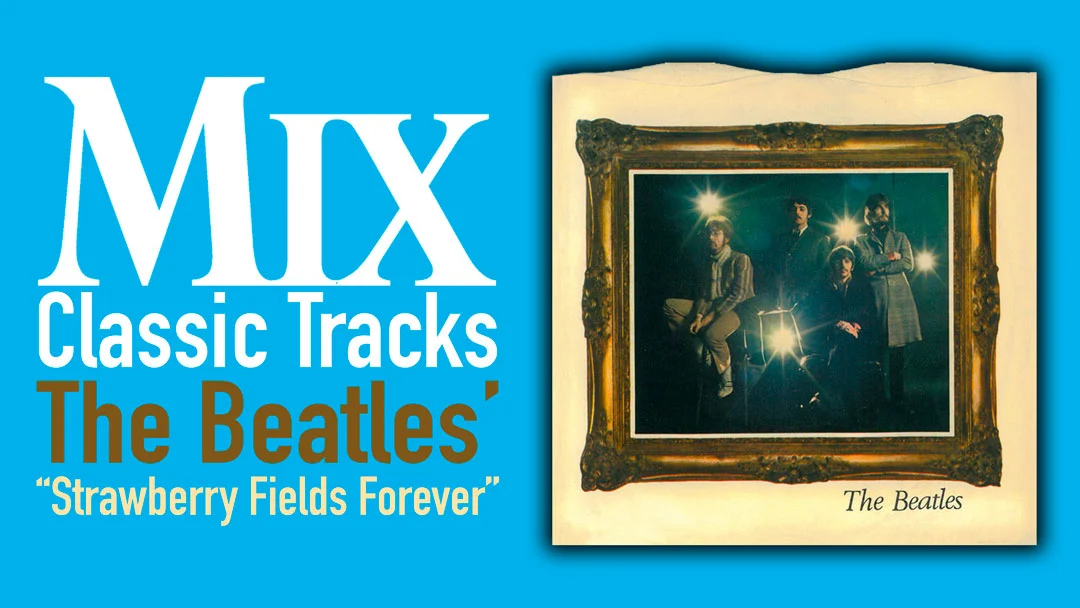
In the winter of 1966, the musical landscape was shifting beneath the feet of the global audience. The Beatles, having retired from the grueling cycle of touring, had retreated into the sanctuary of Abbey Road’s Studio Two. What emerged in February 1967 was not merely a pop song, but a sonic manifesto. "Strawberry Fields Forever," released as a double A-side with "Penny Lane," remains arguably the most revolutionary single in the history of recorded music.
Produced by George Martin and engineered by Geoff Emerick, the track represents a pinnacle of studio innovation, where the limitations of four-track recording were overcome by sheer creative audacity. It is a song built from two entirely different versions, spliced together through a feat of technical "sleight of hand" that remains a benchmark in music production.
Main Facts: A Masterpiece of Studio Artifice
"Strawberry Fields Forever" was the first track recorded during the sessions that would eventually produce Sgt. Pepper’s Lonely Hearts Club Band. However, the song itself—along with its counterpart "Penny Lane"—was famously excluded from the album due to pressure from EMI for a new single.
The song is defined by several key elements:
- The Mellotron: One of the first prominent uses of this proto-sampler in pop music, creating the iconic "flute" introduction.
- The "Impossible" Splice: The final master is a composite of two separate takes, recorded weeks apart, in different keys and at different tempos.
- Lyrical Depth: A departure from standard romantic themes, the lyrics explore John Lennon’s childhood memories of a Salvation Army garden, filtered through the lens of LSD-influenced introspection and the poetic influence of Bob Dylan.
- Technical Density: The track utilized "bouncing" (mixing multiple tracks down to one to free up space) on Studer J37 4-track machines, pushing the equipment of the era to its absolute breaking point.
Chronology: From Acoustic Roots to Orchestral Intensity
November 24, 1966: The Genesis
The Beatles reconvened at Abbey Road after a three-month hiatus, the longest break they had taken since their rise to fame. John Lennon presented a new composition on acoustic guitar. At this stage, the song was a relatively straightforward folk-inspired piece.
The group spent the first evening (7:00 p.m. to 2:30 a.m.) crafting "Take 1." This version was skeletal but already featured the Mellotron played by Paul McCartney. George Harrison contributed slide guitar, and the band experimented with vocal harmonies. While evocative, this version lacked the "dreamscape" quality Lennon envisioned.
Late November to Early December 1966: The Evolution
The band spent the following weeks refining the rhythm track. By "Take 7," the song had gained piano, bass, and double-tracked vocals. For a period, this was considered the "best" version—a psychedelic but relatively standard rock arrangement. However, Lennon remained unsatisfied. He felt the song needed to be more expansive, more "symphonic," and more representative of the visions he had while filming How I Won the War in Spain.
December 8–15, 1966: The "Heavy" Version
Lennon approached George Martin with a request for a more elaborate arrangement. Martin subsequently scored the piece for four cellos and three trumpets. This second version (culminating in Take 26) was markedly different: it was faster, more intense, and featured a "heavy" drum sound from Ringo Starr, along with backward recorded percussion and the distinct, swarmandal (an Indian zither) played by George Harrison.
December 22, 1966: The Final Edit
Lennon famously told George Martin he liked the beginning of the earlier, simpler version (Take 7) and the ending of the later, more complex version (Take 26). He requested they be joined. Martin and Emerick were faced with a significant technical hurdle: Take 7 was in the key of A major, while Take 26 was in B-flat major. Furthermore, the tempos were entirely mismatched.
Supporting Data: Technical Specifications and Studio Innovation
The production of "Strawberry Fields Forever" was a masterclass in the "Studio as an Instrument" philosophy. To achieve the final result, Martin and Emerick relied on several key pieces of hardware and techniques:
The Studer J37 and EMI REDD.51
The sessions utilized the Studer J37 4-track recorder. Because 8-track recording would not arrive at Abbey Road until late 1967, the team had to perform "reduction mixes." They would record four tracks, mix them down to one or two tracks on a second machine, and then record new parts over the remaining tracks. This process, while ingenious, increased tape hiss and required precise planning to avoid losing fidelity.
Variable-Speed Splicing
To solve the key and tempo discrepancy between the two takes, George Martin used a variable-control tape machine.
- Take 7 (The "Light" version): Sped up to raise the pitch and tempo.
- Take 26 (The "Heavy" version): Slowed down to lower the pitch and tempo.
By sheer luck or "divine intervention," as Martin often suggested, the adjustments brought both takes into the same approximate key (somewhere between A and B-flat) and tempo. The splice occurs exactly 60 seconds into the track, on the word "going" in the line "Let me take you down, ’cause I’m going to…" If one listens closely, the timbre of Lennon’s voice changes slightly at this juncture, becoming thicker and more "phased" due to the tape slowing down.
The Mellotron Mark II
The flute sound that opens the track was produced by the Mellotron, an instrument that used internal tape loops of real instruments. It was notoriously temperamental and difficult to keep in tune, but its slightly "wobbly" and ethereal quality provided the perfect gateway into the song’s hallucinatory world.
Official Responses: Perspectives from the Control Room
The architects of the sound have frequently reflected on the session’s intensity. In his 1979 autobiography All You Need Is Ears, George Martin recalled the daunting task Lennon set for him:
"He said, ‘Why don’t you join the beginning of the first one to the end of the second one?’ I replied, ‘There are two things against it. They are in different keys and different tempos.’ He said, ‘Well, you can fix it!’"
Martin later admitted that "Strawberry Fields Forever" was his favorite production, noting that it pushed the boundaries of what was considered "pop" into the realm of avant-garde art.
Geoff Emerick, the engineer whose innovative miking techniques gave the drums their "compressed" and "heavy" feel, noted in his memoirs that the atmosphere in the studio was one of total immersion. He described the "cranberry sauce" moment—where Lennon mutters the phrase at the end of the track—as a spontaneous bit of studio chatter that added to the song’s mysterious lore (and inadvertently fueled the "Paul is Dead" conspiracy theories, as fans misheard it as "I buried Paul").
John Lennon, speaking to Rolling Stone years later, emphasized the personal nature of the song:
"’Strawberry Fields’ was real-life hearing, written because I was embarrassed and didn’t know what to do… I was different. I was always different. It took me a long time to realize that was ‘genius’ or whatever you call it."
Implications: A Paradigm Shift in Popular Music
The release of "Strawberry Fields Forever" had profound implications for the music industry and the evolution of rock and roll.
1. The Death of the "Performance" Requirement
Before this track, records were generally expected to be captures of a performance that could be replicated on stage. "Strawberry Fields Forever" proved that the studio could be used to create an "impossible" performance—one that existed only on tape. This opened the door for progressive rock, electronic music, and the highly layered production styles of the 1970s.
2. The Birth of the Music Video (Promotional Film)
Because the Beatles were no longer touring, they filmed a promotional clip for the song. Directed by Peter Goldmann, the film featured "reverse" filming, strange lighting, and jump cuts. It is widely considered one of the earliest examples of the modern music video, treating the visual medium with the same experimental fervor as the audio.
3. The Psychedelic Standard
The song defined the aesthetic of the 1967 "Summer of Love." Its blend of Eastern influence (the swarmandal), classical orchestration, and electronic experimentation (the Mellotron) set a standard that thousands of bands attempted to emulate. It shifted the focus of the British Invasion from blues-rock to high-concept psychedelia.
4. The "Sgt. Pepper" Context
By releasing "Strawberry Fields Forever" as a single in February, the Beatles and George Martin made what Martin later called "the biggest mistake of my professional life." Had the song been included on Sgt. Pepper’s Lonely Hearts Club Band, the album would have likely been even more formidable. However, its release as a standalone single allowed it to exist as its own entity—a singular, towering achievement that remains as haunting and fresh today as it did in the winter of 1966.
In conclusion, "Strawberry Fields Forever" is more than a classic track; it is a monument to the moment when technology and imagination collided. It remains a testament to a band that refused to be limited by the possible, instead opting to "fix" the impossible.