The assembly of the Linkwitz LXmini kit represents a significant milestone for any DIY audiophile, yet building the physical enclosure is merely the foundation. To truly unlock the potential of this sophisticated, active two-way loudspeaker system, one must master the intricacies of signal chain management. In this installment, we shift our focus from woodworking and soldering to the technical precision required for system integration: selecting robust amplification, implementing digital crossovers, and applying the essential DSP tuning required to bring these open-baffle designs to life.
Main Facts: The Anatomy of an Active System
The Linkwitz LXmini is not a conventional "plug-and-play" loudspeaker. Because it is an active system, the crossover network occurs before the amplification stage. This design philosophy offers a distinct advantage: by separating the high-frequency and low-frequency signals at the line level, we eliminate the complex, power-sapping passive components usually found inside speaker cabinets.
However, this architecture demands that the user provide four discrete channels of high-quality amplification—two for the tweeters and two for the mid-woofers—alongside a Digital Signal Processor (DSP) to handle the frequency partitioning and room correction. The system’s performance is intrinsically linked to the accuracy of these electronics. The goal is a transparent signal path that respects the integrity of the Linkwitz design while offering the flexibility to adapt to the acoustic environment of the listening room.
Chronology of Integration: From Power to Precision
The process of moving from a static build to a musical instrument follows a distinct logical progression. Once the cabinets are finalized, the integration journey begins:

- Amplifier Selection: Identifying a power source capable of handling the demands of an active crossover without introducing coloration or noise.
- DSP Implementation: Configuring the digital crossover to ensure the drivers receive only the frequencies they are intended to reproduce, preventing mechanical stress and distortion.
- Initial Calibration: Entering the Linkwitz-provided biquad filter parameters into the DSP environment.
- System Benchmarking: Connecting the source components, such as a high-fidelity USB audio interface, to conduct initial listening tests.
- Refinement: Addressing room-specific acoustic challenges through subtle parametric EQ adjustments and allowing for the mechanical break-in of the driver suspensions.
Supporting Data: Amplification and the Power of the "Chipamp"
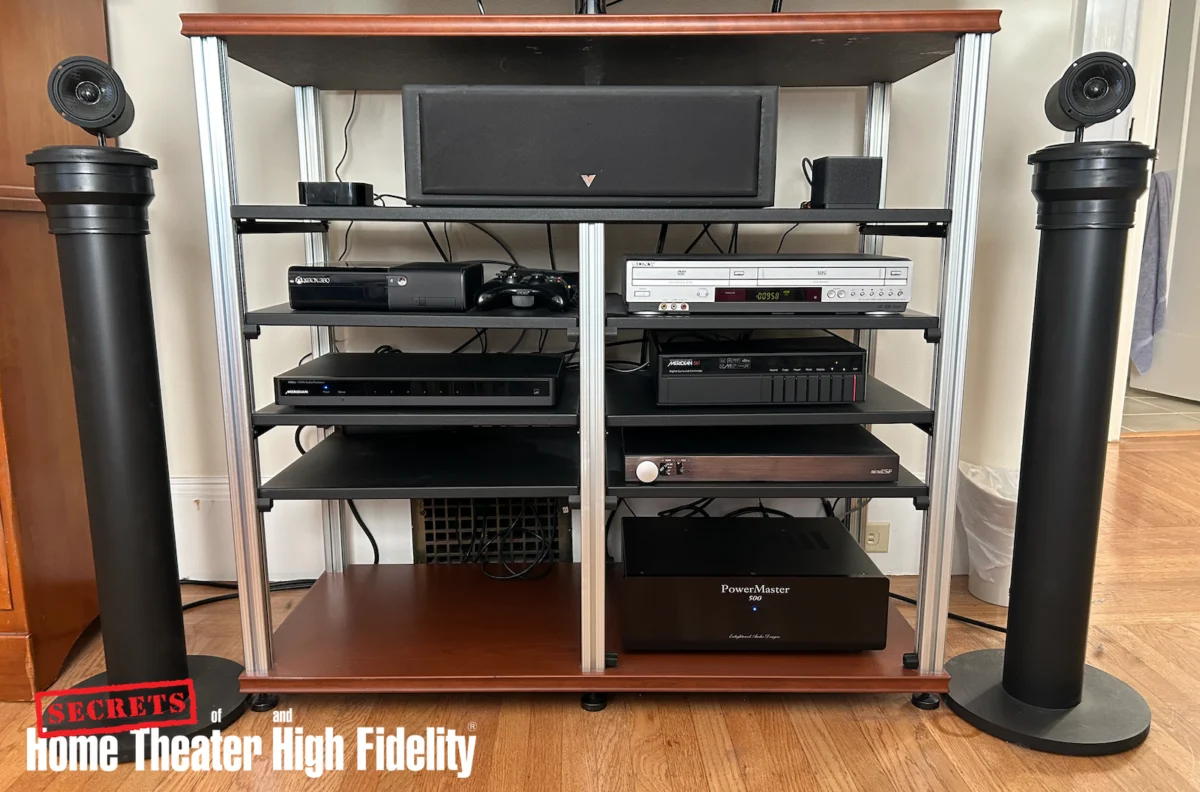
A common misconception in the audiophile community is that small loudspeakers require massive power reserves. While the LXmini does not need thousands of watts, it does require a high-current, low-distortion signal. For this build, the Enlightened Audio Designs (EAD) Powermaster 500—a legendary 5-channel amplifier from the early 2000s—was selected.
At the heart of the PM500 lies the Texas Instruments LM3886, a "chipamp" integrated circuit that has earned a cult following for its exceptional linearity and low noise floor. By operating two LM3886 chips in parallel per channel, the PM500 delivers 100 watts per channel of clean, Class AB power.
Technical measurements confirm that the PM500 maintains textbook performance well beyond the human range of hearing, reaching up to 200kHz. Because the amplifier utilizes a shared power supply, it exhibits a "borrowing" effect; when only four of the five channels are utilized for the LXmini’s stereo configuration, the remaining power rail overhead allows the active channels to achieve higher transient peaks without clipping. This provides the dynamic headroom necessary to handle complex musical passages with ease.
The Crossover Strategy: DSP as the Equalizer
The "magic" of an active loudspeaker lies in the control afforded by Digital Signal Processing. Traditional passive speakers are often limited by the physical constraints of capacitors and inductors. With a DSP crossover, the signal can be shaped with mathematical precision.

In this setup, the miniDSP 4x10HD served as the primary processing engine. While the 4x10HD has since been succeeded by more modern hardware like the miniDSP Flex HTx, its ability to handle Infinite Impulse Response (IIR) biquad filters remains perfectly suited to the LXmini requirements. The 4x10HD allows for a direct, clean digital path that preserves the transient speed of the drivers. For those embarking on this journey today, the miniDSP 2×4 HD or the more contemporary Flex series offer identical functionality at a lower cost, proving that entry into high-performance active audio has become increasingly accessible.
Official Guidance and Tuning Protocols
Linkwitz provides purchasers of the LXmini kit with a proprietary set of crossover and parametric EQ configurations. These settings are a critical component of the kit’s value proposition.
Why Tuning is Non-Negotiable
The LXmini’s open-baffle design is its greatest sonic strength, but it presents unique challenges. Drivers operating in "free space" lack the containment of a traditional box, leading to significant cancellation effects and frequency response anomalies. The provided DSP configurations are engineered to mathematically compensate for these interactions.
To achieve the intended sound signature, one must utilize the full suite of available filters in the DSP software. This includes:

- High-Pass/Low-Pass Crossovers: Defining the exact handover frequency to ensure a seamless transition between the tweeter and woofer.
- Parametric EQ: Applying large-scale corrections to the driver’s frequency response to flatten the output.
- Global EQ: Adjusting the overall system balance to suit the specific acoustics of the listening space.
While the learning curve for DSP software can be steep, the result—a linear, phase-coherent, and transparent soundstage—is unparalleled.
Implications: The Quest for Bass and Future Expansion
Upon the initial connection of the LXminis, the performance was immediately impressive, characterized by clarity and an expansive soundstage. However, as is common with small-diameter drivers, the low-end extension begins to roll off naturally at 50Hz.
Managing Low-Frequency Extension
To mitigate this, a subtle 5dB boost at 40Hz was applied via the DSP. While this restored a degree of low-frequency "weight," it is a temporary solution. Because boosting frequencies at the bottom of a driver’s range increases excursion requirements, it must be managed carefully to avoid exceeding the power handling limits of the drivers.
The ultimate solution for the LXmini user is the integration of the optional LXsub2 dipole woofers. By adding these units, the system evolves into a true 3-way setup, physically offloading the deep bass reproduction to dedicated woofers. Furthermore, the importance of a mechanical break-in period cannot be overstated; the driver suspensions require time to loosen, and utilizing low-frequency material over a 24-48 hour period significantly improves the system’s linearity and bass response.

Conclusion: The Path Forward
The transition from a finished wood kit to a calibrated high-end audio system is a technical endeavor, yet it is one that rewards the user with a level of sonic transparency rarely found in passive speakers at any price point. By leveraging the power of the EAD amplification and the surgical precision of miniDSP processing, the LXmini demonstrates that with the right data and a disciplined approach to tuning, the DIY enthusiast can achieve performance that rivals, and often exceeds, high-end commercial offerings.
In the next installment of this series, we will move beyond the initial setup to perform in-depth room measurements and subjective listening tests, exploring how the LXmini handles diverse musical genres and how it responds to the final, fine-tuned adjustments that separate a "good" system from a "great" one.