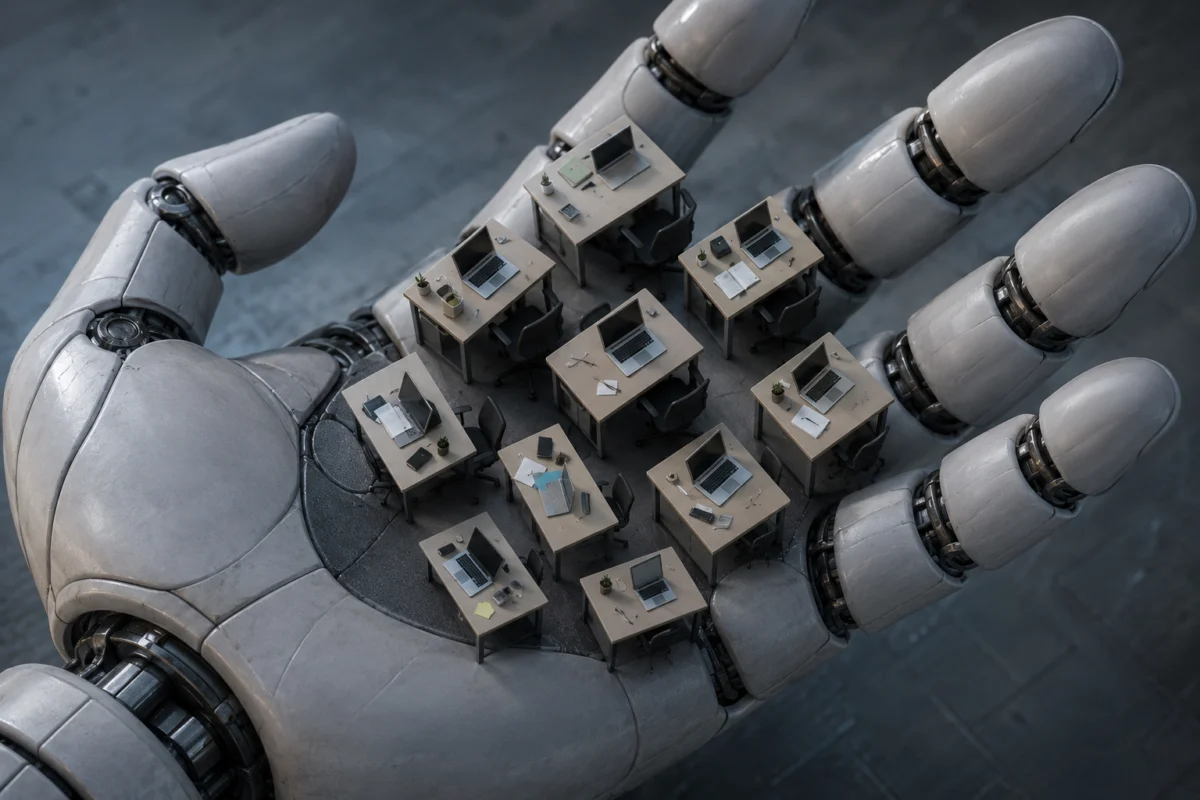
The technology sector is currently navigating a profound and often contradictory transformation. While the industry continues to report robust growth, record-breaking revenues, and soaring stock valuations, a parallel trend has emerged that is reshaping the modern workforce: the systematic, large-scale reduction of human staff in favor of artificial intelligence.
Oracle’s latest annual regulatory filing has served as a sobering inflection point for this movement. The software giant disclosed on Monday that it has reduced its global workforce by 21,000 employees over the past 12 months—a 13% contraction that exceeded previous market estimates. In its filing, Oracle explicitly linked this culling to the bottom line, stating, “The adoption and deployment of AI technologies across our operations have resulted, and may continue to result, in reductions to our workforce.”
This admission confirms what many analysts have suspected for months: AI is not merely a tool for augmenting productivity; it is being used as a primary lever for operational restructuring and cost-cutting, even at companies that are ostensibly thriving.
The Chronology of the "AI Pivot"
The scale of these reductions is not isolated to Oracle. Throughout 2026, a "who’s who" of the technology sector has engaged in significant layoffs, citing AI integration as a foundational rationale. The following timeline tracks the most significant workforce reallocations seen this year:
2026 Workforce Reductions: A Summary
- GitLab (June 3): Cutting 14% of its staff (approx. 350 roles) to pivot toward agentic AI infrastructure, aiming for "100x growth" in capacity.
- Google (Ongoing, through May): Utilizing a rolling performance review and voluntary buyout process, estimates suggest between 1,500 and 3,000+ engineers have been cut, particularly in the Cloud and security divisions.
- Intuit (May 20): Eliminated 3,000 roles (17% of staff) to prioritize AI-driven product simplification.
- Meta (May 20–21): Reduced headcount by 8,000 (10%), while simultaneously shifting 7,000 employees into new, AI-specific roles.
- Cisco (May 14): Despite record revenues, the company cut 4,000 jobs (5%) to realign resources toward silicon, optics, and AI development.
- Cloudflare (May 7–8): Cut 1,100 roles (20%), targeting middle management and administrative functions that the company deemed "obsolete" due to AI automation.
- General Motors (May 12): Eliminated 500–600 IT jobs, citing a need to transform organizational structure for an AI-centric future.
- Coinbase (May 5): Cut 700 roles (14%), adopting a "one-person team" structure enabled by AI-assisted coding velocity.
- PayPal (May 5): Announced plans to cut 4,500 jobs (20%) over the next three years to implement AI across customer service and risk management.
- Microsoft (April–May): Initiated voluntary separation programs, with executive leadership signaling further headcount declines as AI investment intensifies.
- Snap (April 16): Cut 1,000 roles (16%), citing AI’s ability to reduce repetitive tasks and increase speed.
- IBM (Rolling): Between late 2025 and April 2026, cumulative cuts exceed 15,000, with AI agents replacing approximately 200 HR positions.
- Atlassian (March 11): Cut 1,600 roles (10%) to rebalance the organization toward AI and enterprise sales.
- Dell (Jan 30): Workforce shrank by 11,000 roles (10%) over the fiscal year as the company shifted focus to AI-optimized server revenue.
- Block (Feb 26–27): Cut 4,000 roles (nearly 50% of staff), with CEO Jack Dorsey claiming that smaller, AI-empowered teams represent the future of company building.
- Salesforce (Feb 10): Continued staff reductions, particularly in support roles, as AI agents handle an increasing volume of customer queries.
- Amazon (Jan 28): Eliminated 16,000 corporate jobs, following a similar reduction in late 2025, to remove "bureaucracy" via AI-driven efficiency.
The Data Behind the Disruption
The data provided by firms such as Challenger, Gray & Christmas indicates that May 2026 saw the highest single-month total for tech layoffs in years. Crucially, "AI" has overtaken traditional economic headwinds—such as inflation or interest rate volatility—as the most-cited reason for these decisions.
However, a deeper look at the financials reveals a paradox. For instance, Cisco reported better-than-expected profits and revenue in May, yet still proceeded with a 4,000-person layoff. Similarly, Cloudflare reported record-high quarterly revenues of $639.8 million, only to lay off 20% of its workforce days later. This suggests that the current wave of layoffs is not a response to financial distress, but rather a proactive strategy to "lean out" companies in anticipation of a new AI-enabled operating model.
Official Responses and Corporate Rationale
Corporate leadership is framing these cuts as a necessary evolution rather than a simple cost-saving measure. The messaging across the industry shares common themes: removing "organizational layers," eliminating "bureaucracy," and achieving "velocity."
- Jack Dorsey (Block): "I think most companies are late. Within the next year, I believe the majority of companies will reach the same conclusion and make similar structural changes."
- Marc Benioff (Salesforce): Emphasized that because of the efficiency of "Agentforce," the company no longer needs to backfill support engineer roles, explicitly stating the company needs "less heads."
- Mark Patterson (Cisco CFO): Clarified that the layoffs were "not a savings-driven restructure," but rather an attempt to pivot resources toward core growth areas like AI and security.
These statements suggest that CEOs are using the current AI hype cycle to aggressively trim middle management—a segment of the workforce often accused of slowing down corporate agility.
Implications for the Future of Work
The widespread adoption of this "AI-first" workforce strategy carries significant, long-term implications for the tech industry and the broader economy.
1. The End of the "Hiring Surge" Era
Many of the roles currently being eliminated were created during the pandemic-era hiring boom. Critics of these layoffs argue that companies are using AI as a convenient scapegoat to correct for over-hiring in 2020–2022. By framing these as "AI-driven" cuts, firms can maintain investor confidence while correcting past operational bloat.
2. The Shift in Skill Requirements
The nature of employment is shifting away from repetitive, administrative, or entry-level technical tasks. Companies like IBM and Coinbase are hiring for AI-specialized roles while simultaneously automating the roles that previously served as the "entry point" for junior staff. This creates a potential "skills gap" where the junior-level experience required to become a senior engineer is being automated away.
3. Structural Fragility
By flattening management layers and relying on "agentic workloads," companies are testing the limits of organizational structure. While the immediate effect is a leaner, more profitable company, the long-term impact on culture, mentorship, and employee morale remains an open question. Reports from inside Meta’s AI units suggest that the transition has been "soul-crushing" for some engineers, highlighting the potential for burnout and cultural erosion.
4. The "Powder Keg" Effect
As more companies follow the "Block model"—drastically reducing staff in the belief that AI can replace human output—the industry risks creating a volatile environment. If AI-driven productivity gains do not materialize at the scale promised, these companies may find themselves understaffed, lacking the institutional knowledge that was discarded during the transition.
Conclusion
The "AI Layoff Wave" is, at its core, a test of whether artificial intelligence can truly replace human labor in complex, professional environments. As Oracle and others push forward with these aggressive restructurings, the tech sector is effectively conducting a massive, real-time experiment on the value of human capital in the age of automation. Whether this leads to a new golden age of efficiency or a period of structural instability remains to be seen, but one thing is clear: the relationship between technology and the workforce has been permanently altered.