As of July 2026, the global podcasting industry has officially solidified its status as a multi-billion-dollar juggernaut, with total valuation hitting a staggering $9.2 billion. For years, analysts struggled to quantify the true scale of the medium, often relying on fragmented metrics that excluded significant revenue channels. However, the release of the second edition of the Global Podcast Economy Report by Owl & Co has finally provided a comprehensive, audited roadmap of this booming sector.
This report marks a turning point in media economics, moving beyond simple advertising revenue to include the holistic ecosystem of video podcasting, subscription models, and diversified consumer revenue streams.
Main Facts: A New Economic Benchmark
The $9.2 billion figure is not merely a headline; it is a calculated reflection of a maturing market. The Global Podcast Economy Report is currently recognized as the industry’s most rigorous analytical tool, cited by top-tier financial publications such as Bloomberg and Forbes.
The core of the report’s methodology lies in its analysis of five distinct revenue streams:
- Direct Advertising: Traditional spot-buys and host-read sponsorships.
- Dynamic Insertion: The scaling of programmatic revenue.
- Video Integration: The rapidly growing monetization of podcasts on platforms like YouTube.
- Subscription/Premium Content: Direct-to-consumer revenue via platforms like Apple Podcasts, Spotify, and Patreon.
- Ancillary Revenue: Merchandise, live event touring, and intellectual property (IP) licensing.
For too long, the industry relied on outdated models that ignored the "long tail" of independent creators and the surging transition of audio-first content into visual mediums. By accounting for these previously overlooked variables, the report offers a granular view of how money flows through the podcasting value chain.
Chronology of Industry Maturation (2024–2026)
The journey to a $9.2 billion valuation did not happen overnight. The following timeline tracks the critical shifts that allowed the industry to scale at this velocity:

- Q1 2024: Major platforms shift their focus from aggressive user acquisition to "creator monetization." The pivot from exclusive licensing deals to open-ecosystem support begins to bear fruit.
- Q3 2024: The "Video-First" movement accelerates. Advertisers begin to treat video podcasts with the same budget priority as traditional television spots.
- Q1 2025: The first Global Podcast Economy Report is published, highlighting the massive, previously hidden value in the consumer-revenue (subscriber) segment.
- Q3 2025: A wave of mergers and acquisitions (M&A) signals a consolidation of the middle-market, as enterprise-level investors seek to own the "long tail" of niche, high-engagement content.
- July 2026: The second edition of the Global Podcast Economy Report is released, confirming the $9.2 billion milestone and providing deep-dive data on deal valuations and revenue multiples.
Supporting Data: Understanding the "Long Tail" and M&A Activity
The Subscriber Edition of the report offers a look behind the curtain for institutional investors and industry leaders. One of the most significant takeaways is the stability of the "long tail"—the millions of smaller podcasts that, in aggregate, command a significant portion of the total listening market.
M&A Trends and Valuations
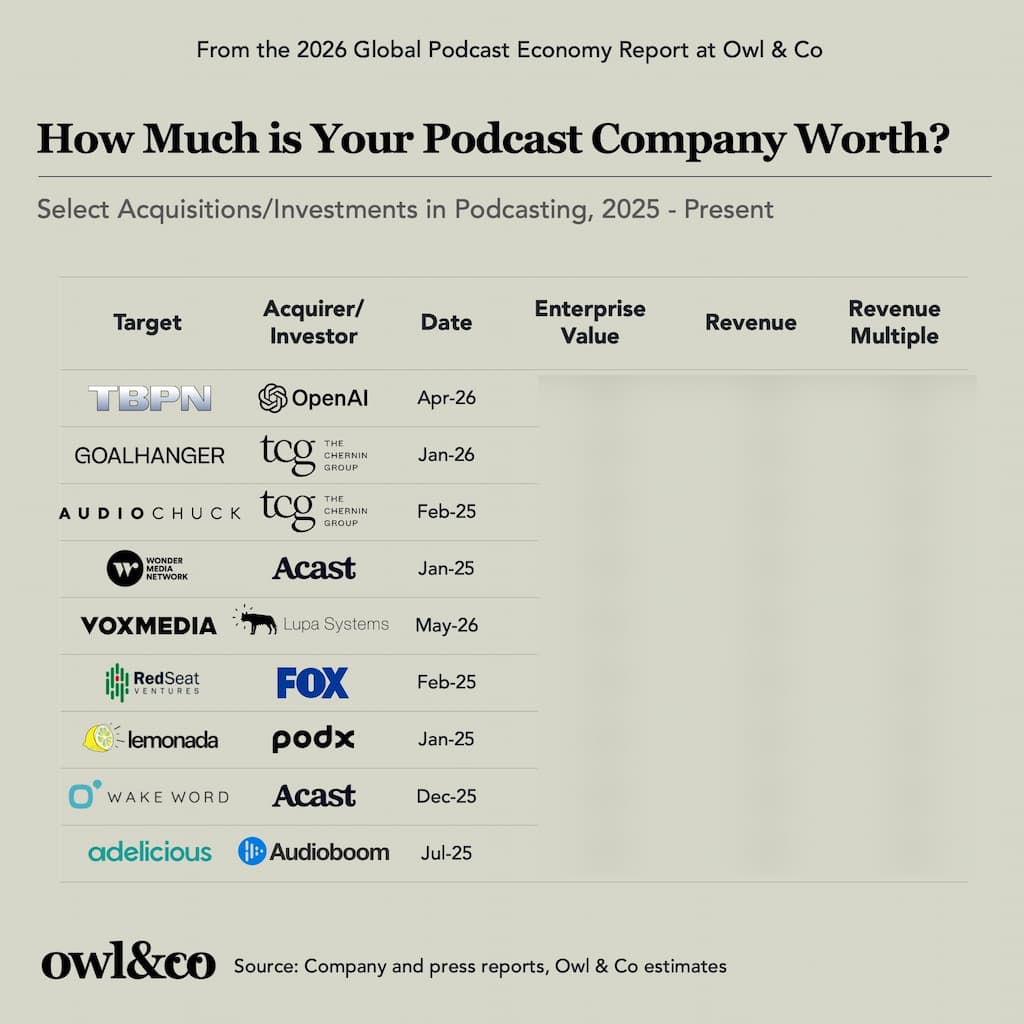
Over the past 16 months, the report highlights a specific trend in podcasting M&A: the premium placed on community-driven content. Unlike traditional media, where mass reach is the primary driver of enterprise value, podcast companies are now commanding high multiples based on listener loyalty and data sovereignty.

The report details:
- Revenue Multiples: How enterprise buyers are calculating the future value of podcast networks.
- Deal Structures: A shift away from "talent-heavy" contracts toward "IP-ownership" structures.
- Valuation Drivers: Why certain companies—despite having lower download numbers than their peers—are fetching higher prices during acquisition.
Implications for the Future of Media
The validation of a $9.2 billion market has profound implications for creators, advertisers, and tech platforms.

For Creators: The Professionalization of the Medium
The data confirms that the "bedroom creator" is increasingly a relic of the past. As the industry matures, the barrier to entry has evolved from technical knowledge to business acumen. Creators who leverage multi-platform distribution (audio + video) and diversify revenue streams are not only surviving but thriving. The success of podcasts like The Sound Off and Podnews Weekly Review underscores a trend: content that provides value, community, and expert insight is the most resilient against market volatility.
For Advertisers: Precision over Volume
The "spray and pray" approach to podcast advertising is dead. With the emergence of better data, brands are now looking for high-intent audiences. The growth of niche categories—such as the education and astronomy segments highlighted in recent charts—shows that advertisers are willing to pay premiums for audiences that are deeply invested in specific subject matter.

The Role of Technology Platforms
Platforms like Apple Podcasts and Spotify remain the primary gatekeepers, but the landscape is shifting. The apparent growth of platforms like Overcast suggests that listeners are increasingly seeking specialized, high-performance user experiences. Furthermore, the challenges faced by companies like Microsoft (as discussed in Windows Weekly regarding the future of the Xbox unit) serve as a cautionary tale for the media industry: the reliance on hardware or monolithic platforms is risky. The podcasting industry’s strength lies in its decentralized, open-standard nature (RSS), which provides a layer of protection that walled-garden social media platforms lack.
Official Industry Perspectives and Notable Developments
The current news cycle is dominated by a mixture of macro-economic optimism and micro-level innovation.

The Windows Weekly Case Study
A recent episode of Windows Weekly highlighted a critical trend: the impact of layoffs on corporate strategy. With 4,800 layoffs at Microsoft, observers are questioning the viability of the company’s gaming unit. This discourse reflects the broader economic reality: even giants are tightening their belts, yet the demand for high-quality audio content remains unshakeable.
Milestone Moments
The One Minute Podcast Tips show recently celebrated its 150th episode, featuring an all-star roster of industry experts. This milestone is emblematic of the "creator-to-creator" support network that defines the industry. By sharing best practices, creators are effectively raising the floor of the industry’s quality, making it a more attractive environment for advertisers and listeners alike.

Crisis Simulations and Serious Content
The success of shows like Ernstfall – What if Russia Attacks NATO? demonstrates the public’s appetite for deep-dive, serious, and intellectually demanding content. By simulating complex geopolitical crises, these podcasts are filling a void left by traditional news media, which is often constrained by time slots and soundbite journalism. The fact that such a niche, high-stakes topic is gaining traction in an English-language market proves that audiences are willing to invest hours of their time into complex audio storytelling.
Conclusion: A Maturing Asset Class
The podcasting industry has transitioned from an experimental medium to a fundamental pillar of the global media economy. With a valuation of $9.2 billion, it has outgrown the "niche" label and now stands shoulder-to-shoulder with other digital media sectors.

For those operating within the space—whether as independent creators, network heads, or advertisers—the message from the 2026 data is clear: the industry is no longer about just "growing the audience." It is about deepening the relationship with the audience. The companies and individuals that succeed in the next five years will be those who treat their content not just as a stream of audio, but as a robust, multi-faceted business enterprise.
As the industry moves forward, the Global Podcast Economy Report will undoubtedly remain the primary barometer for growth. For stakeholders, the opportunity now lies in capitalizing on the data-driven insights provided in the report to optimize their positions in this thriving, $9.2 billion economy. The era of guessing the value of podcasting is over; the era of scaling it has arrived.