BUENOS AIRES, ARGENTINA — In the high-stakes world of international film scoring and multimedia composition, the environment in which a creator works is as vital as the instruments they play. This philosophy has reached a new pinnacle in Argentina with the unveiling of Swing Music 2.0, a dual-studio creative complex designed by the world-renowned Walters-Storyk Design Group (WSDG).
The project represents a renewed collaboration between WSDG and the celebrated Argentine composing-producing duo Andres Goldstein and Daniel Tarrab. Years after their initial partnership created the first iteration of Swing Music, the partners have returned to the drawing board to address the seismic shifts in media production workflows. The result is a bespoke environment that blends cutting-edge technical integration with a deeply personal aesthetic, ensuring that Buenos Aires remains a global hub for world-class soundtrack production.
Main Facts: A New Benchmark for Latin American Production
Swing Music 2.0 is not merely a renovation; it is a ground-up reimagining of how modern composers interact with technology and space. Led by WSDG Senior Partner and Co-CEO Sergio Molho, the project focuses on two distinct studio environments: Swing Godoy Cruz (Goldstein’s workspace) and Swing Control Z (Tarrab’s workspace).
While both studios are housed within the same complex and maintain a unified architectural language, they are meticulously tailored to the individual artistic personalities of their owners. The facility is designed to handle every stage of the modern audio lifecycle—from initial thematic sketching and MIDI programming to live tracking, intricate editing, final mixing, and high-bandwidth remote collaboration with directors and orchestras worldwide.
Key Project Highlights:
- Lead Designers: WSDG (Walters-Storyk Design Group).
- Project Leadership: Sergio Molho (Co-CEO).
- Primary Users: Andres Goldstein and Daniel Tarrab.
- Core Focus: Film, television, and multimedia composition.
- Services Provided: Acoustic design, technical systems integration, lighting design, and interior architecture.
Chronology: From Swing 1.0 to the Multimedia Future
The journey to Swing Music 2.0 is a testament to a long-standing professional relationship. To understand the significance of the new facility, one must look at the trajectory of Goldstein and Tarrab’s careers and the evolving needs of the industry.
The Foundation (The Early Years)
Decades ago, Goldstein and Tarrab established themselves as the premier composers in Argentina, winning accolades for their work on iconic films such as The Official Story (La Historia Oficial) and XXY. Their first collaboration with WSDG resulted in a studio that served them well during the transition from analog-heavy workflows to early digital workstations.
The Catalyst for Change (2020–2025)
As the 2020s progressed, the demands of the industry shifted. The rise of streaming platforms (Netflix, Amazon, Disney+) necessitated faster turnaround times and more complex deliverables, including immersive audio formats and high-definition remote session streaming. The "old" way of working—moving between separate tracking rooms and mixing suites—began to feel cumbersome.
The Vision for 2.0 (2025–2026)
In 2025, the decision was made to consolidate their operations into a more streamlined, "all-in-one" environment. They reached out to Sergio Molho and WSDG to design a space that could handle "very long creative sessions" without causing ear fatigue or creative burnout. Construction and technical integration took place throughout late 2025 and early 2026, culminating in the official launch in June 2026.
Supporting Data: Technical Integration and Bespoke Design
WSDG’s approach to Swing Music 2.0 was holistic. The firm was tasked with balancing the technical "coldness" of modern computers with the "warmth" required for creative inspiration.
Swing Godoy Cruz: The Hybrid Powerhouse
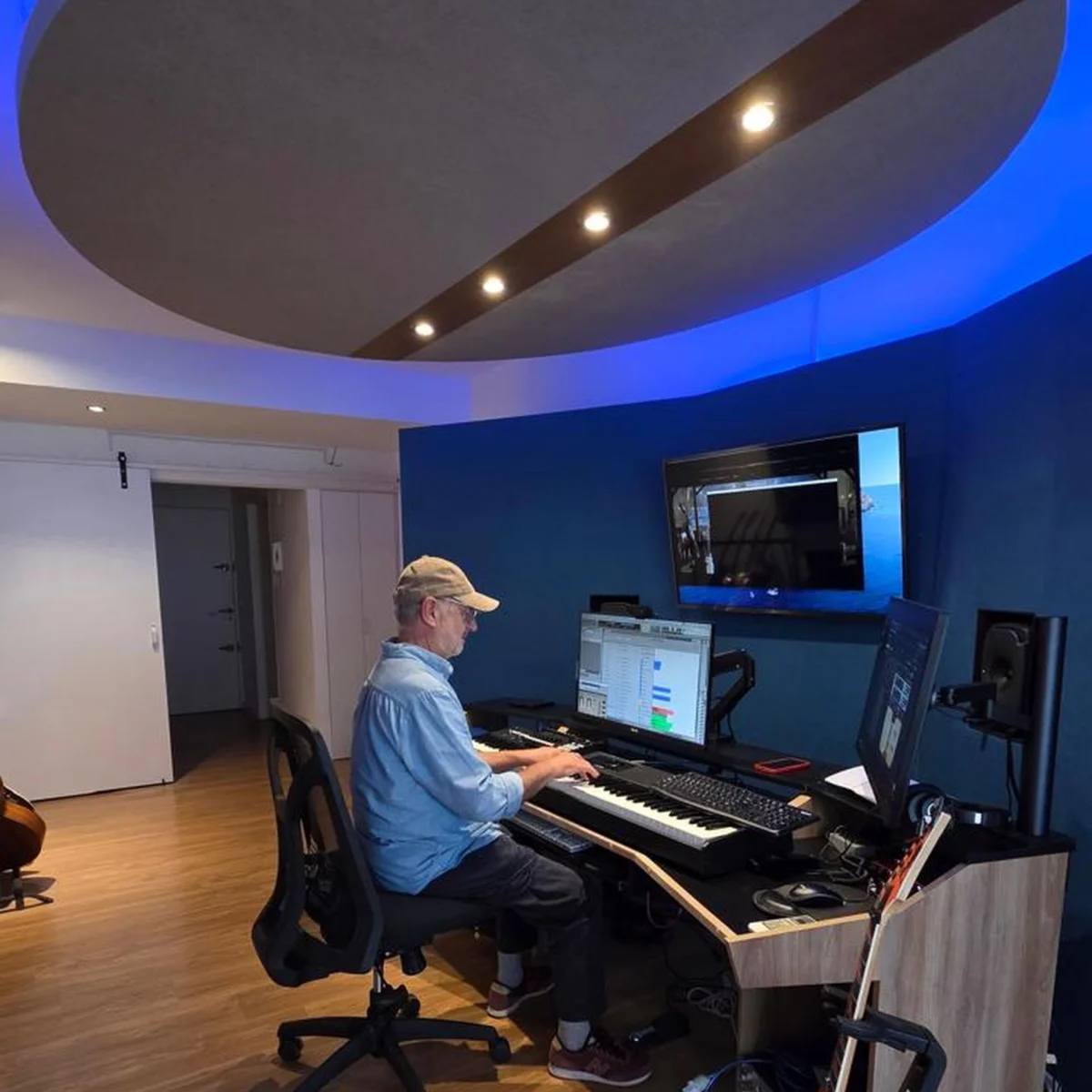
Andres Goldstein’s studio, Swing Godoy Cruz, is a masterclass in hybrid scoring. It is designed for a composer who needs massive processing power at his fingertips while maintaining an ergonomic physical layout.
- Computing: A dual-computer setup featuring a master Mac system for the Digital Audio Workstation (DAW) and a dedicated Mac slave specifically tasked with hosting massive orchestral sound libraries (Vistual Instruments).
- Monitoring: Genelec 8331A Three-Way Coaxial Monitors. These are part of Genelec’s "The Ones" series, chosen for their pinpoint imaging and ability to deliver accurate sound in the near-field, which is essential for long composing sessions.
- Outboard Gear & I/O: The signal path includes a Focusrite Scarlett 4th Gen interface for low-latency conversion and an Avalon compressor for adding analog character to vocal or instrument overdubs.
- Control: A Studiologic control surface and keyboard controller provide tactile feedback, bridging the gap between the virtual and physical worlds.
Swing Control Z: The Instrumentalist’s Sanctuary
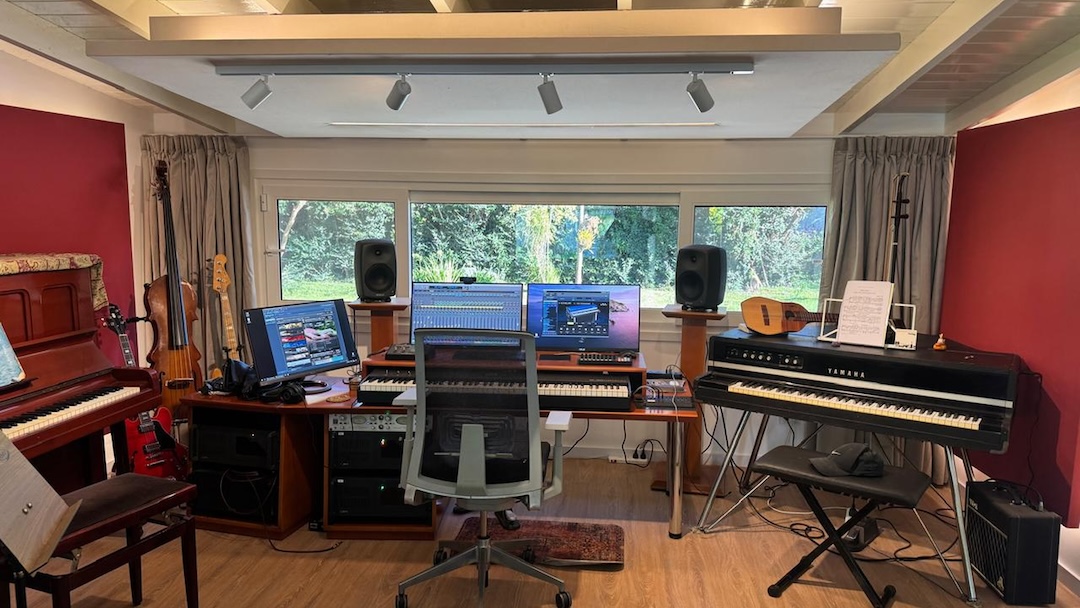
Daniel Tarrab’s Swing Control Z takes a different approach, leaning heavily into a collection of curated vintage and modern instruments.
- Acoustic Centerpiece: A 1905 Steinway & Sons Vertegrand piano, which provides a unique, "lived-in" sonic character that modern samples often struggle to replicate.
- Vintage Tech: The studio houses a Yamaha CP70 electric grand piano, a Fender Jazz Bass, and a variety of Epiphone guitars.
- Technical Specs: Monitoring is handled by Genelec 8040A speakers. The recording chain is elite, featuring an Avalon AD2022 dual-mono preamplifier and an SSL 2+ interface.
- Microphone Locker: Both studios share access to industry standards, including the Neumann U87 and AKG 414, ensuring that any live element—from a solo cello to a voiceover—is captured with pristine clarity.
Architectural and Acoustic Innovations
WSDG implemented advanced acoustic treatments that are invisible to the untrained eye but essential to the room’s performance.
- Low-Frequency Control: Custom-designed bass traps were integrated into the room’s geometry to ensure a flat frequency response, preventing "muddiness" in the low end.
- Variable Lighting: A sophisticated lighting design allows the composers to change the mood of the room instantly, moving from "bright and clinical" for technical editing to "warm and moody" for creative composition.
- Ergonomics: Furniture was custom-built to ensure that screens, controllers, and instruments are all within the "golden triangle" of reach, minimizing physical strain.
Official Responses: A Partnership of Sensitivity
The success of the project stems from the deep mutual respect between the clients and the design team.
Andres Goldstein emphasized the necessity of the upgrade:
"Over the years, the way we work has evolved enormously. We needed spaces that could support very long creative sessions, allow us to move quickly between different stages of production, and still feel inspiring and comfortable every day. WSDG understood that immediately and translated it into rooms that genuinely support the creative process."
Daniel Tarrab highlighted the emotional resonance of the design:
"Working with Sergio and the WSDG team felt incredibly collaborative from beginning to end. There was a real understanding that these studios were not just technical rooms, but creative environments where ideas need to flow naturally. That level of sensitivity made a huge difference."
Sergio Molho, speaking on behalf of WSDG, noted the challenge of the dual-identity project:
"Our goal was to create a cohesive identity for Swing Music while respecting the fact that Andres and Daniel have unique workflows. It wasn’t about building two clones; it was about building two distinct instruments that happen to play in the same orchestra."
Implications: The Future of Globalized Post-Production
The completion of Swing Music 2.0 has broader implications for the South American music industry and the global film market.
1. The Rise of the "Boutique" High-End Studio
The industry is moving away from massive, multi-room commercial complexes toward "boutique" private environments that offer the same technical specs as a major studio but with the intimacy of a private creative suite. Swing Music 2.0 is a prime example of this trend, proving that world-class scores don’t require a 5,000-square-foot facility if the acoustics and technology are perfectly optimized.
2. Remote Collaboration as a Standard
With high-speed data links and integrated remote-monitoring tools, Goldstein and Tarrab can now collaborate with directors in Los Angeles, London, or Madrid in real-time. The acoustic accuracy of their new rooms ensures that what they hear in Buenos Aires is exactly what the director will hear on a Hollywood dubbing stage.
3. Economic and Cultural Impact
By investing in such high-level infrastructure, Swing Music cements Buenos Aires’ reputation as the "Paris of the South" for the arts. It attracts international projects to Argentina, providing work for local session musicians and engineers, and keeping the country at the forefront of the global "Orange Economy" (creative industries).
4. Technological Longevity
By choosing a hybrid setup—mixing the best of 1905 (the Steinway) with the best of 2026 (Genelec and high-end Mac systems)—Swing Music 2.0 is designed to be future-proof. The rooms are built to last decades, even as software continues to evolve.
In conclusion, Swing Music 2.0 is more than just a place to record audio; it is a meticulously engineered "creative engine." Through the combined vision of Goldstein, Tarrab, and the architectural mastery of WSDG, it stands as a beacon of what is possible when acoustic science meets artistic passion.