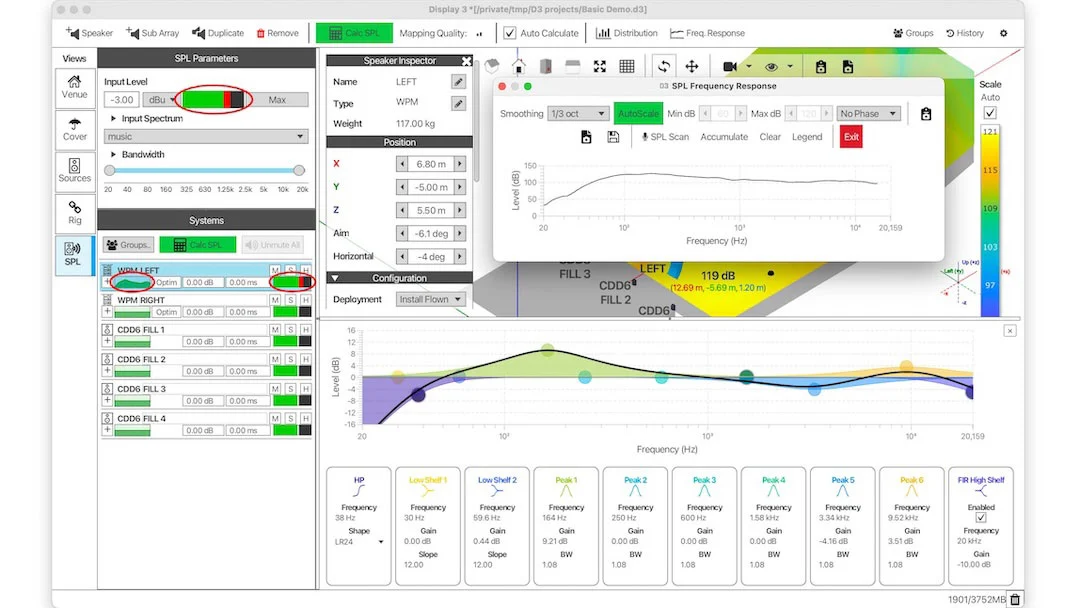
NEW YORK, NY — In the high-stakes world of professional live sound reinforcement, the gap between a digital simulation and real-world acoustic performance is often where a production succeeds or fails. Today, Martin Audio officially bridged that divide with the launch of Display 3, a major evolution of its proprietary prediction and optimization software. Designed to streamline the workflow for system engineers and venue integrators, the release promises a leap forward in speed, granular control, and predictive accuracy, boasting a tolerance within ±1dB of real-world results.
The Evolution of Precision: Main Facts
The introduction of Display 3 is not merely an incremental update; it represents a comprehensive overhaul of the underlying engine that powers Martin Audio’s Wavefront Precision (WP) line array series. The core mission of the software remains the same—to harmonize mechanical array geometry with advanced DSP filtering—but the execution has been fundamentally accelerated.
For the touring engineer or the fixed-install integrator, Display 3 offers a centralized hub for managing complex venue acoustics. By automating the configuration process against user-defined SPL (Sound Pressure Level) and frequency response targets, the software removes the guesswork that often plagues large-scale system deployments. Perhaps most notably, the software now facilitates a uniform "tonal signature" across the entire Wavefront Precision series, ensuring that whether a venue utilizes a compact WP system or a massive stadium-grade array, the sonic character remains consistent from the front row to the back balcony.
A Chronology of Development
The road to Display 3 was paved by months of rigorous beta testing, involving a select group of global production partners and acoustic consultants. Martin Audio’s development team spent the better part of 2026 analyzing feedback from the field, specifically targeting the bottlenecks associated with large-scale venue modeling.
- Early 2026: Initial architectural redesign of the prediction engine begins, focusing on parallel processing to reduce calculation times.
- Q2 2026: Beta versions are deployed to select rental houses and touring engineers to stress-test the "Hard Avoid" and "Don’t Care" algorithms in real-world scenarios.
- August 2026: Final optimization of the VU-NET integration to ensure a seamless handoff between design files and hardware deployment.
- September 21, 2026: Official global release of Display 3, available as a free download for Mac and Windows environments.
Technical Deep Dive: Supporting Data and Advanced Features
The technical sophistication of Display 3 lies in its ability to parse massive amounts of data in real-time, allowing designers to iterate through multiple configurations in seconds rather than minutes.
The "Don’t Care" and "Hard Avoid" Logic
One of the most requested features by system designers is the ability to intelligently ignore non-audience areas. The new "Don’t Care" designation allows users to highlight regions in a model—such as stage areas, off-site zones, or structural obstructions—where SPL and frequency response targets are irrelevant. By designating these as "Don’t Care," the optimization engine effectively ignores these zones, concentrating its DSP resources exclusively on the audience plane. This leads to more efficient array configurations and significantly cleaner sound projection.
Building on the company’s trademark "Hard Avoid" technology, Display 3 allows for an impressive 30dB of rejection in sensitive zones. This capability is vital in festivals or urban venues where noise spill must be strictly managed to comply with local sound ordinances or to keep the stage environment quiet for performers.
Managing Environmental Variability
Live sound is rarely static. Temperature, humidity, and audience density all play roles in how sound propagates through a space. Display 3 addresses this with the introduction of "Optimization Snapshots." Designers can now save multiple states within a single project file. For instance, an engineer can prepare a "Sound Check" snapshot (empty venue) and a "Showtime" snapshot (full audience), toggling between them instantly as the environment changes.
Enhanced Integration with VU-NET
The software ecosystem is completed by the concurrent update of VU-NET to version 2.3.5. This update is specifically designed for the "final mile" of deployment—the moments before the house lights go down.
- LED Mode: Allows for the remote illumination of cabinet LEDs, enabling technicians to verify the physical stacking order of an array from the floor.
- Mute Mode: Provides a safe, sequential way to step through each cabinet, ensuring that signal routing is verified without the need for high-SPL pink noise.
Official Perspectives: The Philosophy of Workflow
In the pro-audio industry, software is the bridge between art and physics. Martin Audio’s approach with Display 3 emphasizes that the tools should serve the engineer, not dictate to them. By integrating SketchUp for 3D modeling, Martin Audio has ensured that the learning curve for new users is minimized, while the depth of control remains sufficient for the most demanding acoustic challenges.
"The goal was to provide a workflow that mirrors the speed of modern production," noted a spokesperson for the company. "When you have ten minutes to make a decision in a stadium, you don’t need a tool that slows you down. You need a tool that gives you high-confidence results the first time."
Implications for the Industry
The release of Display 3 arrives at a time when the demands for sonic precision and safety are at an all-time high. The ability to pull diagnostic files directly from iKON amplifiers—which capture internal states, fault history, and protection logs—is a game-changer for production managers. It moves the industry toward a more proactive maintenance model. Instead of reacting to an amplifier failure during a show, a technician can check the diagnostic report during the morning load-in to see if a component is nearing its threshold or if an internal error has occurred.
Furthermore, the consistency provided by the software’s updated voicing algorithms suggests a move toward standardized sound quality. As venues become more acoustically challenging, the software’s ability to "sculpt" the sound away from reflective surfaces while maintaining punchy, clear audio in the audience area will likely set a new benchmark for system design.
Availability and Future Outlook
Display 3 is available today as a free download, reinforcing Martin Audio’s commitment to providing comprehensive support to its user base without additional licensing costs. For those utilizing the Wavefront Precision series, the update is essentially mandatory for any new project, as it unlocks the full potential of the latest DSP architecture.
As the industry moves toward 2027, the focus will likely shift toward further automation and AI-assisted acoustic modeling. With the foundational work done in Display 3, Martin Audio is well-positioned to lead this transition. By empowering engineers with data, speed, and reliability, the company is ensuring that no matter the complexity of the venue, the audience experience remains the priority.
For more information on the latest pro-audio developments, subscribe to the Mix SmartBrief or visit the Martin Audio official portal.