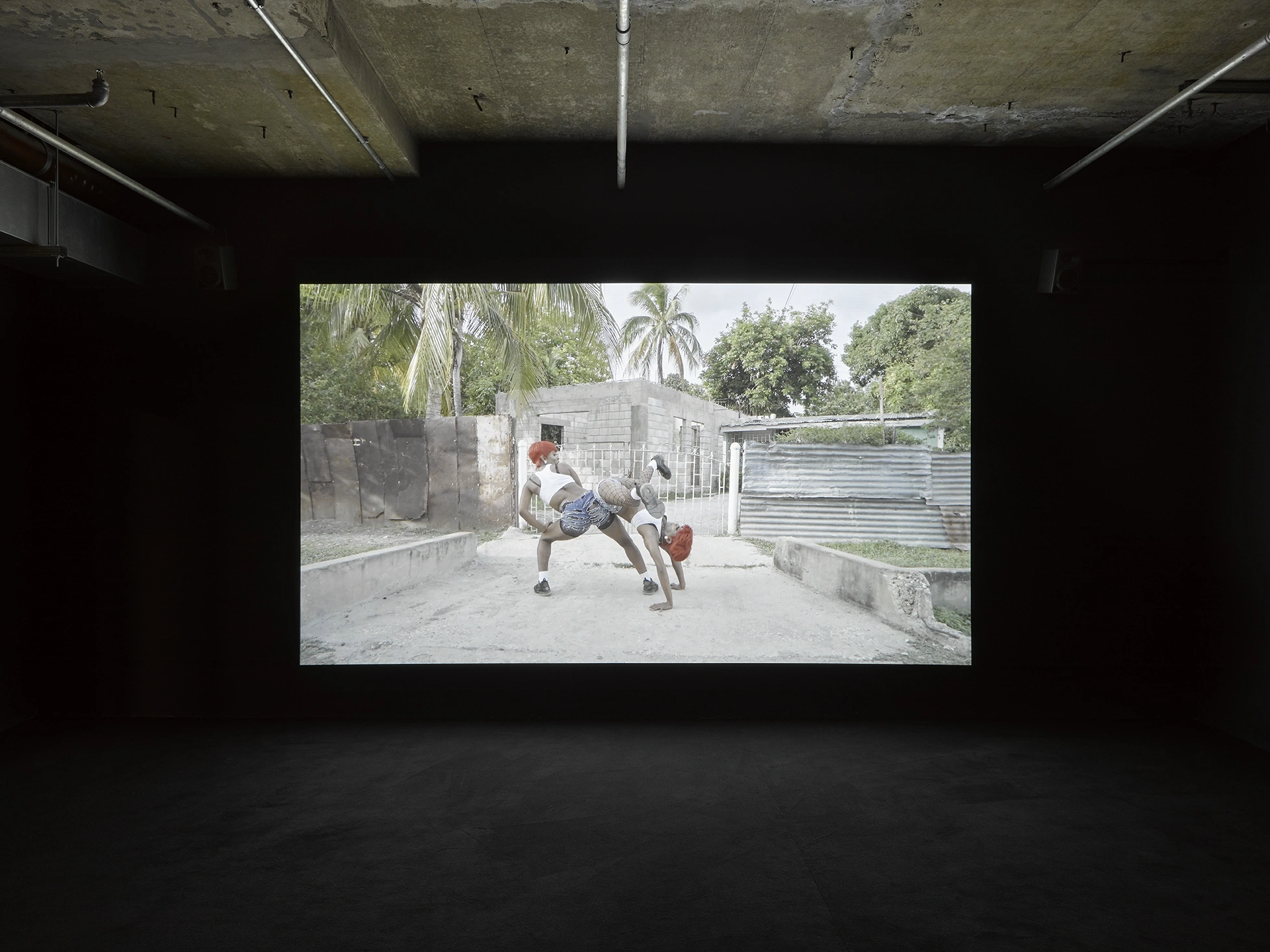
In the cavernous, industrial expanse of 180 Studios at 180 The Strand, London, a vibrant, kinetic energy pulses through the walls. As part of the sprawling The Vinyl Factory: Reverb exhibition, visitors are invited into a world far removed from the city’s concrete grey—the rhythmic, defiant, and deeply communal world of Jamaican dancehall. At the heart of this immersive experience is Shelly Belly Inna Real Life, a video installation by the Argentinian artist, choreographer, and dancer Cecilia Bengolea.
Shot on location in Jamaica between 2015 and 2019, the piece serves as both a documentary and a love letter to a culture that is often misunderstood or reduced to its aesthetics. By embedding herself within the scene and collaborating closely with dancehall icon Shelly Belly, Bengolea has crafted a work that interrogates the sociopolitical landscape of street dance, the tension between local communities and state authority, and the transcendent power of human movement.
The Genesis of an Intimate Portrait
Cecilia Bengolea is no stranger to the intersection of contemporary art and global street dance movements. Her work consistently pushes against the boundaries of traditional performance, preferring to exist in the liminal space between high-art gallery installations and the raw vitality of the club. Shelly Belly Inna Real Life represents the culmination of years of dedicated research and personal relationship-building.
The film follows the titular Shelly Belly—a legendary figure in the Jamaican dancehall circuit—as he navigates the streets, the dancefloors, and the social gatherings that define his existence. Bengolea’s lens is not that of a detached observer, but of a participant-witness. She captures the intricacies of the choreography—the specific, lightning-fast isolations and the gravity-defying maneuvers that characterize dancehall—while simultaneously providing a platform for the voices that animate this culture.
"Dancehall is not just a style; it is a life-force," Bengolea explains in a recent interview discussing the exhibition. "It is a language that communities have developed to articulate joy, pain, and resistance in the face of systemic adversity." By focusing on the "real life" aspect of her title, she strips away the performative gloss often associated with music videos, opting instead for a gritty, tender, and authentic exploration of the participants’ daily realities.
A Chronology of Collaboration: From Bom Bom to Shelly Belly
The relationship between Bengolea, The Vinyl Factory, and the world of dancehall is deep-rooted. To understand the significance of the current installation, one must look back to 2016, when Bengolea and her frequent collaborator, the British artist Jeremy Deller, presented Bom Bom’s Dream at The Infinite Mix exhibition.
The 2016 Foundation: Bom Bom’s Dream
In Bom Bom’s Dream, the duo explored the global reach of dancehall by following a Japanese dancer known as Bom Bom. The film highlighted the fascinating, almost surreal way in which dancehall has transcended its Jamaican origins to become a global phenomenon, adopted and adapted by dancers in Tokyo, Paris, and Buenos Aires. Even then, Shelly Belly served as a pivotal anchor, acting as a bridge between the local Jamaican practitioners and the international artists eager to learn from the source.

The 2015–2019 Fieldwork
The footage used in Shelly Belly Inna Real Life was captured over a rigorous four-year period. During this time, Bengolea transitioned from a guest to a trusted figure within the community. This sustained presence was essential to the project’s integrity. In documentary filmmaking, access is often the primary hurdle; by spending nearly half a decade in Jamaica, Bengolea moved beyond the superficial, gaining an intimate understanding of the unspoken codes, the hierarchy of the dance scene, and the precarious relationship between dancehall culture and Jamaican state authorities.
The Socio-Political Underpinnings of Dancehall
While the visuals of Shelly Belly Inna Real Life are undeniably mesmerizing—filled with fluid motion and vibrant textures—the exhibition’s intellectual core lies in its exploration of social context. Bengolea is deeply invested in the tension between the police and the dance community.
The Policing of Movement
In many of the regions where dancehall thrives, the act of dancing in public spaces is often subject to intense scrutiny or outright prohibition by law enforcement. Bengolea’s work highlights how the "curfew" and the policing of street parties act as a mechanism of control, attempting to suppress the very gatherings that foster collective identity.
"The police presence is a constant," Bengolea notes. "When you film these dancers, you aren’t just filming art; you are filming a act of defiance. Every movement is a reclamation of space." The dance floor becomes a sanctuary where the rules of the state are temporarily suspended, replaced by the rules of rhythm and mutual respect. This, she argues, is the essence of street dance: a survival strategy that uses the body as a primary tool for autonomy.
Data and Exhibition Logistics
The Vinyl Factory: Reverb is currently hosted at 180 Studios, a premier venue for multidisciplinary art in London. The exhibition is a testament to the power of audiovisual storytelling and serves as a major cultural anchor for the 2024–2025 season.
Exhibition Details
- Venue: 180 Studios, 180 The Strand, London, WC2R 1EA
- Duration: May 22, 2024 – March 2, 2025
- Scheduled Closure: The gallery will be closed for the winter break between December 23, 2024, and January 8, 2025.
- Visiting Hours:
- Wednesday – Saturday: 12:00 PM – 7:00 PM
- Sunday: 12:00 PM – 6:00 PM
- Note: Tickets are required and can be booked via the official 180 Studios website.
The curation of Reverb focuses on the synergy between sound, vision, and the physical experience of the spectator. By placing Shelly Belly Inna Real Life in a gallery space, the exhibition challenges the traditional hierarchy of the art world, elevating a street-born dance form to the same level as monumental sculpture or abstract film.
The Broader Implications for Art and Culture
The success of Shelly Belly Inna Real Life poses an important question for the contemporary art world: How can institutional spaces effectively platform subcultures without commodifying them?

Bengolea’s approach suggests that the answer lies in radical transparency and prolonged engagement. By documenting the individuals—not just the dance—she ensures that the subjects remain the protagonists of their own stories. The implications of this work extend to the broader field of ethnographic art. It serves as a blueprint for how artists can navigate the ethics of representation, moving away from the "outsider looking in" trope and toward a model of collaborative storytelling.
Furthermore, the exhibition highlights the importance of archiving. Dancehall, as an ephemeral and oral tradition, is notoriously difficult to preserve. By creating high-fidelity, large-scale video installations, Bengolea is effectively creating a digital archive of a culture that is in constant flux. Future generations will look to these works not just for the choreography, but as a historical record of the social conditions of Jamaica in the early 21st century.
Conclusion: A Living Legacy
As The Vinyl Factory: Reverb continues its run, Shelly Belly Inna Real Life remains one of its most compelling attractions. It reminds the viewer that art is not something that happens in a vacuum; it is a living, breathing entity that reacts to its environment.
Cecilia Bengolea has succeeded in distilling the complex, often chaotic energy of dancehall into a focused, powerful, and deeply human work. Whether you are a scholar of contemporary dance, a fan of Caribbean culture, or simply an art enthusiast looking for an immersive experience, the installation offers a vital, pulse-pounding insight into the human condition.
As the exhibition moves toward its close in March 2025, the legacy of this project will likely continue to reverberate. It has successfully bridged the gap between the street corners of Jamaica and the pristine white walls of London’s art institutions, proving that when the rhythm is real, it knows no borders.
For those planning to visit, the experience is best approached with an open mind and a willingness to be moved—not just by the images on the screen, but by the profound story of resilience and creativity that they represent.