STOW, OH – In a move that further solidifies the intersection of professional audio engineering and the burgeoning creator economy, Audio-Technica (A-T) has officially announced the launch of its 20 Series Control Application. This new software, specifically developed as a dedicated plug-in for the Elgato Stream Deck ecosystem, represents a significant leap forward in how content creators, streamers, and audio professionals interact with their hardware in real-time.
By integrating the control of high-fidelity USB microphones directly into the tactile interface of Elgato’s popular control surfaces, Audio-Technica is addressing a long-standing pain point for creators: the need to manage complex audio parameters without breaking character or interrupting the flow of a live broadcast.
Main Facts: A New Era of Tactile Audio Control
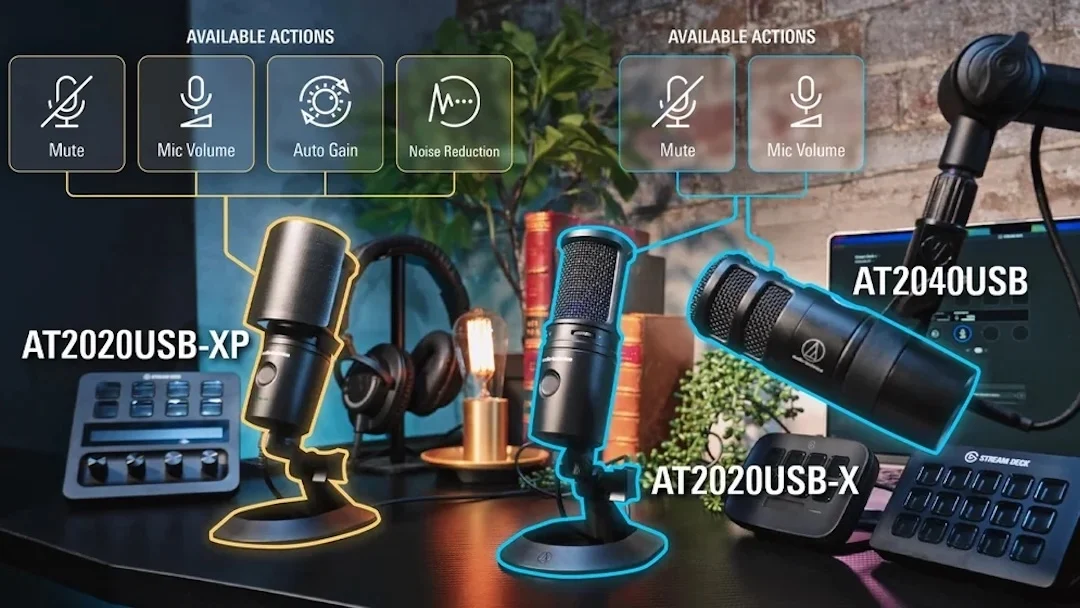
The Audio-Technica 20 Series Control Application is not merely a utility tool; it is a comprehensive software bridge designed to bring the granular control of a studio mixing console to the desktop of a home-based creator. The plug-in is compatible with three of Audio-Technica’s most popular digital transducers: the AT2020USB-X, the AT2040USB, and the feature-rich AT2020USB-XP.
Core Functionalities
The application allows users to map essential microphone functions to Elgato Stream Deck keys, rotary dials (on the Stream Deck +), and even foot pedals. Key features include:
- Instantaneous Mute/Unmute: A critical fail-safe for live environments.
- Virtual Fader Control: Precise, incremental adjustment of input gain and monitoring levels.
- Advanced DSP Access: For AT2020USB-XP users, the plug-in unlocks onboard Automatic Gain Control (AGC) and multi-level Noise Reduction directly from the Stream Deck interface.
- Workflow Customization: Drag-and-drop configuration through the Elgato Marketplace.
The launch underscores a broader industry trend where hardware manufacturers are increasingly relying on software integration to provide "quality of life" improvements that differentiate their products in a saturated market.
Chronology: The Evolution of the 20 Series and Digital Integration
To understand the significance of this launch, one must look at the timeline of Audio-Technica’s "20 Series"—a line that has become synonymous with the "prosumer" audio revolution.
2004–2015: The Analog Foundation
The original AT2020 was launched in 2004, quickly becoming the gold standard for entry-level studio condensers. It provided the "Audio-Technica sound"—transparent, detailed, and reliable—at a price point previously unheard of for a side-address condenser. For a decade, it was the staple of home studios globally.
2016–2022: The Shift to USB
As podcasting and YouTube content creation exploded, the demand for high-quality audio without the need for an XLR interface grew. Audio-Technica responded with the AT2020USB+, followed by the AT2020USB-X. These microphones integrated high-resolution A/D converters (up to 24-bit/192 kHz) directly into the chassis, but control was still largely limited to physical dials on the microphone body or software sliders within a computer’s OS settings.
2023–2025: The Rise of the "Smart" Mic
With the release of the AT2020USB-XP and the AT2040USB (a dynamic variant), A-T introduced onboard Digital Signal Processing (DSP). This allowed for noise reduction and gain leveling to happen inside the microphone. However, adjusting these settings during a high-stakes gaming session or a live interview remained cumbersome.
July 16, 2026: The Control Application Launch
The release of the 20 Series Control Application marks the final stage of this evolution. By partnering with Elgato—the dominant force in streamer hardware—Audio-Technica has moved the "brain" of the microphone from the back of the device to the user’s fingertips, completing the transition from a passive recording tool to an active, integrated production component.
Supporting Data: Technical Specifications and Compatibility
The 20 Series Control Application is built to leverage the specific hardware capabilities of each supported microphone. Below is a breakdown of how the software interacts with the different models in the lineup.
1. The AT2020USB-XP: The Power User’s Choice
The AT2020USB-XP is the flagship of the USB 20 Series, and it benefits most from the new plug-in.
- Automatic Gain Control (AGC): The plug-in allows users to toggle AGC on or off. This feature is vital for creators who move around their desk or whose vocal projection varies significantly (e.g., transitioning from a whisper to a shout during a gaming "react" video).
- Noise Reduction (NR): Users can now cycle through different levels of noise reduction via a Stream Deck key. This is particularly useful for creators in non-treated environments where background noise (like air conditioning or PC fans) can fluctuate.
2. The AT2040USB: The Podcaster’s Tool
The AT2040USB is a dynamic microphone, designed to provide a "broadcast" sound with superior off-axis rejection.
- Virtual Fader: Because dynamic mics often require more precise gain staging to avoid "muddy" audio, the Virtual Fader function on the Stream Deck + rotary dials allows for 1dB incremental changes, providing a level of precision that physical dials on the mic often lack.
3. The AT2020USB-X: The Modern Standard
For the standard condenser model, the plug-in focuses on workflow efficiency. The ability to map the mute function to a foot pedal is a standout feature for musicians who need to mute their talkback mic while playing an instrument with both hands.
System Requirements and Integration
The application is hosted on the Elgato Marketplace, ensuring that it remains updated alongside Elgato’s own firmware updates. It is compatible with:
- Stream Deck (Classic, MK.2, Mini, XL)
- Stream Deck + (Supporting rotary dial functionality)
- Stream Deck Pedal
- Windows and macOS operating systems
Official Responses: Industry Perspective and Corporate Vision
In statements accompanying the launch, representatives from Audio-Technica and industry analysts have highlighted the strategic importance of this software release.
Audio-Technica’s Strategic Vision
According to the company’s product development team, the goal was to create a "frictionless" experience. "We recognize that today’s creators are essentially one-person production crews," a spokesperson noted. "They are the talent, the engineer, and the director all at once. By bringing 20 Series controls to the Stream Deck, we are allowing them to focus on their performance while maintaining total command over their audio landscape."
The Elgato Synergy
Elgato, a subsidiary of Corsair, has long sought to make its Stream Deck the "universal remote" for the digital workspace. By allowing Audio-Technica—a traditional "audio-first" company—into its ecosystem, Elgato strengthens its position as the central hub for content creation.
Market Analysis
Industry analysts suggest that this move is a direct response to competitors like Shure (with their Motiv app) and Rode (with Rode Connect). However, Audio-Technica’s decision to integrate with a third-party hardware controller (Stream Deck) rather than forcing users into a proprietary A-T software-only environment is seen as a "user-first" strategy that acknowledges the existing habits of the streaming community.
Implications: What This Means for the Future of Audio Production
The launch of the 20 Series Control Application has implications that reach far beyond a simple software update. It signals a shift in the hierarchy of home studio equipment.
1. The Decentralization of the Audio Interface
Traditionally, if a user wanted tactile control over their microphone, they had to buy an XLR microphone and a physical mixer or audio interface. This required space, extra cables, and a steeper learning curve. The A-T plug-in effectively turns the Stream Deck into a virtual audio interface, providing the same tactile benefits without the analog bulk. This "virtualization" of hardware is likely to become the standard for all consumer-grade audio gear moving forward.
2. Accessibility in Professional Audio
By making advanced features like Noise Reduction and AGC accessible via a single button press, Audio-Technica is democratizing professional sound. A creator who knows nothing about "thresholds" or "ratios" can now achieve a polished sound simply by selecting a preset on their Stream Deck. This lowers the barrier to entry for high-quality content creation.
3. The "Hands-Free" Content Era
The inclusion of foot pedal support is a subtle but significant nod to the diversifying world of content. From "Live Coding" and "Digital Art" streams to "Speedrunning" in gaming, creators’ hands are often occupied. The ability to control gain and muting with a foot switch allows for a more professional broadcast where technical adjustments are invisible to the audience.
4. Future-Proofing through Software
This launch demonstrates that the value of a microphone in 2026 is no longer just in its capsule or its frequency response curve; it is in its software ecosystem. As AI-driven audio processing becomes more prevalent, we can expect Audio-Technica to push updates to this plug-in that include AI-assisted EQ, de-essing, and more, all controllable via the same Stream Deck interface.
Conclusion
The Audio-Technica 20 Series Control Application is a landmark release for the Stow, Ohio-based company. It successfully bridges the gap between the legendary 20 Series hardware and the modern, fast-paced world of digital content creation. By prioritizing tactile, intuitive control, Audio-Technica has ensured that its microphones remain the centerpiece of the modern creator’s desk—not just because of how they sound, but because of how easily they can be mastered.
As the lines between professional broadcasting and home streaming continue to blur, tools like this will define the next generation of "pro" audio, where the best technology is the kind that stays out of the creator’s way.