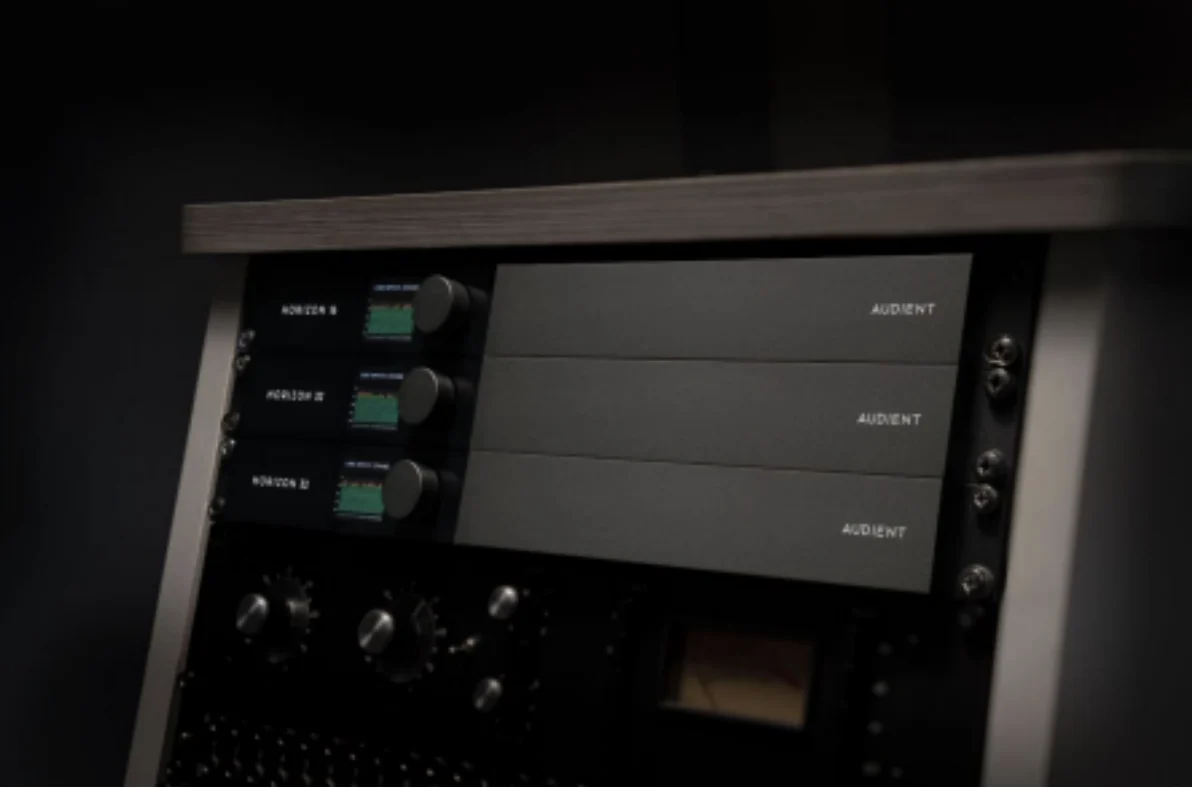
LONDON, UK — In what represents the most significant research and development milestone in the company’s history, renowned audio hardware manufacturer Audient has officially announced the launch of Horizon. This flagship range of Thunderbolt 3 audio interfaces comprises three distinct models: the Horizon 8P, Horizon 16, and Horizon 32. Designed from the ground up to meet the rigorous demands of modern professional tracking, mixing, and mastering facilities, the Horizon series combines mastering-grade 32-bit conversion, ultra-low latency, and an infinitely scalable modular architecture.
The launch signals a major shift in how Audient approaches high-end studio infrastructure, offering engineers a native, high-performance alternative to traditional, heavily restricted digital signal processing (DSP) ecosystems.
Main Facts
The Audient Horizon lineup is engineered around a high-bandwidth Thunderbolt 3 core, delivering exceptional performance metrics that challenge the status quo of modern audio interfaces.
- The Three-Model Lineup: The series is divided into the Horizon 8P (tailored for tracking studios), the Horizon 16 (built for hybrid setups), and the Horizon 32 (designed for large-format and commercial facilities).
- Conversion and Audio Quality: Each unit features 32-bit mastering-grade converters, ensuring extraordinary dynamic range, transparent signal capture, and pristine playback.
- Ultra-Low Latency: The architecture achieves a remarkable 0.99 ms round-trip latency at 192 kHz, allowing producers and engineers to monitor and track through native software plugins in real time without perceived delay.
- Scalability: Systems can be scaled effortlessly by daisy-chaining up to four units using a single, unified macOS driver. At maximum capacity, a four-unit configuration using the Horizon 32 can scale up to an astounding 200 inputs and 200 outputs.
- Comprehensive Connectivity: Standard features across the range include digital recall of input gains and system settings, ADAT expansion capabilities, BNC Word Clock I/O, and selectable reference levels for seamless calibration with external analog outboard gear.
- Global Release Date: The Audient Horizon range will hit the market on September 28, 2026, available globally through authorized Audient dealers.
Chronology: Five Years in the Making
The journey toward the Horizon series is a story of meticulous engineering, prolonged testing, and a refusal to compromise on component-level quality.
Phase 1: Conceptualization and R&D Initiation (2021–2022)
Recognizing a shifting tide in the professional audio market—where native host processing on computers was beginning to vastly outperform proprietary hardware DSP—Audient’s engineering team conceptualized a new flagship platform. The goal was simple yet immensely difficult to execute: build an interface architecture that could leverage modern computer power while offering uncompromising analog front-ends and zero-compromise conversion. This kicked off a five-year R&D cycle, the largest financial and technical investment Audient had ever dedicated to a single product line.
Phase 2: Prototyping and Native Latency Breakthroughs (2023–2024)
During the middle phases of development, the engineering team focused heavily on streamlining the data path between the Thunderbolt 3 controller, the core audio drivers, and the digital-to-analog/analog-to-digital converters. By optimizing the driver architecture specifically for macOS, the team achieved the benchmarked sub-millisecond round-trip latency. Simultaneously, the discrete Class-A preamp topologies—originally designed for Audient’s celebrated ASP8024-HE analog mixing consoles—were miniaturized and adapted for the 1U rack format without losing their sonic integrity.
Phase 3: Modular Architecture and Software Refinement (2025)
With the hardware platform stabilized, attention shifted to workflow versatility. Audient realized that modern studios do not fit a single mold; some rely heavily on direct microphone tracking, while others utilize massive walls of analog outboard compressors and equalizers. This realization birthed the three-tiered model structure (8P, 16, and 32). Concurrently, the control software was completely rewritten from the ground up, emphasizing instant digital recall, intuitive routing, and hardware invisibility during high-pressure sessions.
Phase 4: Global Announcement and Upcoming Release (September 2026)
Following rigorous beta testing in high-profile commercial studios across London, Los Angeles, and Nashville, Audient officially unveiled the Horizon series to the public. Global distribution is slated to commence on September 28, 2026.
Supporting Data & Hardware Breakdown
To understand how the Horizon series fits into different studio environments, it is necessary to examine the specific hardware configurations, I/O counts, and specialized features of each of the three models.
Shared Core Specifications
Across the board, the Horizon series utilizes identical core conversion technology, clocking stability, and driver architecture. Key shared specifications include:
- Connection Protocol: Thunderbolt 3 (high-bandwidth, low-overhead data transmission).
- Conversion: 32-bit mastering-grade A/D and D/A conversion.
- Latency: 0.99 ms round-trip latency at 192 kHz.
- Clocking: BNC Word Clock I/O for synchronization with external digital hardware.
- Expansion: ADAT digital I/O for expanded channel counts.
- Calibration: User-selectable reference levels to match studio-standard operating levels (+4dBu / -10dBV, etc.).
Model-by-Model Analysis
1. Horizon 8P: The Tracking Studio Solution
- I/O Configuration: 24 inputs / 32 outputs.
- Primary Focus: Designed explicitly for tracking live instruments, drums, vocalists, and acoustic ensembles.
- Key Feature: Built around eight discrete Class-A console mic preamps—the exact same topology found in Audient’s flagship ASP8024-HE large-format analog console.
- ORBIT Control: Features ORBIT Control variable impedance, allowing engineers to dynamically alter the input impedance of the preamps. This gives users the ability to subtly shape the frequency response and transient behavior of various microphones (such as ribbon or dynamic mics) right at the analog stage before conversion.
2. Horizon 16: The Hybrid Studio Workhorse
- I/O Configuration: 34 inputs / 34 outputs.
- Primary Focus: Engineered for hybrid producers and mix engineers who split their time between digital in-the-box processing and analog outboard gear.
- Conversion Channels: 32 channels of conversion routed via four industry-standard DB25 connectors, allowing seamless integration with patchbays and multi-channel outboard gear.
- Dedicated Paths: Includes a dedicated stereo mix-bus path for monitoring and summing workflows, making it ideal for routing stems out to analog compressors and equalizers and back into the DAW.
3. Horizon 32: The Large-Format Facility Flagship
- I/O Configuration: 50 inputs / 50 outputs.
- Primary Focus: Built for commercial recording studios, scoring stages, and large project studios managing complex routing setups.
- Analog Connectivity: Features a massive 64 channels of analog I/O distributed across eight DB25 connectors.
- Scalability Apex: When daisy-chained with up to three additional Horizon 32 units via the unified macOS driver, a single facility can scale up to a staggering 200 inputs and 200 outputs, functioning as a unified, tightly synchronized super-system.
Official Responses and Industry Insights
The philosophy behind the Horizon series represents a direct challenge to prevailing industry trends. During the official product unveiling, key figures at Audient elaborated on the engineering choices and market positioning of the new range.
"Horizon has been five years in the making; it is the most significant R&D investment we’ve ever put into a product range," stated Andrew Allen, Chief Product Officer at Audient. "We spared no compromise at the component level, and the result is best-on-the-market audio and latency performance. This is a modern system built for modern workflows."
Allen expanded on the decision to forgo proprietary DSP chips in favor of a purely native Thunderbolt 3 architecture, noting how computing power has evolved over the past decade.
"As Apple Silicon and modern host processing get more capable, the value proposition of the DSP walled-garden model continues to diminish," Allen explained. "Engineers no longer need to lock themselves into proprietary plugin ecosystems to get professional-level performance. Horizon’s native architecture is built exactly for this shift, and we expect it to land very well with customers who have been waiting for a credible, open alternative."
Addressing the practical realities of a high-pressure recording session, Allen emphasized that technology should assist, rather than obstruct, the creative process.
"In a session, the interface should get out of the way," Allen noted. "We designed Horizon so engineers can focus on the performance, not the routing—and we redesigned the software from the ground up, paying close attention to the user experience. Whether that’s using ORBIT Control on the 8P to shape a ribbon mic at the analog stage, or streaming an entire console through the Horizon 32, the hardware stays invisible and the workflow stays fast."
Implications for the Pro Audio Market
The introduction of the Audient Horizon series carries several important implications for the professional audio hardware and studio design sectors:
1. The Decline of Closed DSP Ecosystems
For years, certain high-end interface brands relied heavily on internal DSP cards to run proprietary plugins with low latency, locking users into specific software stores. By demonstrating that a native Thunderbolt 3 connection can achieve a blistering 0.99 ms round-trip latency at 192 kHz without proprietary chips, Audient validates the power of modern host computers (particularly Apple Silicon systems). This empowers engineers to use any native plugin on the market while monitoring in real time.
2. Bridging the Analog-Digital Divide
With the Horizon 16 and Horizon 32 utilizing industry-standard DB25 connectivity and supporting expansive multi-unit daisy-chaining, Audient is aggressively targeting the high-end hybrid studio market. As more mixing engineers return to external summing boxes, analog compressors, and hardware EQ racks, the demand for high-channel-count, transparent conversion integrated into a streamlined digital workflow has never been higher.
3. Setting a New Standard for Scalability
The ability to link up to four units under a single macOS driver to achieve 200 x 200 I/O provides commercial facilities with an attractive, modular upgrade path. Rather than being forced to purchase monolithic, prohibitively expensive core systems, studios can scale their conversion capabilities incrementally as their business grows, all while maintaining unified clocking, gain recall, and system settings.
Summary
As the pro audio community looks toward the official release date of September 28, 2026, the Audient Horizon range stands poised to disrupt the high-end audio interface market. By pairing world-class analog pedigree—exemplified by the ASP8024-HE console heritage—with cutting-edge 32-bit conversion and lightning-fast Thunderbolt 3 performance, Audient has delivered a formidable flagship ecosystem designed for the next generation of audio professionals.