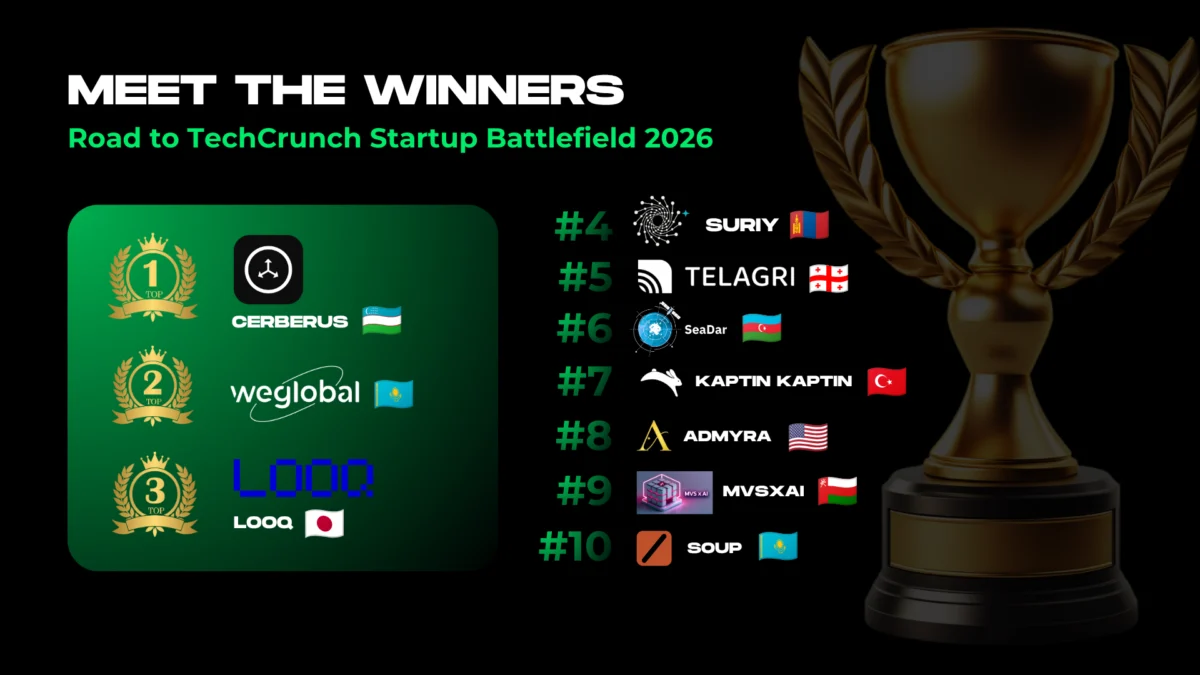
The global technology map is being redrawn, and this year, the ink is being provided by Central Eurasia. In a high-stakes demonstration of innovation, Cerberus, WeGlobal AI, and LOOQ have emerged as the top three victors of the regional final of the Road to TechCrunch Startup Battlefield 2026. These three trailblazing startups have earned the right to represent the region on the global stage, securing their spots in the prestigious Startup Battlefield 200 at TechCrunch Disrupt 2026 in San Francisco this October.
Standing before a global audience of over 10,000 tech leaders, investors, and visionaries, these founders will represent the culmination of a rigorous selection process that parsed through a record-breaking 726 applications from 39 countries. This triumph is not merely a win for three companies; it is a definitive statement that the Central Eurasian startup ecosystem has evolved from a burgeoning frontier into a powerhouse of high-caliber, AI-driven technological development.
The Chronology of a Competitive Ascent
The journey to the San Francisco stage was far from a simple sprint. The Road to TechCrunch Startup Battlefield—a collaborative initiative spearheaded by the Silkroad Innovation Hub in partnership with TechCrunch, Freedom Holding, Astana Hub, and IT Park Uzbekistan—began months ago with a mandate to surface the most promising talent in the region.
The scale of the competition was unprecedented. With a 50% increase in applications compared to the 2025 debut, the selection committee faced the daunting task of filtering 726 entries down to 22 finalists. These finalists were selected through intensive national rounds that tested not only the technical viability of their products but also their scalability and market readiness.
The final stage, held before 47 distinguished jurors representing eight different nations, served as the ultimate proving ground. The event featured a unique technological integration: AI-Dana, an independent AI judge, which provided an unbiased, data-driven perspective on the pitches for the second consecutive year. After intense deliberation and live scrutiny, the winners were announced, marking the beginning of their journey toward the ultimate showdown in Silicon Valley.
Data-Driven Innovation: The AI Supremacy
The defining characteristic of this year’s competition was the overwhelming dominance of Artificial Intelligence. Among the 726 startups that submitted applications, a staggering 84% were building products centered on AI. This trend was not merely a superficial adoption of the technology; it was a deep-seated integration that reflected global market demands for security, mental health support, and data analytics.
The three winners embody this trend in distinct, high-impact sectors:
- Cerberus (Uzbekistan): An AI agent specialized in autonomous cybersecurity vulnerability detection.
- WeGlobal AI (Kazakhstan): A platform leveraging AI to scale student mental health and career guidance services.
- LOOQ (Japan): A hardware-software hybrid that utilizes AI to bring granular, digital-style analytics to physical billboard advertising.
This shift toward AI-centric solutions underscores a broader trend identified by experts: founders are no longer just "building apps"; they are building sophisticated infrastructure that addresses systemic inefficiencies.
Deep Dive into the Champions
Cerberus: Redefining Corporate Cybersecurity
As the first-place winner, Cerberus has put Uzbekistan on the map in a way that few companies have managed before. The startup addresses a critical friction point in the modern tech stack: the reliance on general-purpose Large Language Models (LLMs) for security. Because standard models are prone to "hallucinations," their application in sensitive corporate infrastructure can be dangerous. Cerberus’s proprietary agent acts as a specialized auditor, hunting for vulnerabilities without the risk of system-wide failure. Having already been accepted into the Alchemist Silkroad residency, Cerberus is well-positioned to scale its operations internationally.
WeGlobal AI: Bridging the Human Capital Gap
Second-place winner WeGlobal AI identified a socioeconomic crisis in Kazakhstan: a severe shortage of school psychologists. By deploying AI, they have created a scalable, accessible bridge that provides students with the support they need to navigate mental health and career development. Their success is a poignant reminder that AI’s highest calling is often the augmentation of human services in areas where human resources are critically constrained.
LOOQ: The "Google Analytics" of the Physical World
Third-place winner LOOQ, founded by Ayan Sakenov and Yudai Ishida, brings a unique hardware perspective to the field. Their "attention API" effectively digitizes the physical world of advertising. By using camera-based hardware to measure real-world engagement with billboards, they are providing a level of accountability that has historically been missing in out-of-home (OOH) media. Their transition from a mere prototype to real-world deployment demonstrates the technical rigor required to succeed in the Startup Battlefield arena.
Official Perspectives: Building Locally, Scaling Globally
The significance of this regional win was echoed by high-level stakeholders who view the Road to Battlefield as more than a competition.
Isabelle Johannessen, head of the Startup Battlefield program at TechCrunch, noted the strategic importance of the event. "The companies pitching across health tech, education, productivity, enterprise, and cyber were cutting-edge and impressive," she stated. "These founders are getting global visibility at TechCrunch Disrupt, and that sends a message to the next generation: You can build locally and scale globally. This ecosystem is thriving."
Asset Abdualiyev, founder and CEO of the Silkroad Innovation Hub, emphasized the networking power of the competition. "From the beginning, the idea has been to give talented founders a platform to be seen, heard, and connected to opportunities beyond the region. The strongest teams made it through to the final, and we are proud to have TechCrunch as a partner in creating this global pathway."
The governmental support for these winners is equally robust. Sherzod Shermatov, Minister of Digital Technology of Uzbekistan, noted that Cerberus’s win is a "strong example of the progress" in the nation’s ecosystem, while Zhaslan Madiyev, Deputy Prime Minister of Kazakhstan, highlighted that the event serves as a "bridge" connecting Central Eurasian entrepreneurs directly with the global tech ecosystem.
The $100,000 Investment and Beyond
Beyond the prestige and the trip to San Francisco, the winners received tangible support to accelerate their growth. The three companies share a $100,000 investment pool provided by Astana Hub Ventures, IT Park Ventures, and Silkroad Innovation Hub. Cerberus leads with a $50,000 infusion, followed by $30,000 for WeGlobal AI and $20,000 for LOOQ.
Furthermore, the commitment from industry giants is significant. OpenAI, recognizing the technical ambition of the applicants, awarded a total of $280,000 in API credits across the 22 finalists, ensuring that even those who did not take the top three spots have the resources to continue their research and development. Thomas Jeng, Head of Startups APAC at OpenAI, praised the finalists for their "technical skill in building with AI," reinforcing the idea that these startups are equipped to compete on the world stage.
Implications for the Future of Central Eurasian Tech
The success of the Road to TechCrunch Startup Battlefield 2026 signals a maturation of the startup landscape in Central Eurasia. It represents a transition from a region characterized by outsourcing to one defined by original, globally competitive intellectual property.
The top 10 finalists—which included ventures from Mongolia, Georgia, Azerbaijan, Türkiye, the United States, and Qatar—further highlight the interconnected nature of this new tech corridor. As these founders head to San Francisco, they carry with them the expectations of a region that is finally finding its voice in the global innovation conversation.
Whether through Cerberus’s security protocols, WeGlobal AI’s social impact, or LOOQ’s advertising metrics, these startups are proving that the next generation of "unicorn" companies may not originate in the traditional corridors of the West, but rather from the high-growth, high-ambition ecosystems of Central Eurasia. As they prepare to step onto the stage at TechCrunch Disrupt, the world will be watching to see if they can turn this regional triumph into a global legacy.