HERRIARD, UK – September 15, 2026 – In what is arguably the most significant R&D milestone in the company’s history, British pro-audio stalwart Audient has officially pulled back the curtain on "Horizon." This new flagship line of Thunderbolt 3 audio interfaces represents a bold departure from mid-market solutions, positioning Audient firmly in the upper echelon of high-end, studio-grade hardware.
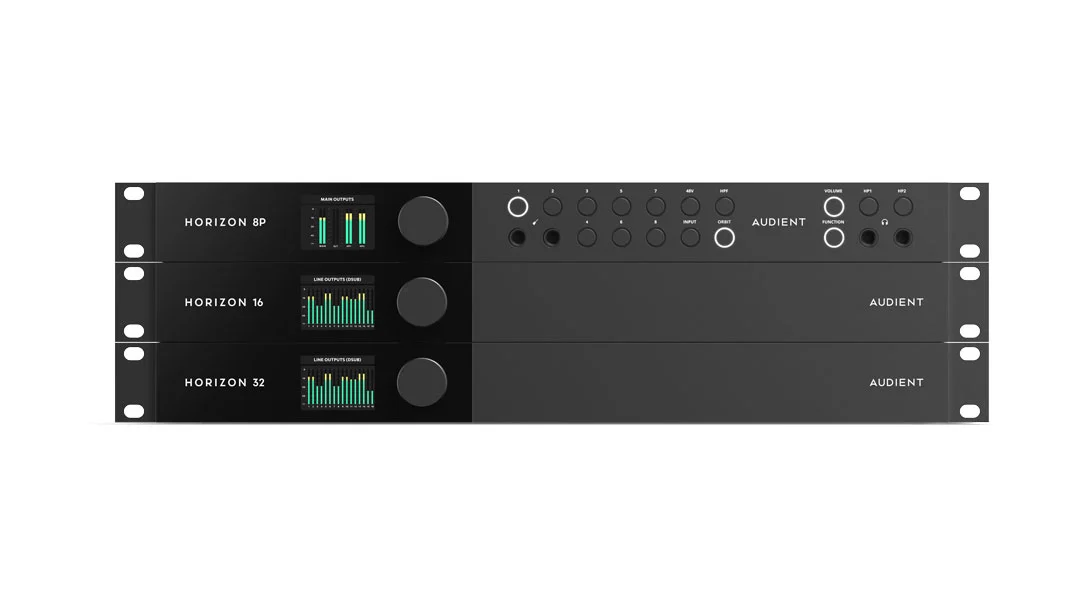
Designed to meet the demands of modern, high-track-count production environments, the Horizon series—comprising the 8P, 16, and 32—promises to bridge the gap between traditional analog console workflows and the raw, unbridled power of modern native computing.
The Main Facts: A New Paradigm in Conversion and Connectivity
At its core, the Horizon range is built to address the evolving needs of the contemporary engineer. By prioritizing 32-bit mastering-grade conversion and sub-millisecond round-trip latency at 192 kHz, Audient has signaled that it is no longer content with being the "best value" choice; they are now competing for the "best performance" title.
The series is built upon a scalable architecture that allows users to daisy-chain up to four units under a single macOS driver. At maximum capacity, this configuration yields a staggering 200 x 200 I/O, providing a robust solution for large-scale orchestral recording, complex hybrid mixing, or immersive audio production.
The Horizon Lineup Overview:
- Horizon 8P (24-in / 32-out): Engineered primarily for tracking, this unit integrates eight of Audient’s acclaimed Class-A console mic preamps. A standout feature is the inclusion of "ORBIT Control" variable impedance, allowing engineers to match the input stage to a wide variety of vintage and modern ribbon, dynamic, and condenser microphones.
- Horizon 16 (34-in / 34-out): Targeted at the modern hybrid studio, the Horizon 16 focuses on connectivity. It features 32 channels of high-end conversion via standard DB25 connectors, complemented by a dedicated stereo mix-bus path for analog summing workflows.
- Horizon 32 (50-in / 50-out): The powerhouse of the range, designed for large-format facilities. It provides 64 channels of analog I/O via eight DB25 connectors, offering the massive headroom and routing flexibility required for complex outboard-heavy setups.
Chronology of Development: From Concept to Reality
The journey to the Horizon range has been one of quiet, methodical development. While Audient has spent the last decade dominating the desktop interface market with the iD and EVO series, the internal desire to reclaim a space in the professional studio rack has been brewing for years.
Industry insiders note that the project began in early 2023, following a massive shift in how professional studios were interacting with their hardware. As Apple Silicon began to demonstrate performance benchmarks that dwarfed traditional outboard DSP (Digital Signal Processing) chips, Audient’s engineering team pivoted. They moved away from the "walled-garden" DSP approach that defined the previous decade of interface design, choosing instead to focus on a high-bandwidth, native-first architecture that leverages the massive compute power of modern Mac workstations.
Following three years of iterative testing, board revisions, and beta-testing in select high-profile UK and US studios, the Horizon line was finalized in mid-2026. The result is a platform that feels both future-proof and respectful of the analog heritage that made the Audient ASP8024-HE console an industry standard.
Supporting Data: Why Native Architecture Matters
The professional audio industry has long been bifurcated between "native" systems—which rely on the host computer’s CPU—and "DSP-accelerated" systems. For years, the latter was favored for its low-latency monitoring. However, as Audient’s Chief Product Officer, Andrew Allen, explains, that narrative is becoming obsolete.
"As Apple Silicon and modern host processing get more capable, the value proposition of the DSP walled-garden model continues to diminish," Allen noted during the product announcement. "Engineers no longer need to lock themselves into proprietary plugin ecosystems to get pro-level performance. Horizon’s native architecture is built exactly for this shift, and we expect it to land well with customers who’ve been waiting for a credible alternative."
Technical Specifications Summary:
- Conversion: 32-bit mastering-grade converters across the entire range.
- Latency: Sub-millisecond round-trip latency at 192 kHz.
- Connectivity: Thunderbolt 3 (backward compatible with Thunderbolt 4/USB-C environments).
- Expansion: ADAT, BNC Word Clock I/O for synchronization in larger digital rigs.
- Recall: Full digital recall of all input gains and system settings, a critical feature for high-turnover studio environments.
- Calibration: Selectable reference levels (+18dBu/+24dBu) to ensure seamless integration with high-end outboard analog gear.
Official Responses and Strategic Implications
The release of the Horizon series is being viewed by market analysts as a calculated move to capture the mid-to-high-end segment that has been largely dominated by manufacturers like Universal Audio, RME, and Antelope Audio.
By pricing the units aggressively—with the 8P and 16 at $2,799 and the 32 at $3,499—Audient is positioning Horizon as a "no-compromise" solution. The ability to use the same driver and software environment across a small tracking setup and a massive mixing facility provides a level of ecosystem consistency that many professional studios currently lack.
Industry response has been cautiously optimistic. Critics have long lauded Audient for their "British sound"—characterized by transparent, fast, and high-headroom preamps—and the decision to include the ASP8024-HE preamp design in the 8P unit is seen as a direct play for the loyalty of engineers who have grown up mixing on Audient consoles.
Implications for the Future of Studio Production
The shift toward the Horizon line suggests several key trends in the pro-audio market:
- The Death of Proprietary DSP: As computers become more powerful, manufacturers are increasingly realizing that the "DSP tax"—the cost of proprietary chips that often become obsolete—is a hurdle for customers. By focusing on native performance, Audient is betting on the longevity of the Mac platform.
- Hybrid Workflow Dominance: The specific inclusion of DB25 connectors and dedicated mix-bus paths across the Horizon range acknowledges that the modern studio is a "hybrid" beast. Engineers want the convenience of digital tracking with the sonic color and tactile interaction of analog summing and outboard processing.
- Scalability as a Service: By allowing users to daisy-chain units, Audient is acknowledging the reality of modern studio budgets. Studios can now start with a single Horizon 8P and grow their system to a Horizon 32-based rig without having to discard or sell their existing hardware.
Conclusion: A New Horizon?
As the September 28 release date approaches, the industry remains focused on how these interfaces perform under the stress of heavy real-world sessions. If the technical specs hold up to the scrutiny of the professional engineering community, Audient may have succeeded in creating a new standard for studio connectivity.
The Horizon series is more than just a set of interfaces; it is a declaration of intent. Audient is moving upmarket, bringing with them a reputation for reliability, sonic excellence, and an understanding of the working engineer’s needs. For those looking to upgrade their signal path, the horizon has never looked quite this clear.
For more information on the new Horizon line, visit www.audient.com.