
In the world of precision electronics, few instruments command the respect of the Hewlett-Packard 3478A. A staple of the 1980s test bench, this 5½-digit digital multimeter (DMM) represents an era of over-engineering and robust build quality that modern, cost-optimized hardware often struggles to replicate. However, acquiring such a piece of history on the secondary market—specifically for a modest $58—comes with significant caveats.
This article explores the meticulous restoration of an aging HP 3478A, detailing the technical hurdles of legacy component failure, the challenges of aesthetic refurbishment, and the surprising accuracy achievable through home-lab metrology.
The Core Technical Challenges
When dealing with test equipment that has spent over four decades in circulation, the primary enemies are time and chemistry. The HP 3478A under review suffered from two critical vulnerabilities typical of its vintage: the degradation of RIFA (Rifa-brand) power line suppression capacitors and the impending expiration of the lithium-sulfur dioxide battery responsible for maintaining calibration data in volatile SRAM.
Capacitor Failure and SRAM Preservation
RIFA capacitors from the 1980s are infamous in the engineering community for their tendency to crack and fail, often releasing pungent smoke and potentially causing short circuits. The restoration required a direct replacement using modern, epoxy-encapsulated equivalents.

More daunting was the battery issue. The 3478A stores its calibration constants in battery-backed RAM. If the battery fails while the unit is unpowered, the DMM loses its calibration identity, rendering it a "brick" in terms of precision. By carefully managing the power-off cycles and utilizing precise soldering techniques, the battery was replaced without the loss of a single byte of calibration data—a testament to the importance of planning in vintage restoration.
Chronology of the Restoration
Phase I: Internal Stabilization
The initial phase focused on electrical stability. After addressing the power supply and memory retention, the secondary issues included a missing input selector button cap. Rather than searching for impossible-to-find original plastic, a 3D-printed replica was engineered to match the mechanical feel and aesthetic of the original unit.
Phase II: The Display Window Dilemma
The most visually jarring defect was a cracked and depressed display window. The LCD panel beneath it remained miraculously intact, but the shattered plastic rendered the 5½-digit readout nearly illegible.
- Disassembly: Contrary to online advice suggesting a full-chassis teardown, careful maneuvering allowed for the removal of the LCD module by angling a Phillips-head screwdriver to access two internal retention screws.
- Removal of the Old Window: The original adhesive, having hardened over 40 years, resisted 99% isopropyl alcohol. Removing the debris required a mechanical approach: a quarter-inch wood chisel and a mallet were used to delicately scrape away the residue without compromising the structural integrity of the front panel.
- Refabrication: A 1mm clear PET sheet was cut to fit the aperture. Using 3M 300LSE heavy-duty, double-sided mounting tape—a material common in smartphone glass assembly—the new window was secured. The result was a pristine, transparent interface that restored the unit’s professional appearance.
Phase III: Evaluating the Hitachi LCD
During the display repair, signs of "LCD rot" or chemical deterioration were noted along the top edge of the Hitachi panel. While not yet impacting the functional display area, it signals the eventual need for a solid-state replacement. Enthusiast-led projects, such as the color TFT LCD replacement developed by Ian Scott Johnson, offer a path forward should the original display eventually fail.

Supporting Data: Home-Lab Metrology
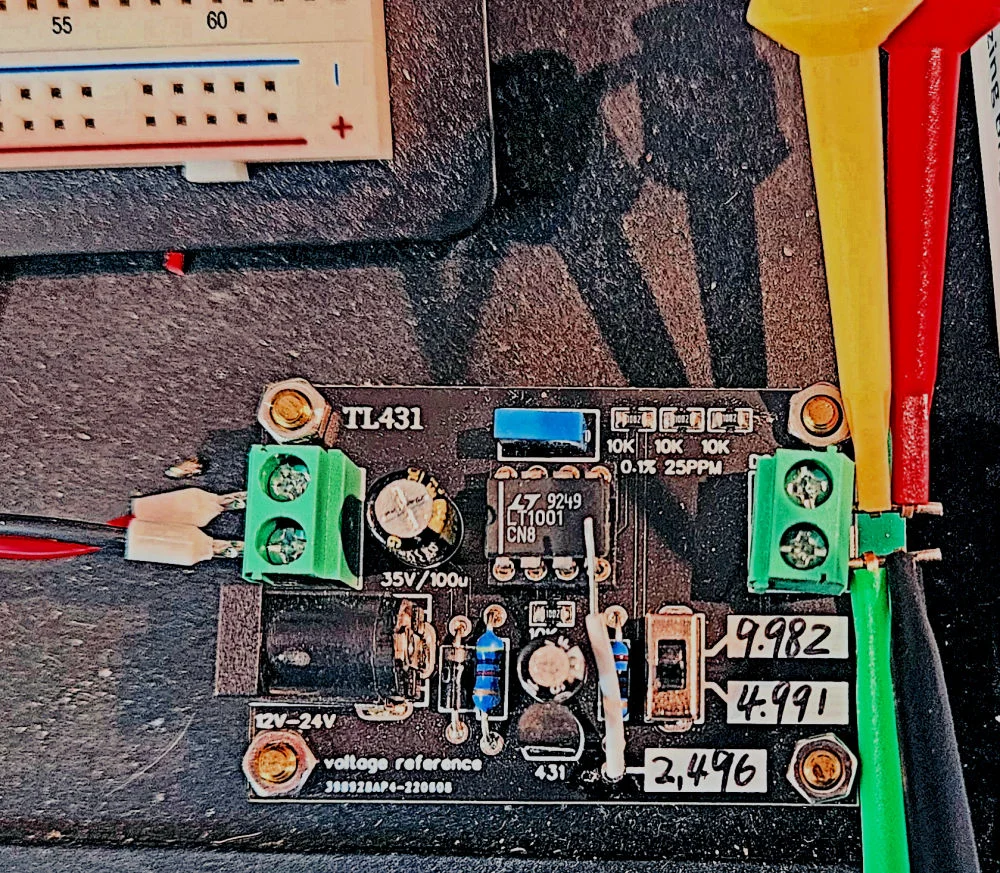
A common point of contention among hobbyists is the validity of "uncalibrated" equipment. To assess the health of the restored 3478A, a comparative analysis was performed using a $10 calibration reference board based on the Texas Instruments TL431 shunt regulator and the Linear Technology LT1001 precision op-amp.
Comparative Measurements
The 3478A was benchmarked against two other restored units: a 5½-digit Keithley 197 and a 3½-digit Keithley 179. The goal was to determine if these legacy devices, none of which had seen a professional calibration lab since the Reagan administration, could still provide meaningful, repeatable data.
| Measurement Type | HP 3478A (Refurb) | Keithley 197 | Keithley 179 |
|---|---|---|---|
| DC Voltage | High Accuracy | Within 0.01% | Within 0.05% |
| 2-Wire Resistance | Stable | Stable | Stable |
| 4-Wire Resistance | Supported | Supported | Not Supported |
The findings were unexpected. The variance between the three units was measured in the range of a few hundred microvolts. As the adage goes, "With one voltmeter, you know the voltage; with two, you never know." By using three, we identified a high degree of consensus, suggesting that the components, despite their age, remained within a usable tolerance for general-purpose laboratory work.
Official Perspectives and Industry Context
While professional calibration laboratories would naturally suggest that any instrument older than a decade requires factory-standard certification, the "prosumer" metrology community—represented by figures such as Marco Reps—advocates for the "verification over certification" model.

For the professional engineer, a calibrated 3478A is a baseline for reliability. For the hobbyist, the device serves as a bridge between modern digital precision and the tactile, high-reliability engineering of the 20th century. Hewlett-Packard’s original documentation for the 3478A highlights the device’s ability to perform self-tests, a feature that provides the operator with immediate confidence in the digital logic of the unit, even if the analog accuracy must be verified externally.
Implications for Future Bench Work
The successful restoration of the 3478A has broader implications for the maintenance of legacy hardware.
- Sustainability: By repairing rather than replacing, the engineer prevents high-quality test equipment from entering landfills.
- Skill Acquisition: Mastering the repair of 40-year-old electronics requires a diverse skill set, ranging from chemistry (solvent usage for adhesives) to mechanical engineering (3D printing and material selection).
- Cost-Efficiency: While a professional calibration service can cost hundreds of dollars, the use of precision reference boards allows for the maintenance of a high-performance lab at a fraction of the cost.
Looking Ahead: Current Source Development
The journey does not end with voltage and resistance. Encouraged by the accuracy of the 3478A, the next objective is the construction of a precision current source. Current measurement is arguably the most difficult aspect of DMM calibration, as it requires highly stable shunt resistors and low-noise circuitry.
As the lab continues to evolve, the HP 3478A will serve as the primary measurement node. It is a striking example of how, with patience and a bit of ingenuity, the tools of the past remain perfectly capable of serving the needs of the future. The 3478A is not merely a piece of equipment; it is a functioning archive of electronic history, currently operating as accurately as it did when it first left the factory floor in the mid-1980s.