HANOI, VIETNAM — In the fast-moving landscape of personal audio, single dynamic driver in-ear monitors (IEMs) have increasingly fought for dominance through brute-force engineering, multi-driver arrays, or aggressively colored signatures designed to capture fleeting market trends. Into this crowded arena steps the ARIA Ear Azuri, an ambitious $135 single dynamic driver IEM hailing from Vietnam.
Reviewed extensively by audio publication Headfonics by reviewer Marcelo, the Azuri attempts a different path: combining sophisticated material science, specialized acoustic chamber design, and traditional craftsmanship to offer a near-neutral, highly musical listening experience. Priced accessibly at $135.00, the Azuri challenges the status quo established by legacy brands, proving that high-end acoustic methodologies can trickle down into budget-friendly tiers.

Main Facts: What is the ARIA Ear Azuri?
At its core, the ARIA Ear Azuri is a wired in-ear monitor built around a single 10mm metal-composite lithium-magnesium dynamic driver. Designed to bridge the gap between technical precision and emotional engagement, the Azuri incorporates several proprietary acoustic innovations to suppress distortion and smooth out frequency transitions.
- Price Point: $135.00 USD, available directly through the official ARIA Ear website.
- Driver Architecture: Single 10mm lithium-magnesium diaphragm dynamic driver.
- Acoustic Innovations: Dual Helmholtz resonance chambers, a "Ribbon Waveguide System" for back-wave absorption, and a robust metal damping system.
- Impedance & Sensitivity: 16Ω impedance with a sensitivity rating of 106 dB/mW @ 1kHz.
- Included Hardware: 0.78mm 2-pin 6N OCC copper stock cable with a 3.5mm termination, a hard leather carrying case, six pairs of ear tips, and a microfiber cleaning cloth.
Chronology: From Concept to Critical Reception
The arrival of the Azuri represents a notable milestone not only for ARIA Ear as a boutique manufacturer but also for the burgeoning Vietnamese audiophile hardware scene.

- Pre-Production & Engineering: ARIA Ear spent considerable development cycles addressing common pitfalls of single dynamic driver configurations—specifically, high-frequency resonance and back-wave distortion. By integrating dual Helmholtz resonance chambers and a Ribbon Waveguide System, the engineers targeted specific problem areas in the upper-midrange and treble domains.
- Market Launch: The Azuri debuted at a competitive $135 price point, immediately drawing comparisons to established models from brands like FiiO, TinHiFi, and Kiwi Ears.
- Independent Evaluation Period: Following standard review protocols, independent testing units were dispatched globally. Reviewers subjected the IEMs to rigorous burn-in periods (typically 24 hours to settle the dynamic driver suspension) and paired them with high-end source gear such as the iBasso DC-Elite, MUSE HiFi M6 Double, and the FiiO M15S Digital Audio Player (DAP).
- Critical Consensus: Upon publication of the initial findings, the Azuri earned an impressive reader score of 8.4/10, praised for its organic timbre, expansive soundstage, and lack of listening fatigue.
Supporting Data: Acoustic Engineering & Performance
The true test of any IEM lies in its hardware implementation and subsequent acoustic measurements. The Azuri employs an array of advanced design choices to separate itself from competitors relying on generic off-the-shelf components.
Material Science of the Diaphragm
The 10mm diaphragm utilizes a lithium-magnesium composite. Magnesium provides exceptional rigidity, which preserves transient speed and prevents structural warping under high excursions. However, pure magnesium can sometimes introduce a metallic timbre. By blending it with lithium—a much softer damping metal—ARIA Ear successfully neutralized this harshness, yielding a natural, uncolored sound.

Managing Resonance and Distortion
To combat unwanted peaks typically found between 5 kHz and 6.2 kHz, ARIA Ear engineered two specialized Helmholtz resonance chambers within the shell. Furthermore, instead of using traditional paper or cloth filters for high-frequency damping—materials prone to degradation from ear moisture over time—the Azuri uses a durable metal damping system alongside a "Ribbon Waveguide System" to absorb destructive back-waves.
Frequency Response and Sonic Signature
- Measurements: Frequency response analysis reveals a near-perfect channel-matched pairing, underlining strict quality control standards. The graph displays a 10 dB sub-bass boost paired with a moderately narrow peak at 2.5 kHz for pinna gain compensation, resulting in a mild-to-moderate V-shaped profile.
- Bass Performance: The low-end is punchy, tight, and deep, offering a healthy balance between sub-bass extension and mid-bass impact without bleeding into the lower midrange.
- Midrange Clarity: While the upper-midrange shows notable elevation on paper, real-world listening reveals zero shoutiness or harsh fatigue. Vocals and instruments remain articulate, clean, and forward.
- Treble Extension: The high frequencies extend smoothly and naturally. It avoids artificial sharpness, providing ample air and micro-detailing without introducing digital glare or congestion.
- Soundstage & Imaging: The soundstage is wider and deeper than the market average, boasting a holographic, surround-sound-like presentation with precise instrument separation and layering.
Ergonomics, Design, and Packaging
Beyond raw sound, the user experience of an audio product heavily influences daily satisfaction. ARIA Ear paid meticulous attention to physical presentation, comfort, and accessories.

Shell Design and Aesthetics
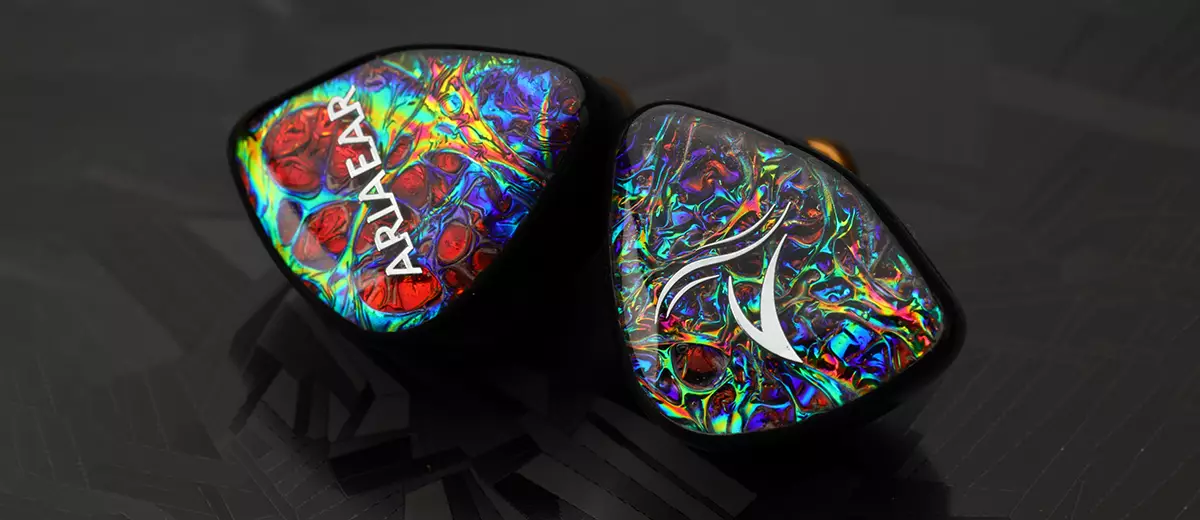
While the inner shell utilizes a tried-and-true 3D-printed resin structure for ergonomic comfort, the faceplate serves as the visual centerpiece. It features a cosmic, multi-colored swirling pattern that evokes deep-space imagery, accented by a mix of deep blues, reds, oranges, and greens. A metal nozzle with a secure retention lip ensures ear tips stay firmly in place, while a series of pressure-relief vent holes prevents driver flex and vacuum pressure build-up.
The Stock Cable
Abandoning cheap oxygen-free copper (OFC) alternatives found in many entry-level sets, ARIA Ear bundles a high-purity 6N OCC copper cable terminated with standard 0.78mm 2-pin connectors and a 3.5mm plug. The cable strikes an ideal balance: flexible enough to prevent memory tangles while retaining a sturdy, premium hand-feel with metal hardware accents.

Comfort and Isolation
The lightweight resin anatomy fits flush against the concha, allowing for hours of uninterrupted listening during commutes or long walks. Passive noise isolation sits at a comfortable average level—allowing ambient urban noise to gently filter through when music is paused, but completely fading into the background once playback begins.
Implications: Where the Azuri Fits in the Modern Audiophile Market
The release and reception of the ARIA Ear Azuri carry broader implications for the personal audio industry.

- Democratization of High-End Tuning: Historically, advanced acoustic solutions like custom waveguide systems and multi-chamber tuning were reserved for flagship multi-hundred-dollar flagships. The Azuri demonstrates that these sophisticated design principles can be successfully scaled down to a $135 price point, raising consumer expectations for budget and mid-tier IEMs.
- Geographic Diversification: Dominated for years by manufacturing hubs in specific East Asian territories, the audiophile market is increasingly recognizing boutique innovators from emerging tech regions like Vietnam. The success of the Azuri signals a shift toward a more globally distributed landscape of acoustic engineering talent.
- The Rise of Single Dynamic Drivers: As hybrid and multi-driver configurations (combining dynamic drivers, balanced armatures, and planar magnetic tweeters) frequently complicate crossovers and phase coherence, the Azuri champions the cohesive, seamless presentation possible through a well-tuned single dynamic driver.
For listeners seeking an engaging, highly versatile, and technically competent set of earphones that refuses to compromise on natural timbre, the ARIA Ear Azuri establishes a compelling new benchmark in its class.