By Headfonics Review Desk
In the ever-evolving landscape of personal audio, Topping has firmly established itself as a household name among audiophiles for its high-performance digital-to-analog converters (DACs) and headphone amplifiers. From flagship desktop powerhouses like the DX9 Discrete down to budget-friendly solutions like the DX1 II, the brand’s engineering pedigree is well documented.

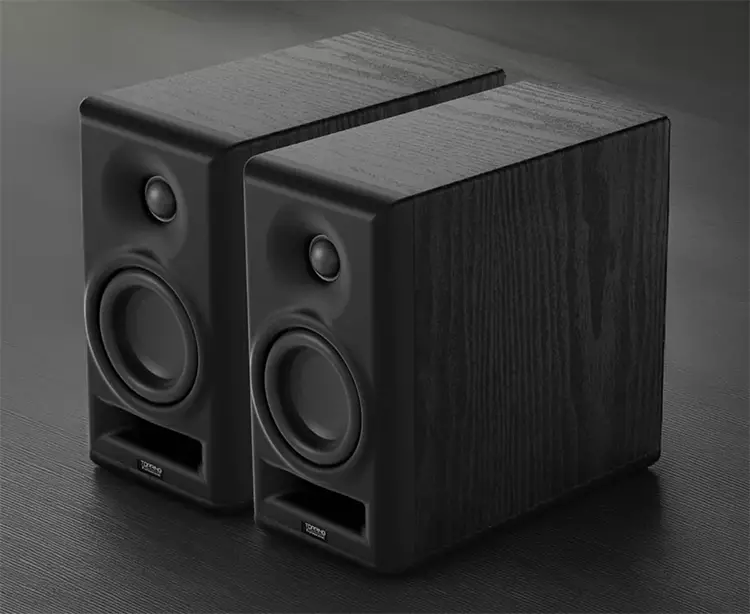
Now, Topping is making a calculated stride into uncharted territory under its newly minted "Topping Professional" banner. Enter the Topping MA4, a compact, bi-amplified active desktop speaker featuring a custom 4-inch woofer and an advanced Opti-Wave waveguide. Priced competitively at $319.00 per set, the MA4 is designed to bridge the gap between uncompromising studio-grade monitoring and nearfield casual listening.
Main Facts at a Glance
- Product Name: Topping MA4
- Manufacturer: Topping Professional
- Price: $319.00 (per set)
- Design Type: Bi-amplified active desktop monitor speaker
- Driver Configuration: 1-inch domed tweeter paired with a 4-inch paper woofer cone
- Amplification: 50W allocated to the woofer, 25W allocated to the tweeter
- Connectivity: Fully balanced analog XLR inputs
- Acoustic Standards: Adheres to stringent CTA-2034 loudspeaker performance standards
- Dimensions: 14.0 cm x 25.5 cm x 28.8 cm per unit
- Weight: 3.78 kg per speaker
Chronology and Development: Venturing Beyond Headphone Audio
The Evolution of Topping Professional
For years, enthusiasts have watched Topping dominate the source gear market, building electronics that emphasize extreme transparency, low distortion, and measured perfection. However, expanding from pure electronics into loudspeaker design is a notoriously treacherous path. Transducer physics, cabinet resonances, and acoustic crossovers present entirely different engineering challenges than surface-mount circuit boards and digital signal processing.

When rumors began circulating regarding Topping’s entry into active monitors, the audiophile community reacted with a mixture of intense anticipation and cautious skepticism. Many wondered if a brand so deeply rooted in digital source gear could successfully pivot to raw acoustic physics.
Upon arrival, the review sample immediately signaled that Topping was taking this endeavor seriously. Rather than opting for consumer-friendly compromises like Bluetooth pairing or a litany of RCA and auxiliary inputs, the MA4 was engineered with a purist, studio-first philosophy. Featuring strictly balanced XLR inputs and a fully analog crossover, Topping made it clear that these monitors were built for serious work environments.

Supporting Data: Engineering and Feature Set
Adherence to CTA-2034 Standards
The Topping MA4 is built to meet the rigorous benchmarks set by the CTA-2034 standard. Applicable specifically to loudspeakers, this standard evaluates frequency response, directivity patterns, and maximum output capability in simulated residential or studio environments. It measures a loudspeaker’s true acoustic performance rather than merely testing its ability to survive an aggressive input signal.
Acoustic Architecture and Amplification
Under the hood, the MA4 employs a bi-amplified architecture, driving its 4-inch paper cone woofer with 50 watts of power and its 1-inch dome tweeter with 25 watts. This separation ensures that transient peaks do not modulate the high frequencies, keeping distortion minimal.

Topping optimized the physical placement of the drivers for superior off-axis dispersion. The crossover point is meticulously set at 1.4kHz, which allows the front-facing bass reflex port to work in tandem with the high-frequency waveguide. This specific tuning helps suppress unwanted internal resonances around the 1kHz spectrum, resulting in a cleaner presentation.
Crucially, Topping utilized a fully balanced analog crossover rather than opting for a digital DSP-based system. By avoiding unnecessary analog-to-digital (AD) and digital-to-analog (DA) conversion loops, the MA4 ensures a lossless signal path that preserves temporal accuracy and harmonic naturalness.

I/O and Rear-Panel Controls
Simplicity defines the MA4’s input interface. The rear panel houses a single pair of balanced XLR inputs per speaker. While some users accustomed to consumer multimedia monitors may lament the absence of RCA or wireless options, pairing the MA4 with a high-grade external DAC equipped with XLR outputs unlocks the speaker’s true potential. During evaluation, sources such as the JC Acoustics UDP-5 and the YULONG DA-ART Aquila III served as exceptional digital front ends.
The rear panel also hosts physical tuning switches:

- Sensitivity Switch: Features three distinct headroom settings (+4dBu, +14dBu, and +24dBu) to match varying source output voltages. The +4dBu setting serves as the sweet spot for most desktop setups.
- High Trim Adjustment: Offers a subtle treble contour (+2dB, 0dB, and -2dB) to adapt the high-frequency response to heavily treated or overly live room acoustics.
Official Responses and Industry Context
Initial early-run reviews from external testing publications highlighted minor design quirks, such as potential air leakage around the bass port perimeter during extreme, high-volume playback. Topping’s engineering team swiftly evaluated these early units, and subsequent production iterations—including the review sample evaluated here—resolved these acoustic anomalies entirely. Even under heavy load and high SPL testing following a 75-hour burn-in period, the cabinet integrity remained flawless, with zero audible turbulence from the reflex ports.
In comparison to contemporary desktop offerings from brands like FiiO (such as the SP5) and Edifier (such as the M90 and MR5), the Topping MA4 carves out a distinct identity. While competitors often rely on DSP trickery or consumer-tuned V-shaped sound signatures to catch the ear, Topping leans heavily into true-to-source neutrality.

Implications: Sound Impressions and Real-World Performance
General Sonic Character
Marketed primarily as a desktop studio monitor that doubles as a nearfield reference speaker for casual listening, the MA4 delivers a sound profile defined by clarity, restraint, and exceptional coherence.
- The Bass Response: The low end is not designed to rattle walls with exaggerated sub-bass bloat. Instead, the 4-inch woofer and front-firing port deliver taut, highly controlled bass with surprising extension for its footprint. It maintains an agile character that refuses to muddy the lower midrange.
- The Midrange: The 1.4kHz crossover pays massive dividends here. Vocals and acoustic instruments possess a vibrant, natural texture without artificial forwardness. Transients balance attack and decay gracefully, preventing notes from sounding either overly dry or unnaturally smeared.
- The Treble: The high-end performance leans toward neutrality rather than sparkling brightness. It extends smoothly, granting the soundstage a sense of holographic air and vertical expansion without inducing listening fatigue.
Spatial Imaging and Staging
When positioned properly—roughly 2.3 meters apart, angled inward at an optimal nearfield convergence—the MA4 constructs a remarkably three-dimensional soundstage. The cubic spatial presentation feels slightly deeper than it is wide, allowing complex mixes to deconstruct themselves cleanly across the stereo field. Even when fed lower-resolution source material like vintage compact discs, the MA4 refuses to turn harsh or overly analytical, maintaining a forgiving yet transparent window into the recording.

Conclusion
The Topping MA4 proves that Topping Professional is more than just a passing experiment in loudspeaker manufacturing. By respecting acoustic physics, avoiding cheap digital shortcuts, and prioritizing a transparent, balanced analog signal path, Topping has delivered a formidable nearfield monitor.
For producers, content creators, and discerning audiophiles seeking studio-accurate sound on a crowded desktop, the $319 MA4 set represents a remarkably cohesive and high-value investment.