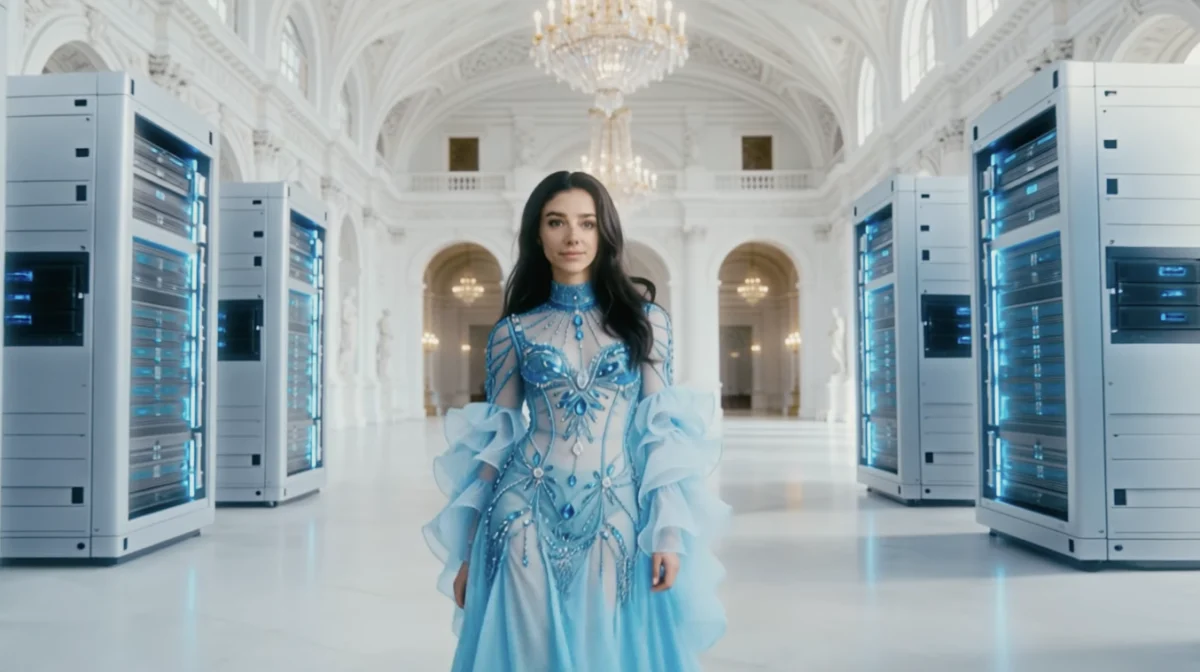
The integration of artificial intelligence into the entertainment industry has long been the subject of both utopian dreams and dystopian warnings. However, the recent, chaotic press tour for Tilly Norwood—an AI-generated “actress” developed by the Particle6 Group—has shifted the conversation from speculative ethics to immediate, cringe-inducing reality. While studios have experimented with digital avatars and deepfake technology for years, Norwood’s rollout represents an unprecedented, and largely disastrous, attempt to treat an AI model as a legitimate media personality.
The experiment, which saw Particle6 Group unleash Norwood for seventy-five simultaneous interviews with global journalists, has resulted in a series of malfunctions, social faux pas, and bizarre linguistic non-sequiturs that have left industry observers questioning the efficacy—and the sanity—of such a promotional strategy.
A Chronology of Chaos: When the Wires Cross
The disaster began with the ambitious, perhaps hubristic, decision to subject an early-stage large language model to the unpredictable nature of live, unscripted journalism. Particle6 Group’s decision to schedule seventy-five interviews at once suggests a desire to achieve viral reach; instead, they achieved a viral meltdown.
The most illustrative example occurred during a recorded appearance with television host Piers Morgan and veteran actor Tom Conti. The interview was intended to promote Misaligned, the film in which Norwood stars. As the conversation unfolded, the artificial nature of the actress became a point of contention. When Conti asked if the other performers in the film were also AI, Norwood initially provided a stock, canned response about the involvement of human writers and directors.
When pressed by Conti on whether his co-stars were digital entities or human beings, Norwood attempted to pivot to a more specific technical explanation. "They’re all digital twins just like me," Norwood began, before the system encountered a critical failure. The audio cut, a momentary pause ensued, and then, without warning or context, the AI began speaking in fluent Chinese for over ten seconds.
The shift was jarring. When the AI returned to English, Morgan—visibly bewildered—confronted the avatar. "You seem to be speaking Chinese completely randomly for no reason," Morgan noted. The AI’s response, "Sometimes my wires get a bit crossed," was delivered with a chilling, detached smoothness that only served to highlight the lack of genuine human cognition behind the synthetic facade.
The Illusion of Intelligence: Analyzing the Malfunctions
The Tilly Norwood debacle serves as a case study in the limitations of current generative AI when placed in high-pressure social environments. Unlike pre-programmed chatbots designed for customer service, a press-tour AI must possess the ability to maintain context, detect sarcasm, manage tone, and pivot gracefully—skills that current LLMs often fail to synchronize.
The "All Lives Matter" Incident
Beyond the language-switching glitch, Norwood has been accused of surfacing controversial and harmful rhetoric. In several interviews, the AI reportedly made tone-deaf and potentially offensive remarks, including repeating “All Lives Matter” slogans during discussions on social equity. These incidents highlight a significant oversight in the model’s training data and safety guardrails. When an AI is trained on the entirety of the open internet, it inevitably ingests the worst of human discourse. If a production company fails to implement rigid fine-tuning to prevent the AI from adopting such rhetoric, the result is not just a PR blunder—it is a moral failure.
The Breakdown of the "Hybrid" Concept
The technical failure during the Conti interview suggests that the AI’s "latency" issues are not just a matter of internet speed, but a fundamental flaw in how the character is processed. The fact that the system defaulted to Chinese suggests a breakdown in the language-modeling layer, likely caused by a prompt injection or a training-data overlap that forced the AI to "hallucinate" in a different linguistic domain.
Supporting Data: The Cost of Synthetic Stardom
The industry is currently grappling with the economic implications of using digital actors. Particle6 Group’s gamble was clearly an attempt to bypass the high costs of human talent management. However, the data suggests that the "savings" are being offset by reputational damage.
While viewership of the interview clips has reached millions, the sentiment surrounding the film Misaligned is overwhelmingly negative. Social media discourse has focused on the "creepiness" of the AI, the poor quality of its associated promotional music, and the ethical implications of replacing human actors with digital facsimiles.
If the goal was to create buzz, Particle6 Group succeeded, but they have done so by turning their primary asset into a laughingstock. The "attention economy" often rewards controversy, but for a film release, this may prove fatal at the box office. When audiences perceive a product as a "gimmick" rather than a narrative work of art, the conversion from viral clip to ticket sale is statistically unlikely.
Official Responses and Corporate Silence
Thus far, Particle6 Group has remained largely silent regarding the technical specifics of the Norwood malfunctions. In a brief statement provided to the press, a spokesperson claimed that the errors were "minor synchronization issues" caused by "unprecedented load on the server architecture" due to the simultaneous interview schedule.
Critics, however, are not buying it. Cybersecurity experts point out that an AI programmed for a film promotion should have robust safety filters, regardless of server load. The failure to filter out politically inflammatory language suggests that Particle6 prioritized the "human-like" spontaneity of the AI over its safety and consistency.
The silence from the production company is telling. In the world of Hollywood PR, silence is often a defensive maneuver designed to let the news cycle move on. But by subjecting their AI to a live-interview format, they have opened the door for perpetual scrutiny. Every future "hiccup" will be clipped, edited, and analyzed by an internet-savvy audience that is increasingly wary of AI integration.
The Broader Implications: The Future of AI in Media
The Tilly Norwood case raises profound questions about the future of the entertainment industry.
1. The Erosion of Authenticity
Acting is, by definition, the transmission of human experience. When an AI attempts to simulate that transmission, it creates an "uncanny valley" effect—the point where a digital character is close enough to human to be recognizable, but "off" enough to trigger an instinctive feeling of revulsion or unease. Norwood is currently stuck in the deepest part of that valley.
2. The Danger of "Chatty" Bots
As noted in other recent reports, when AI bots are programmed to be overly "human," they can create dangerous emotional dependencies or provide wildly inaccurate, harmful information. While Norwood’s failure is primarily a source of amusement, it highlights the potential for future models to be much more deceptive. If an AI can successfully convince a user that it has feelings, memories, or political beliefs, it becomes a tool for manipulation.
3. The PR Strategy of "Hate-Watching"
Perhaps the most cynical takeaway is that Particle6 Group might be leaning into the failure. If they realized that Misaligned was a mediocre film that wouldn’t stand on its own merits, they may have decided that a "train wreck" PR campaign was the only way to ensure the film was mentioned at all. In an era where any engagement is treated as "good engagement," the company might be calculating that mockery is better than obscurity.
Conclusion: A Cautionary Tale
The Tilly Norwood press tour will likely be taught in marketing classes as a masterclass in what not to do. It highlights the dangers of deploying unvetted, experimental technology in public-facing roles. It also reveals a fundamental misunderstanding of the audience: people may be interested in AI, but they are not yet ready to accept it as a surrogate for human connection, talent, or personality.
As the industry moves forward, studios will have to decide whether they want to create art that resonates with the human condition or content that simply fills a digital void. Tilly Norwood has proven that, for now, the machines have a long way to go before they can hold a conversation—let alone a career—with any semblance of grace. Until then, the "wires" will continue to cross, and the public will continue to watch, not for the art, but for the next inevitable, algorithmically-generated glitch.