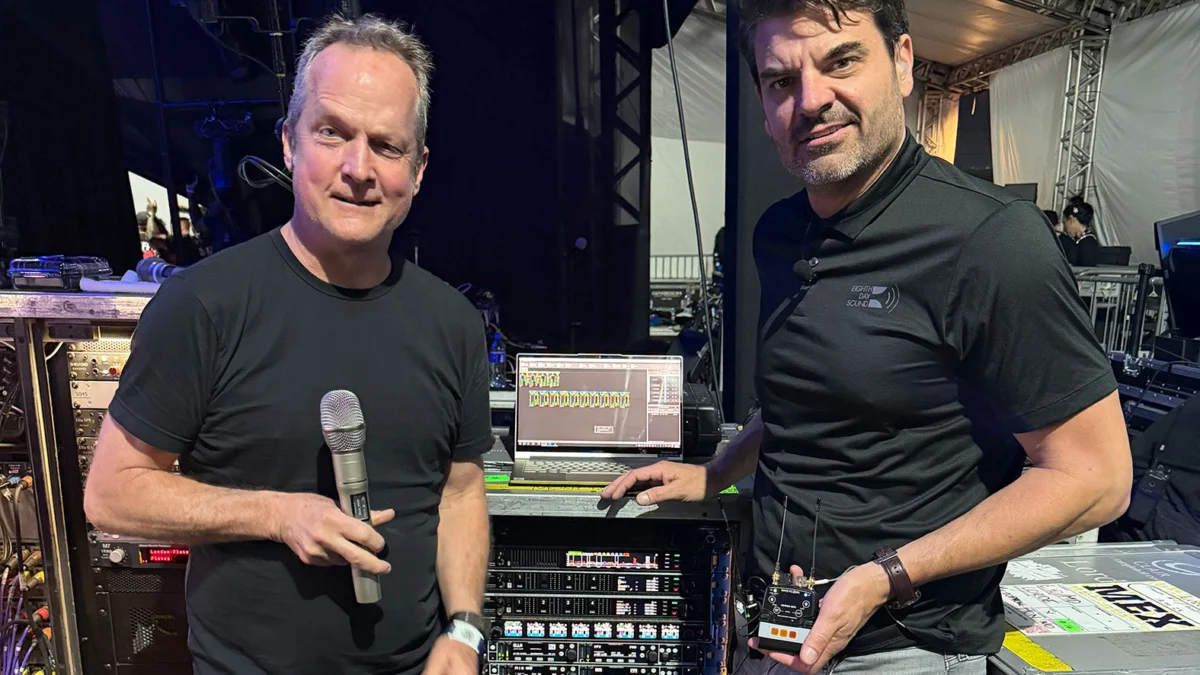
Auckland, New Zealand — September 18, 2026 — As Lorde prepares for the final curtain call of her current world tour at the Austin City Limits Music Festival next month, the sonic blueprint of her live performances stands as a masterclass in minimalist audio engineering. In an era where massive, complex stage setups are the industry standard, Lorde’s touring team has championed a philosophy of "less is more," relying on elite-tier signal chain components to ensure that the intimacy of her vocal delivery remains untarnished by the scale of global arena environments.
At the heart of this operation are Front of House (FOH) Mix Engineer Philip J. Harvey and Monitor Engineer Kevin Glendinning. Together, they have navigated the complexities of international touring by deploying a highly specialized rig anchored by DPA Microphones and Wisycom RF systems. Their work underscores a shift in live sound: prioritizing signal purity and bulletproof reliability over sheer quantity of inputs.
The Philosophy of Minimalism: A Masterclass in Signal Chain
The primary challenge for any pop artist of Lorde’s caliber is balancing the raw, emotional vulnerability of the studio recording with the high-decibel demands of a live concert venue. For Harvey, the solution was found in a remarkably sparse microphone count.
"We are essentially working with just four microphones on stage," Harvey reveals. "Ella’s [Lorde’s] main vocal and three backing vocal mics. Everything else is direct. That makes the quality of those microphones—and the consistency of the entire signal path—even more important. When you don’t have a wall of room mics to hide behind, you have to ensure that every input is pristine."
By eliminating unnecessary stage clutter and relying on direct inputs for instruments, the team has significantly reduced the potential for phase issues and ambient bleed. This creates a "clinical" stage environment, which allows the FOH mix to act as a focused, high-fidelity reproduction of the artist’s creative vision rather than a chaotic battle against room acoustics.
Chronology: From Concept to Global Execution
The design phase for this tour began nearly a year before the first show. Faced with the requirement to perform in venues ranging from intimate theaters to massive open-air festival stages, Harvey and Glendinning had to build a system that was both scalable and inherently portable.
- Phase I: Specification (Late 2025): The engineers evaluated the vocal range and performance style of the artist. They identified the DPA d:facto 4018VL as the essential tool for capturing the wide dynamic range of Lorde’s voice.
- Phase II: RF Infrastructure (Early 2026): With the rise of congested wireless spectrums globally, the team opted for a Wisycom-heavy ecosystem. This choice was dictated by the need for ultra-wideband agility, allowing the crew to quickly re-coordinate frequencies in new regulatory environments across different continents.
- Phase III: The "FOH Performance" Challenge: Mid-tour, the team faced a specific creative requirement: the artist needed to perform segments of the show from the front-of-house mix position. This necessitated a complete overhaul of how RF signals were distributed, moving away from standard stage-centric antenna placements toward a fiber-linked, distributed network.
- Phase IV: Final Optimization (Ongoing): Through the current leg of the tour, the team has fine-tuned the fiber-optic distribution to ensure that whether Lorde is on the main stage or in the center of the crowd, the wireless integrity remains identical.
Supporting Data: The Anatomy of the Rig
To achieve this level of sonic consistency, the engineering team relies on a standardized hardware profile. The equipment list is not defined by excess, but by high-performance redundancy.
The Vocal Chain
The DPA d:facto 4018VL is the undisputed star of the signal chain. According to Harvey, the capsule’s ability to handle extreme transients—the jump from a whisper to a scream—without losing the harmonic richness of the source is unmatched. "To me, it’s the most natural-sounding microphone out there," Harvey says. "Whether it’s a whisper or a full-on scream, the d:facto captures everything with incredible detail and consistency."
The Wireless Ecosystem
Kevin Glendinning’s monitor world is built entirely around the Wisycom ecosystem. The setup includes:
- Wisycom MPR50 Belt-packs: Known for their extreme linearity and low distortion.
- MTK Transmitters: Providing the robust signal required for high-fidelity in-ear monitoring (IEM).
- MFL Optical Links: The backbone of their distributed RF system.
- CSI16T Combiner: Ensuring that antenna distribution remains clean and devoid of intermodulation distortion.
"We’ve outfitted everyone, from the band to the key crew members, with the same system," Glendinning explains. "Consistency is key. When you have a unified RF environment, troubleshooting becomes a matter of seconds rather than minutes."
Official Insights: The Engineering Perspective
In a candid discussion, the engineers highlighted that the biggest hurdle was not the mix itself, but the wireless coverage. The decision to have the artist perform in the audience area necessitated the Wisycom MFL RF-over-fiber solution.
"We run a Wisycom MFL RF over Fiber to extend coverage out into the audience area," Glendinning notes. "It was all part of the system design from the start, and it’s been flawless. It allows us to maintain a rock-solid link even in the middle of a crowd, which is typically an RF nightmare due to the sheer number of mobile devices and interference sources."
For Harvey, the FOH position is the ultimate litmus test. "The audience doesn’t care about the engineering; they care about the connection to the artist," he explains. "Our job is to make the technology invisible. When we move Ella to the FOH position, the transition has to be seamless. The audience shouldn’t hear a change in tone or a drop in signal strength. Thanks to the fiber-linked RF, the transition is undetectable."
Implications: The Future of Live Sound
The success of the current Lorde tour serves as a blueprint for the "Modern Minimalist" touring aesthetic. By reducing the number of open microphones and relying on high-end, fiber-distributed RF systems, the team has successfully mitigated many of the traditional risks associated with arena-scale audio.
1. The Death of Ambient Clutter
As touring costs rise and sustainability becomes a larger concern, many engineers are looking at the "four-mic" approach. Reducing the physical footprint of the backline and the complexity of the drum kit miking leads to lower shipping costs, faster load-ins, and ultimately, a cleaner, more phase-coherent mix for the audience.
2. The Fiber Revolution
The implementation of RF-over-fiber is no longer a luxury—it is becoming a necessity for artists who want to bridge the gap between the stage and the crowd. The Lorde tour proves that long-distance wireless distribution is reliable, provided the hardware is designed for modularity and high-speed data transmission.
3. Consistency in Monitoring
Glendinning’s insistence on putting the entire crew and band on the same Wisycom system highlights a growing trend toward standardized monitoring. By centralizing the RF management, the monitor engineer can monitor the health of every belt-pack in real-time, preemptively identifying battery drain or interference before it becomes an audible issue.
Conclusion
As the final dates of the tour approach at Austin City Limits, the legacy of this production will be one of sonic precision. Lorde’s team has demonstrated that in an industry often obsessed with "more"—more speakers, more mics, more processing—the path to excellence often lies in refining the essentials. Through the expert application of DPA capsules and Wisycom’s robust RF-over-fiber infrastructure, Harvey and Glendinning have ensured that the emotional core of Lorde’s music reaches every seat in the house, regardless of where the artist stands.
As the industry moves toward 2027, this tour will likely be cited as a benchmark for how to effectively combine technical complexity with a minimalist aesthetic, proving that the most powerful sound is often the most focused.