Washington, D.C. (September 17, 2026) — As the United States marked its 250th anniversary this year, the nation’s capital became the stage for one of the most ambitious commemorative spectacles in modern history. Among the myriad of celebratory events held across the country, the July 4th projection show on the Washington Monument stood out as a landmark achievement in both artistic expression and technical engineering. Tasked with the monumental challenge of transforming the 555-foot marble obelisk into a living canvas, industry-leading technical production firm LMG executed a display that blended historical narrative with cutting-edge visual and sonic technology.
The event, which ran for six nights in July, served as a focal point for the “Freedom 250” celebrations, drawing massive crowds to the National Mall. Through a combination of high-intensity projection mapping and a complex, adaptive audio architecture, LMG successfully turned a static national icon into a dynamic vessel of American history.
The Technical Framework: A Canvas of Light
The visual centerpiece of the Freedom 250 celebration was designed by artist and videographer Kyle Barrett. His vision required a surface that could accommodate intricate, large-scale imagery, ranging from the maritime journeys across the Atlantic that shaped the colonial era to the westward expansion of covered wagons and the industrial majesty of the 20th-century skyline, symbolized by the Empire State Building.
To achieve this, LMG deployed a sophisticated array of Barco projectors, powered by a Ross Vertex media server ecosystem. Projection mapping onto a structure as slender and tall as the Washington Monument presents unique geometric challenges, particularly regarding edge blending and keystone correction. The Ross Vertex system allowed for real-time rendering and precision calibration, ensuring that Barrett’s high-fidelity illustrations remained crisp and aligned despite the monument’s extreme verticality and the environmental variables of an outdoor setting in mid-summer Washington.
Chronology of Execution
The project was not merely a single-night performance but a sustained six-night engagement that demanded rigorous stability and consistent performance.
- Pre-Production (Spring 2026): LMG’s engineering team utilized L-Acoustics Soundvision software to model the acoustics of the National Mall. The primary goal was to ensure even coverage for the crowds expected to gather in an oval-shaped, 600-by-400-foot perimeter around the base of the obelisk.
- Installation (Late June 2026): Technical crews mobilized to the Mall, installing the massive array of projectors and the redundant audio infrastructure.
- The July 4th Premiere: The launch night saw record-breaking crowds. During the live event, the technical team observed an unprecedented surge in attendance, with the density of the crowd significantly exceeding the original safety and sightline projections.
- Adaptive Response: Mid-event, the LMG team executed a series of on-the-fly adjustments to the sound system to account for the unexpected crowd distribution, ensuring that the audio experience remained immersive for those both inside and outside the primary viewing perimeter.
Supporting Data: The Architecture of Sound
While the visuals captured the eyes of the attendees, the sonic experience was managed with equal precision. LMG Audio Systems Director Robby Schlegel noted that the audio design was a feat of adaptability.
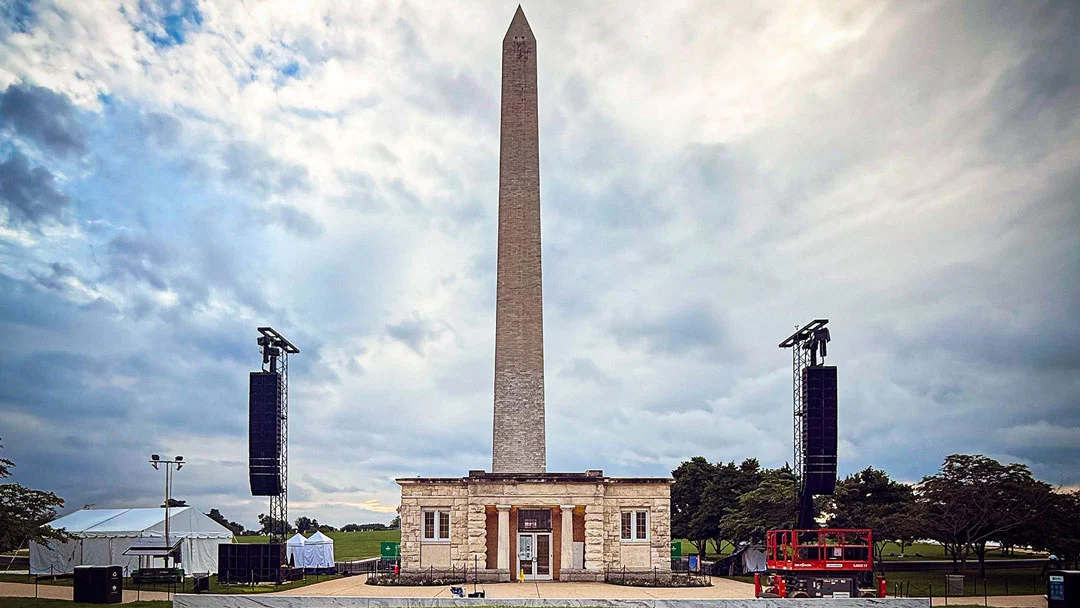
"The audio setup for the projection was designed using L-Acoustics Soundvision software, with the expectation that the crowds would be kept outside an oval-shaped, 600-by-400-foot perimeter around the obelisk," Schlegel explained. "Onsite, however, it became clear that more people would be inside the oval than outside. Consequently, we ended up spinning some of the arrays 180 degrees, with the north and south towers facing inside toward the monument, while the larger towers on the west side covered the rest of the mall."
The final configuration of the system was a masterclass in large-scale event audio engineering:
- Mall East System: Comprised main arrays of eight K1 over six K2 per side, with six KS28 subwoofers stacked in two sets of three. The out-fills utilized arrays of three L2 per side, also bolstered by six KS28 subs in two stacks of three.
- Mall North and South Fills: These were identical in configuration to ensure symmetry, consisting of arrays of three L2 per side and eight K1-SB subwoofers per side, organized in two stacks of four.
- Amplification and Processing: The power behind this massive output was managed by LA12X amplified controllers for the K Series, while LA7.16 units drove the L2 delay components. The entire signal chain was governed by a pair of P1 processors, ensuring phase coherence and signal integrity across the vast expanse of the Mall.
Official Responses and Client Satisfaction
The complexity of the project placed significant pressure on the LMG team to maintain the integrity of the show under the watchful eye of the National Park Service and the celebratory public. According to internal reports, the collaboration between the artistic team and the technical crew was seamless, a necessity for a project of this scale.
Robby Schlegel expressed deep satisfaction with the outcome, emphasizing that the adaptability of the L-Acoustics hardware and software was the deciding factor in the event’s success. "It went phenomenally well and we heard nothing but great responses from our client," Schlegel stated. "It was one of LMG’s most innovative projects yet, and L-Acoustics speakers and software were essential to the event’s success."
The client, representing the Freedom 250 organizers, lauded the production for its ability to balance the solemnity of the Washington Monument with the celebratory spirit of the nation’s milestone birthday.
Implications for Future Landmark Productions
The Freedom 250 project sets a new benchmark for how national monuments can be utilized for public art. By successfully navigating the technical hurdles of 360-degree projection mapping and high-density outdoor audio coverage, LMG has demonstrated that historical preservation and modern digital art are not mutually exclusive.
The implications of this project are twofold. First, it proves that "agile" event engineering—the ability to pivot physical speaker arrays and recalibrate projection mapping in response to real-time crowd behavior—is now a requirement for major public gatherings. Second, the use of advanced simulation software like Soundvision has moved from a "nice-to-have" to a mission-critical tool, allowing firms to predict and mitigate potential sound degradation in complex urban environments.
As the nation looks forward, the technical success of the July 4th display serves as a blueprint. Future events at national landmarks will undoubtedly be held to the standard set by LMG’s Freedom 250 presentation: a harmonious blend of historical reverence, artistic vision, and a rigorous, data-driven approach to technical production.
The Washington Monument, often a silent sentinel of American history, spoke volumes this summer, proving that when technology is handled with expert care, the past can be vividly and powerfully brought into the present.