By Audio News Desk
In the fast-evolving landscape of portable high-resolution audio, dongle DACs have transitioned from simple convenience accessories into formidable audiophile powerhouses. Companies continually push the boundaries of what miniaturized digital-to-analog converters can achieve.
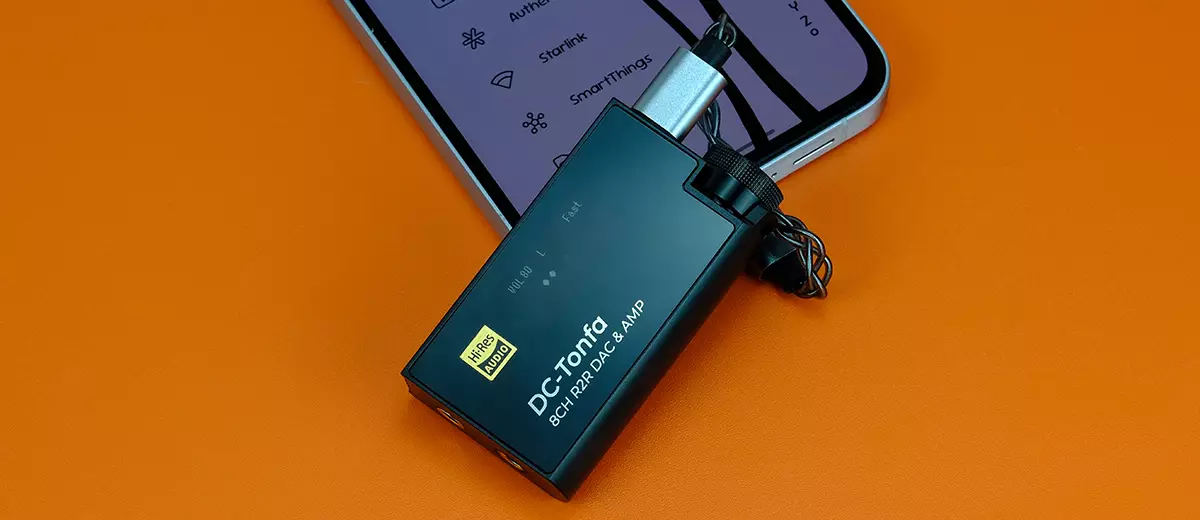
Entering this competitive fray is the new iBasso DC-Tonfa, a discrete R2R dongle DAC priced at $359.00. Co-developed in collaboration with Japan’s prominent audio retailer e-earphone, the DC-Tonfa represents a deliberate design shift for iBasso, trading sterile precision for a rich, analog-focused musicality.

Main Facts: The Anatomy of the iBasso DC-Tonfa
The iBasso DC-Tonfa is a sophisticated portable audio device built around a discrete-engineered, 8-channel, fully differential R2R (Resistor-to-Resistor) ladder architecture. Designed to bridge the gap between high-end desktop gear and pocket-sized mobility, the unit boasts an impressive technical blueprint:
- Price: $359.00 USD.
- Architecture: Discrete 8-channel fully differential R2R DAC utilizing 312 ultra-low-temperature-drift Viking metal film resistors (including 60 dedicated to a hardware resistor compensation network).
- Amplification & Power: Driven by 2 x dual TI op-amps and 4 x BUF634A buffers, delivering up to 800mW of balanced output power into a 32-ohm load.
- Noise Floor Management: Features an integrated Linear LT3042 ultra-low-noise LDO (0.8 µV output noise, 100 dB PSRR) to ensure a black background even with sensitive in-ear monitors (IEMs).
- Digital Signal Processing: Powered by dual Accusilicon femtosecond crystal oscillators and iBasso’s proprietary FPGA-Master system for superior jitter control and clock synchronization.
- File Support: Native playback up to 32-bit/768kHz PCM and DSD512.
- Connectivity & Outputs: Features a USB-C port supporting UAC 1.0/2.0 protocols, along with 3.5mm single-ended (which doubles as an S/PDIF coaxial output) and 4.4mm balanced headphone outputs.
Chronology: The Evolution of iBasso’s Portable Lineup
To understand the strategic significance of the DC-Tonfa, one must trace iBasso’s recent trajectory in the portable audio market. Over the past few years, the brand has established itself alongside competitors like Cayin as a heavyweight producer of elite portable gear.
- Late 2023 – 2024 (The DC-Elite Era): iBasso released the DC-Elite, a flagship dongle widely praised for its exceptional clarity, technical precision, and adoption of a 24-step stepped attenuator. It quickly became a staple for audio enthusiasts traveling to international trade shows.
- Mid-2025 (The Nunchaku Introduction): The company introduced the Nunchaku, which incorporated a 0.96-inch OLED display, a multi-function rotary dial, and a distinct vacuum tube-inspired sound mode, emphasizing visual feedback and granular controls.
- Late 2025 / Early 2026 (The R2R Expansion): Leveraging its R2R engineering expertise previously reserved for high-end digital audio players like the DX270, iBasso began experimenting with discrete ladder DACs in smaller form factors.
- Current Launch (The DC-Tonfa Collaboration): Partnering directly with Japanese retail giant e-earphone, iBasso synthesized consumer demand for higher output power and emotional engagement. The resulting DC-Tonfa combines the display and control mechanics of the Nunchaku with an uncompromised R2R core, hitting the market at a competitive mid-tier price point.
Supporting Data: Performance, Controls, and Ergonomics
Build Quality and Physical Interface
Weighing in on the bulkier side for a dongle DAC, the DC-Tonfa compensates for its footprint with a robust aviation-grade aluminum housing and tempered glass panels. The rounded edges on the right grip side ensure comfortable ergonomics, while the left side features an integrated R2R aesthetic badge.

A 0.96-inch OLED display sits behind a wide glass panel, offering clear visibility of volume, gain states, and active filter modes. Navigation is handled via a guarded multi-function volume/selector dial. Users can click and hold the dial for one second to access the on-screen menu, rotating to adjust parameters seamlessly.
Software Integration
Control over the device is split between the onboard menu system, a web-based UAC control panel for macOS and Windows, and a dedicated Android application (available via the Google Play Store). While iOS users currently lack a native app, the web interface and onboard menus provide complete parity, ensuring no features are locked behind specific operating systems.
Accessories and MagSafe Compatibility
The DC-Tonfa ships with a color-matched grainy leather protective case that wraps tightly around the chassis without obstructing the volume dial or screen. Notably, the rear of the leather case features an integrated MagSafe magnetic ring. While practical for attaching the dongle to an iPhone (such as the iPhone 17 Pro Max), reviewers note that the magnetic hold can be slightly weak during active movement. The package also includes short braided USB-C to USB-C and Lightning cables, alongside a USB-C to USB-A adapter.

Official Responses: Meeting Market Demands
The genesis of the DC-Tonfa lies in direct market feedback gathered by e-earphone from Japanese consumers. According to product development insights shared during the launch, modern portable audio enthusiasts are increasingly shifting away from purely analytical, clinical sound signatures in favor of organic, analog-like presentations capable of driving power-hungry planar magnetic headphones without sacrificing IEM compatibility.
"The DC-Tonfa was designed to capture what our retail partners identified as key consumer desires: substantial output power paired with a deeply engaging, emotional musical delivery," notes the development team. By utilizing 312 Viking metal film resistors alongside a dedicated hardware compensation network, iBasso successfully mitigated the typical thermal drift issues associated with discrete R2R DACs in compact form factors.
Sound Impressions: The R2R Advantage
Evaluated using high-end reference gear—including the PMG Audio Apx, Volk Audio ÉTOILE, and Dan Clark Audio AEON CORE—the DC-Tonfa’s sonic profile marks a clear departure from the cleaner, more clinical presentation of the DC-Elite.

The Analog Signature
The DC-Tonfa delivers a dense, highly textured, and bass-forward sound signature. Rather than leaning into extreme neutrality, it focuses on rich lower-mids and robust weight, offering an energetic, toe-tapping presentation.
NOS (Non-Over-Sampling) Mode vs. OS Filters
A standout feature of the DC-Tonfa is its implementation of NOS mode. While Oversampling (OS) filters provide a more controlled, sedate, and refined presentation, engaging NOS mode unlocks the DAC’s full character:
- Dynamics & Impact: Low-frequency performance gains thundering dynamics, giving electronic and acoustic bass lines palpable physical presence.
- Vocal Imaging: Vocals are brought into sharper, more forward focus.
- Soundstage: NOS mode creates the perception of a wider, more enveloping soundstage compared to the more constrained OS digital filters.
Furthermore, the integration of the Linear LT3042 LDO ensures an exceptionally quiet noise floor. Even when paired with ultra-sensitive multi-driver IEMs, background hiss is virtually nonexistent, and channel balance remains pristine across low-volume listening levels.

Implications: Where the DC-Tonfa Fits in the Audiophile Ecosystem
The release of the iBasso DC-Tonfa at $359.00 establishes a fascinating precedent for the portable audio market. By packing discrete R2R architecture—a topology typically reserved for bulky desktop gear or expensive portable players—into a dongle form factor with 800mW of power, iBasso is effectively democratizing high-end analog sound.
For consumers, the DC-Tonfa blurs the line between portable convenience and desktop-grade performance. It proves that users no longer need to sacrifice musical warmth and emotional connection for the sake of pocket-friendly mobility. As brands continue to refine discrete ladder DACs, the DC-Tonfa stands out as a compelling benchmark for what a modern, co-developed audio product can achieve.