By Headfonics Review Team | August 2026
The current audiophile landscape is defined by an intriguing paradox: while high-resolution streaming services offer millions of tracks at the touch of a button, physical media is undergoing a monumental renaissance. From the enduring appeal of vinyl to the sudden, explosive resurgence of cassette tapes and portable radios, music lovers are eagerly returning to tactile formats.
Over the past eighteen months, however, no retro-styled revival has captured the imagination quite like the portable CD player. Once relegated to thrift stores and dusty drawers, the portable Redbook spinner has been reimagined for the modern high-end market. Brands big and small have rushed to satisfy a growing demographic of consumers who crave the ritual of physical media combined with state-of-the-art digital-to-analog conversion.

Stepping boldly into this burgeoning market is Cayin, a brand universally respected for its masterclass desktop tube amplifiers and high-end digital audio players (DAPs). Priced at $699, the new Cayin CP6 sits comfortably at the premium end of the portable CD player ecosystem. Featuring user-selective triple-timbre modes, a discrete NOS (Non-Over-Sampling) tube amplification stage, a dual-mono DAC architecture, and robust balanced output power, the CP6 promises to bridge the gap between vintage charm and uncompromising modern performance.
Main Facts: Unpacking the Cayin CP6 Ecosystem
The Cayin CP6 is not merely a nostalgia piece; it is a fully realized, high-fidelity audio component engineered for both portable use and desktop system integration.
At its core, the device functions as a dedicated portable CD player, but its feature set extends far beyond simple disc-spinning. It incorporates a custom anti-shock CD mechanism paired with a Class 1 optical laser pickup and a professional servo system. This marks a significant departure from the off-the-shelf budget assemblies typically found in lower-cost competitors.

Key Technical Specifications
- Price: $699 USD
- DAC Architecture: Dual Cirrus Logic CS4308P chips running in dual-mono mode (one per channel) with full differential current outputs.
- USB & Digital Processing: XMOS XU316 16-core USB processor supporting PCM up to 32-bit/384kHz and native DSD256 / DoP256.
- Amplification Stages: Three selectable timbre modes—Solid-State, Classic Tube, and Modern Tube. The tube modes integrate dual Raytheon JAN6418 subminiature pentodes alongside Texas Instruments OPA1652 op-amps.
- Operating Modes: Switchable Class A and Class AB amplification topologies.
- Output Power:
- Single-Ended (3.5mm): 450mW (Battery) / 650mW (12V DC)
- Balanced (4.4mm): Up to 900mW (Battery) / 1.3W (12V DC)
- Wireless Connectivity: Qualcomm QCC3083 Bluetooth 5.4 chipset (LDAC reception max, aptX Adaptive transmission max).
- Display: 2.3-inch color TFT display with a 76 x 284 resolution.
- Weight & Dimensions: Weighing in at approximately 700 grams, placing it firmly in the transportable rather than ultra-portable category.
Chronology and Market Context: The Rise of the High-End Portable Spinner
The rebirth of the portable CD player did not happen overnight. It began as a niche movement driven by independent manufacturers recognizing a gap in the market for dedicated, distraction-free listening devices.
When brands like Moondrop introduced early modern contenders such as the Moondrop DiscDream 2 Ultra, consumer interest was immediate. Audiophiles quickly realized that modern DAC integration could elevate the humble CD far beyond the limitations of 1990s Discman hardware. Soon, competitors flooded the space. FiiO entered the fray with the competitively priced DM15 R2R, while Shanling targeted the tube-loving audiophile crowd with the Shanling EC Zero T.
Cayin’s entry into this arena represents a maturation of the product category. Having spent decades refining desktop CD players and portable tube-amplified DAPs (such as the acclaimed RU9 and various N-series players), Cayin was uniquely positioned to build a device that transcends novelty. The CP6 development cycle focused on solving historical pain points of portable CD playback—namely, skip susceptibility, microphonics from tube elements, and insufficient driving power for demanding over-ear headphones.

Supporting Data and Deep-Dive Feature Analysis
CD Transport and Error Correction
Because Cayin has a long-standing pedigree in manufacturing desktop CD hardware, the CP6 benefits immensely from custom engineering. The integration of a custom anti-shock drive is critical; not only does it prevent skipping during movement, but it also minimizes potential microphonics that could otherwise plague the internal dual vacuum tubes.
The servo subsystem is tuned for high-precision reading and real-time hardware error correction. Impressively, this precision enables a built-in lossless CD ripping capability directly to external USB storage. In terms of media compatibility, the CP6 supports standard 12cm Redbook audio CDs and CD-R discs. However, enthusiasts should note that CD-RW, SACD, DVD-Audio, and compressed data discs (such as MP3 or FLAC data discs) are not supported. Furthermore, users can bypass the internal DAC entirely, utilizing the shared 3.5mm optical or coaxial digital ports to send a raw digital bitstream to an external DAC.
Dual-Mono DAC and Digital Flexibility
Digital-to-analog conversion is handled by dual Cirrus Logic CS4308P DAC chips configured in a true dual-mono layout. Signal management and timing are overseen by a robust 16-core XMOS XU316 USB processor. This ensures that whether you are spinning a standard 16-bit/44.1kHz Redbook CD or streaming high-resolution audio files via USB-C from a laptop or smartphone, the CP6 handles decoding effortlessly (up to 32-bit/384kHz PCM and DSD256).

Wireless integration is equally robust. Powered by Qualcomm’s QCC3083 Bluetooth 5.4 chipset, the CP6 supports high-definition wireless protocols, maxing out at LDAC for reception and aptX Adaptive for transmission.
Amplification and Timbres
The crown jewel of the CP6 is its multi-timbral amplification stage. Users can cycle through three distinct sound signatures:
- Solid-State: Clean, transparent, and neutral, offering rapid transient responses and razor-sharp imaging.
- Classic Tube: Infuses the music with harmonic warmth, a more relaxed upper-midrange, and a liquid analog fluidity reminiscent of vintage desktop gear.
- Modern Tube: Retains tube lushness while sharpening micro-details and expanding soundstage boundaries.
The tube modes leverage dual Raytheon JAN6418 subminiature pentodes paired with TI OPA1652 op-amps for voltage gain. This feeds into a fully discrete push-pull current output stage. Additionally, users can toggle between Class A and Class AB operating modes. While Class A increases current draw and operating temperature to deliver maximum harmonic richness, Class AB optimizes battery efficiency for longer listening sessions.

Industrial Design and Aesthetics
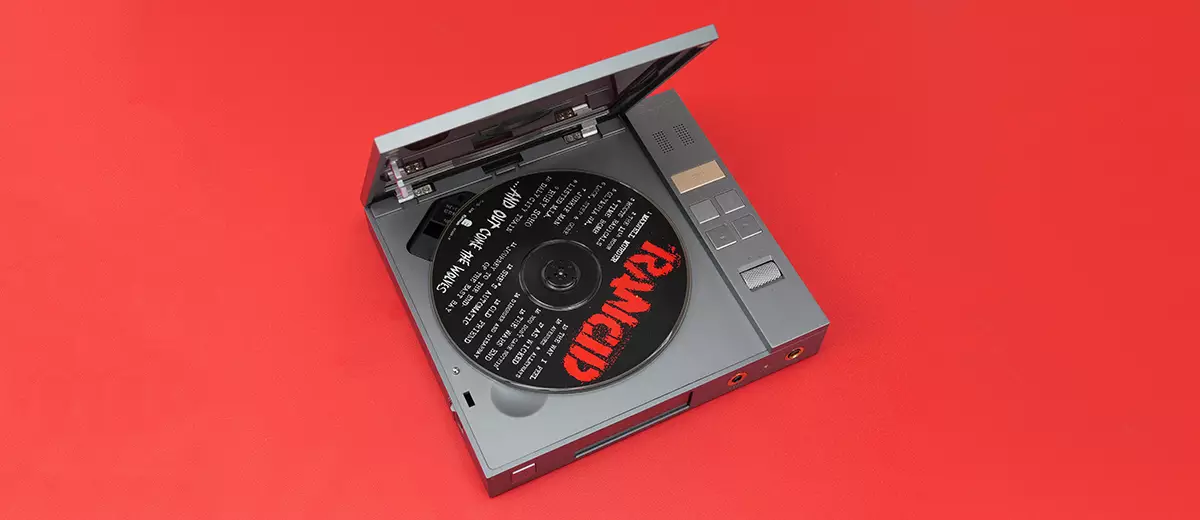
Aesthetically, the CP6 leans heavily into an industrial 1980s minimalist motif while borrowing cues from Cayin’s RU9 design language. Encased in an aluminum alloy chassis with a 180-grit sandblasted matte gunmetal finish, the player features sharp, boxier cornering than typical modern rounded DAPs.
Measuring with a low-profile stance and weighing 700g, it is undeniably hefty. The top-loading CD mechanism is operated via a heavy-duty, smoothly articulating glass-smoke lid secured by a physical latch on the left side. Discs cannot spin while the lid is open, and a charming central "Compact Disc" metal motif sits proudly in the middle of the lid, evoking pure retro appeal.
On the front panel, a warm-toned, narrow letterbox 2.3-inch color TFT display (76 x 284 resolution) provides clear visibility of track data, battery percentages, and system menus from wide viewing angles.

Power Management and I/O
Battery life on the CP6 varies dynamically based on your usage habits. Selecting power-hungry balanced tube modes with low-gain headphone loads yields roughly 5 hours of playback, whereas running single-ended solid-state line-outs can stretch endurance past 10 hours (averaging around 6 to 7 hours under mixed conditions). Quick-charging technologies (QC 3.0 and PD 2.0) shorten full charge times significantly.
For desktop users, Cayin has included a dedicated 12V DC input port alongside a physical DC/BAT toggle switch. Flipping this switch completely isolates and bypasses the internal lithium battery, protecting it from heat degradation during long stationary sessions while unlocking higher internal voltage rails for maximum amplifier output power (up to 1.3W into a balanced load).
Rear-panel connectivity includes dedicated 3.5mm single-ended and 4.4mm balanced line-out ports (supporting both fixed and variable modes), an SPDIF digital output, dual USB ports (for data and ripping), and the DC power inlet.

Official Responses and Manufacturer Intentions
In communications surrounding the launch of the CP6, Cayin emphasized that the device was designed to solve a fundamental dilemma for modern audiophiles: how to enjoy the tactile engagement of physical media without sacrificing the sonic fidelity, power output, and versatility expected from modern high-end audio gear.
By refusing to compromise on the amplification stage—incorporating genuine subminiature tubes alongside discrete push-pull circuitry rather than relying on generic op-amp buffers—Cayin aimed to position the CP6 as a legitimate desktop-class headphone amplifier that happens to feature a built-in CD transport.
However, manufacturer transparency has also extended to software critiques. Cayin’s companion Cayin Control App (available for both Android and iOS) has faced early criticisms for being overly basic. While the app successfully connects via Bluetooth for OTA (Over-The-Air) firmware updates (such as updating to version 1.0.6), it currently lacks deep remote-control customization features. Cayin representatives have acknowledged user feedback regarding app functionality, signaling that future firmware updates will look to expand software integration.

Implications for the Portable Audiophile Market
The arrival of the Cayin CP6 at a $699 price point carries several significant implications for the personal audio industry:
- Legitimization of High-End Portable Spinners: The market has officially graduated from novelty toys to serious, high-end components. With dual-mono DACs, discrete tube stages, and 1.3W of balanced output power, the CP6 proves that portable CD players can compete directly with high-end DAPs and desktop stacks.
- The Transportable Paradigm Shift: Weighing 700g and requiring an optional $99 leather carry case for safe transit, devices like the CP6 redefine "portability." They are best understood as "transportable" gear—easily moved between a bedside table, a workplace desk, and a living room audio rack, rather than slipped into a jeans pocket during a jog.
- The Renaissance of Physical Interaction: As streaming fatigue sets in among audiophiles overwhelmed by infinite song choices, dedicated hardware like the CP6 encourages intentional, album-oriented listening. The ritual of selecting a CD, latching the top lid, watching the disc spin through the smoky glass, and adjusting a knurled volume knob restores a human connection to music consumption that digital playlists often erode.
Summary Verdict
The Cayin CP6 stands as the most comprehensive, feature-rich portable CD player reviewed to date. While it demands a higher investment than entry-level alternatives and lacks advanced software features in its current companion app, its immaculate build quality, versatile multi-timbral tube amplification, and formidable driving power make it a triumphant homage to the golden age of digital audio—refurbished for the modern discerning listener.