In the rapidly evolving landscape of high-end audio, the convergence of digital convenience and analog warmth has long been the "holy grail" for audiophiles. With the release of the NAD M33 V2, the legendary Canadian manufacturer has not only refined its flagship offering but has arguably set a new benchmark for what a modern, all-in-one music hub should represent. Building upon the foundation of its predecessor, the V2 integrates state-of-the-art signal processing, revolutionary amplification, and an uncompromising digital-to-analog conversion architecture.
Main Facts: The New Standard in Integrated Audio
The NAD M33 V2 is more than a simple successor; it is a comprehensive reimagining of the integrated amplifier. At its core lies the second-generation Eigentakt Class D amplification, licensed from Purifi, delivering a robust 200 watts per channel into 8 ohms and a staggering 560 watts of dynamic power into 4 ohms. This efficiency is paired with the ESS ES9039PRO SABRE DAC, a chipset renowned for its clinical precision and breathtaking dynamic range.

Perhaps the most significant addition is the commitment to future-proofing. Through NAD’s signature Modular Design Construction (MDC) platform, the M33 V2 features expansion slots that allow the hardware to evolve as digital standards change, sparing the user the frustration of planned obsolescence. Coupled with the BluOS streaming platform, the M33 V2 acts as a high-resolution command center for everything from MQA-encoded files to high-bitrate streaming services like Qobuz and Tidal.
Chronology: From Olive Green to Modern Elegance
To understand the significance of the M33 V2, one must look at the trajectory of the NAD brand. Five decades ago, NAD disrupted the market by offering high-quality sound in utilitarian, olive-green enclosures that prioritized performance over aesthetics. They were the champions of the "budding audiophile," providing gear that punched well above its price point.

Today, the aesthetic has shifted toward minimalist, sophisticated industrial design—brushed metal and glass—but the DNA remains the same. The transition from the original M33 to the V2 represents a maturation of the Class D philosophy. While early Class D designs were often criticized for a "cold" or "analytical" sound, the M33 V2 utilizes advanced psychoacoustic tuning—specifically the QRONO and FOQUS technologies—to eliminate the temporal smearing and ringing artifacts often associated with digital conversion. This evolution reflects a half-century of engineering refinement, moving from basic amplification to a holistic, digitally-intelligent ecosystem.
Supporting Data: Technical Prowess and Performance Metrics
The performance of the M33 V2 is backed by impressive technical specifications that validate its "Masters Series" pedigree.

Amplification and Power
- Power Output: 200W x 2 into 8 ohms; 380W x 2 into 4 ohms; 700W x 1 in bridged mode.
- Frequency Response: 20–20,000 Hz (±0.2 dB).
- Signal-to-Noise Ratio: >120 dB, ensuring an incredibly quiet background that allows micro-details to shine through.
Digital Precision
The integration of the ES9039PRO DAC is supported by proprietary technologies designed to preserve the integrity of the signal:
- QRONO: A rendering technology for the DAC that mitigates temporal errors and pre/post-ringing artifacts.
- FOQUS: An analog-to-digital encoding technology that enhances the precision of the ADC stage.
- Dirac Live: The unit comes with a Limited Bandwidth license (20-500 Hz) and a calibrated microphone. By correcting the most problematic frequency ranges in a room, the M33 V2 achieves a level of bass clarity that traditional amplifiers struggle to match. For power users, the full-bandwidth upgrade and Dirac Live Bass Control offer surgical precision for multi-subwoofer setups.
Connectivity
The M33 V2 is a versatile workhorse, featuring:

- Analog: Moving Magnet/Moving Coil (MM/MC) phono stage for vinyl enthusiasts, plus balanced XLR and line-level RCA inputs.
- Digital: Two Toslink, two coaxial, AES/EBU, and an HDMI eARC input, which allows the amplifier to integrate seamlessly with modern television setups.
- Wireless: Two-way aptX HD Bluetooth and Apple AirPlay 2 support.
Official Responses and Engineering Philosophy
The development team at Lenbrook (NAD’s parent company) has been vocal about the intent behind the M33 V2. By purchasing MQA and integrating its labs’ technology, they aimed to bridge the gap between studio-master quality and domestic playback. The decision to include modular slots is a direct response to consumer feedback regarding the rapid pace of digital obsolescence.
"The goal," says the engineering team, "was not just to provide power, but to provide a soundstage that is both spacious and effortless." This philosophy is evident in the inclusion of high-current headphone amplification and the meticulous attention to physical build quality, such as the magnetic, non-slip isolation feet that come standard with the unit.

Implications for the Future of Audiophilia
The release of the NAD M33 V2 has profound implications for the high-end audio market.
1. The Death of the "Component Mess"
For years, a high-performance system required a separate preamp, power amp, DAC, streamer, and phono stage. The M33 V2 demonstrates that these functions can coexist in a single chassis without sacrificing audio quality. When compared to traditional Class A/B behemoths—like the reference-grade Musical Fidelity Nu-Vista 600.2—the M33 V2 performs with comparable authority, detail, and musicality, all while occupying a fraction of the space and running at a fraction of the temperature.

2. Streaming as a Primary Source
Ten years ago, streaming was largely dismissed as a "low-fidelity fad." The M33 V2 represents the final nail in that coffin. With support for MQA, FLAC, and high-resolution streaming services, the unit treats digital streams with the same reverence previously reserved for physical media. The ability to use Roon or the BluOS app to navigate vast libraries of high-res music turns the listening room into an infinite archive of sound.
3. The Room Correction Revolution
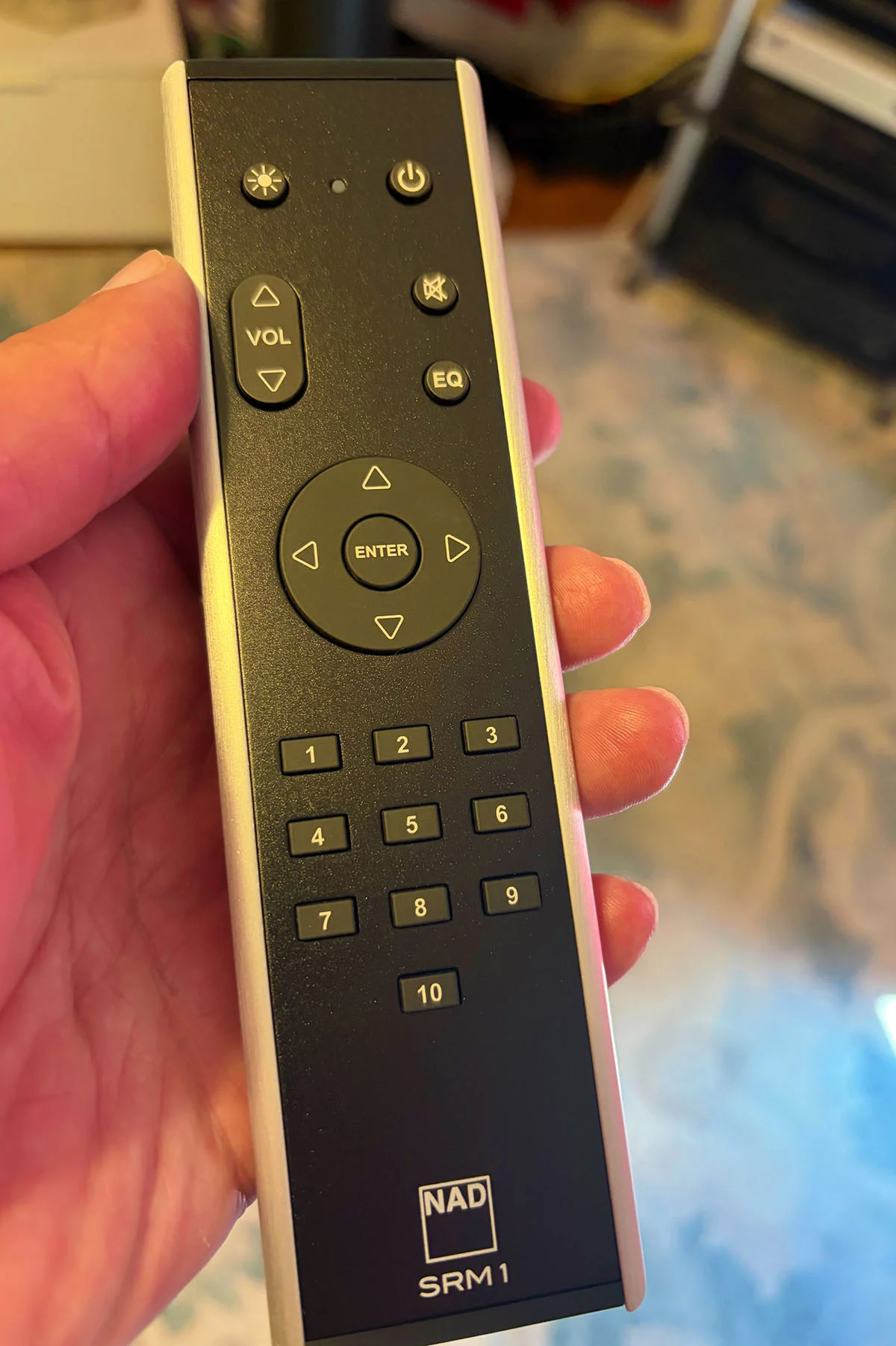
The inclusion of Dirac Live as a standard feature signals that modern high-end audio is no longer just about the gear; it is about the environment. By acknowledging that the room is the final component in the signal chain, NAD has empowered the average user to achieve "Symphony Hall" acoustics in their own living room. The ability to toggle Dirac on and off via the remote allows for an immediate, tangible demonstration of how room acoustics impact the soundstage—a feature that serves as both a tool and an education for the listener.

Conclusion: A Masterclass in Modern Audio
The NAD M33 V2 stands as a testament to the idea that innovation does not have to come at the cost of tradition. It honors the legacy of NAD’s early, performance-focused roots while fully embracing the digital future.
While the BluOS app occasionally suffers from minor timeout glitches—a small hurdle that will likely be addressed in future firmware updates—the overall experience is one of unmatched convenience and sonic excellence. From the visceral punch of a drum kick in a Tom Petty track to the sprawling, cinematic depth of a Mussorgsky orchestral suite, the M33 V2 renders music with a clarity that is both honest and emotionally engaging.

For the modern audiophile, the M33 V2 is not merely an investment in an amplifier; it is an investment in a versatile, future-proof media hub that invites the listener to stop worrying about the hardware and start engaging with the music. It is, quite simply, a masterclass in modern design, proving that you don’t need eighty pounds of steel to capture the soul of a performance.