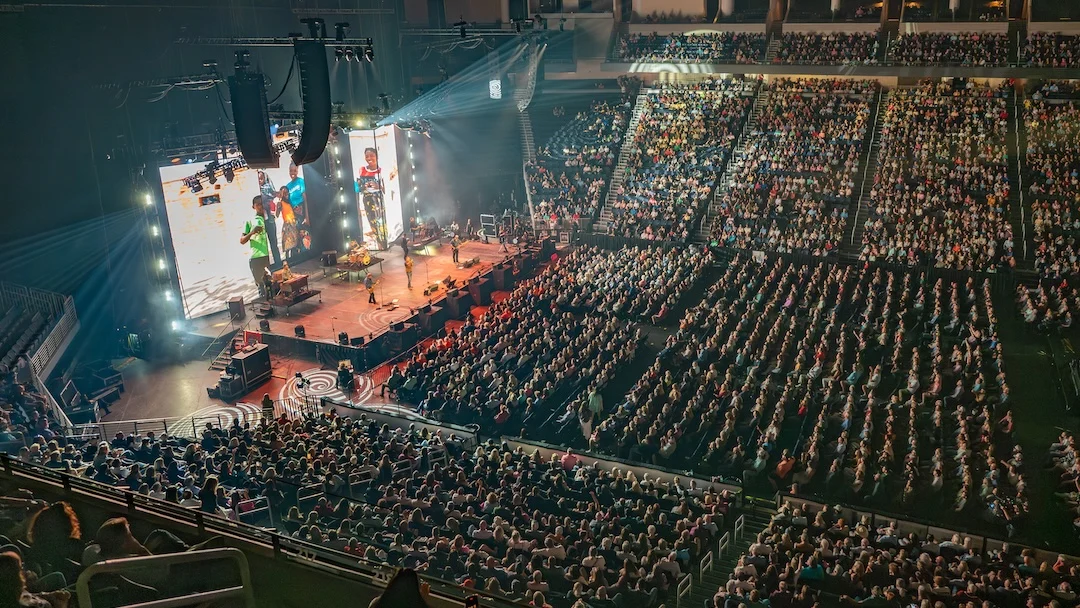
NASHVILLE, TN — In the landscape of contemporary Christian music (CCM), few names carry as much weight or history as Third Day. Emerging from the suburban sprawl of Marietta, Georgia, in the early 1990s, the band became a defining force in the genre, blending Southern rock sensibilities with faith-driven lyricism. Now, as the group celebrates its 30th anniversary, they have returned to the road for a landmark 30-city reunion tour that serves as both a retrospective of their storied career and a masterclass in modern live sound production.
To meet the sonic demands of this high-profile trek, Nashville-based production powerhouse CTS AVL partnered with tour promoter Awakening Events to deploy a massive JBL VTX P.A. system. The tour represents a significant technological leap for the band, ensuring that their multi-decade catalog—ranging from intimate acoustic ballads to high-energy rock anthems—reaches every corner of the venue with studio-grade clarity.
The Main Facts: A Milestone Reunion
The "Third Day 30th Anniversary Tour" is more than just a series of concerts; it is a calculated production effort designed to honor the band’s legacy while utilizing 2026’s cutting-edge audio technology. The tour encompasses 30 major markets across the United States, reflecting the band’s three decades of influence.
Central to the tour’s success is the partnership between CTS AVL and Awakening Events. CTS AVL, a leader in full-service audio, video, and lighting solutions, was tasked with creating a sonic environment that could handle the vocal nuances of frontman Mac Powell and the intricate instrumentation of a seasoned rock ensemble. The solution was a comprehensive JBL Professional VTX system, powered by Crown amplification, a combination known for its reliability and high-output transparency.
The production footprint is substantial. The primary audio rig consists of 32 JBL VTX A12 line array loudspeakers, supplemented by side hangs, flown and ground-stacked subwoofers, and a sophisticated monitoring package. This setup allows the production team to maintain consistent coverage in a variety of venues, ranging from modern arenas to older, acoustically challenging theaters.
Chronology: Thirty Years of Third Day
To understand the significance of this tour, one must look back at the trajectory of Third Day. Formed in 1991 by Mac Powell and Mark Lee, the band spent their early years playing small churches and local venues before signing with Reunion Records.
- The 1990s: Foundations and Breakthrough: Their self-titled debut in 1996 established them as a "Southern rock" alternative in the CCM world. By 1997’s Conspiracy No. 5, they were experimenting with alternative rock sounds, earning their first Grammy nomination.
- The 2000s: Global Dominance: The turn of the millennium saw the release of Offerings: A Worship Album, which went platinum and cemented their place as leaders in the worship music movement. Throughout the 2000s, the band racked up four Grammy Awards and 24 Dove Awards, releasing hits like "Cry Out to Jesus" and "Show Me Your Glory."
- The 2010s: Continued Relevance and Farewell: The band continued to evolve, exploring blues and country influences. However, in 2018, they announced a farewell tour, seemingly closing the chapter on their collective career to pursue solo projects and pastoral work.
- 2026: The 30th Anniversary Reform: The current tour marks a significant "reforming" of the group. Recognizing the milestone of 30 years since their debut, the band decided to reunite for a limited but highly produced run, bringing their career full circle.
This chronological journey is reflected in the tour’s setlist, which requires a sound system capable of transitioning from the raw, grunge-influenced tones of their early work to the polished, anthemic production of their later years.
Supporting Data: The Technical Architecture
The technical specifications of the tour reveal a commitment to high-fidelity sound. CTS AVL’s deployment of the JBL VTX series is a testament to the system’s versatility.
The Main Array and Side Coverage
The primary arrays feature two hangs of 16 JBL Professional VTX A12 loudspeakers. The A12 is designed to provide high-frequency clarity and consistent horizontal coverage. By using 16 boxes per side, the team ensures sufficient vertical throw to reach the highest balconies in larger theaters. To handle wide-seating configurations, the team added two hangs of 12 VTX A12 loudspeakers for side-fill, ensuring that the "off-axis" audience members receive the same tonal balance as those in the center.
Low-Frequency Management
Low-end reinforcement is a critical component of Third Day’s Southern rock sound. The tour utilizes a hybrid subwoofer configuration:
- Ground-Stacked: 18 JBL Professional VTX B28 dual 18-inch subwoofers are placed in front of the stage to provide physical "impact" for the floor audience.
- Flown: 12 VTX B28 subwoofers are flown alongside the main arrays. Flying subwoofers helps to provide more even bass distribution throughout the venue, particularly in the upper tiers where ground-stacked bass often loses its definition.
Monitoring and Front Fill
For the performers, the stage environment is managed by five JBL Professional VTX F12 loudspeakers. Monitoring for the rhythm section—crucial for a band with Third Day’s timing—is supported by two JBL Professional VTX B18 subwoofers dedicated to the drum and keyboard risers. To bridge the "sonic gap" for fans in the front rows who are too close to the main arrays, eight JBL Professional VRX932 loudspeakers are used as front fills.
Power and Processing
The entire system is driven by Crown I-Tech 12000HD and Crown I-Tech 4x3500HD amplifiers. These units are not merely power sources; they provide the Digital Signal Processing (DSP) necessary for the VTX presets, ensuring that the speakers operate within their optimal parameters.
Official Responses: Insights from the Front of House
The dual role of Front of House (FOH) Engineer and Tour Manager (TM) is a demanding one, but for Curtis Flatt, the JBL VTX system provided the necessary peace of mind to handle both responsibilities.
“This was my first tour with the JBL A12 system, and CTS sent out the perfect crew for it,” said Flatt. He emphasized that the physical design of the system was just as important as its sound. “The ease of flying the rig allowed the team to move quickly and effortlessly. As both TM and FOH on the tour, that made the audio side something I didn’t have to worry about.”
Flatt also noted the specific acoustic challenges of the 30-city run. “We played several older, acoustically challenging venues, but vocal clarity remained exceptional night after night. With audience levels regularly exceeding 100 dBA, it was critical that every lyric and spoken moment remained intelligible. The JBL A12 system consistently delivered that clarity in every room.”
The success of the tour is also attributed to the specialized crew provided by CTS AVL:
- Project Manager: Trent Stegink
- FOH System Tech: Jonathan Smith
- Monitor Engineer: Jeremy Simmons
- Systems Engineer: Josiah Novinger
- Lead Patch: Brooke Colebank
This team’s expertise in managing the complex "patch" and system tuning allowed the band to focus entirely on their performance.
Implications: A New Standard for CCM Touring
The Third Day 30th Anniversary Tour sets a significant precedent for the Christian music industry. Historically, faith-based tours often operated on tighter budgets with smaller production footprints compared to their mainstream pop and rock counterparts. However, the scale of this tour—and the high-end technology involved—signals a shift.
1. The "Mainstream" Quality of CCM Production
By utilizing a P.A. system of this magnitude, Third Day and Awakening Events are asserting that the message of the music deserves a world-class delivery system. The use of flown subwoofers and 32-box main arrays is a setup typically reserved for top-tier arena tours, indicating that the CCM market is demanding—and supporting—higher production values.
2. The Longevity of Legacy Acts
The success of this reunion tour suggests a robust market for "legacy" acts within the genre. Much like the "Classic Rock" tours of the general market, Third Day’s ability to sell out a 30-city tour three decades into their career proves that their fanbase has matured and remained loyal. This opens the door for other cornerstone CCM bands of the 90s and 2000s to consider similar high-production reunions.
3. Technological Synergy
The partnership between CTS AVL and Harman Professional (the parent company of JBL and Crown) demonstrates the importance of integrated ecosystems. The ability to control the entire signal chain—from the processing in the Crown amps to the physical transducers in the JBL boxes—allows for a level of "predictability" in sound that is essential for a tour moving through 30 different rooms in 30 days.
4. Impact on Future Live Sound Trends
As live sound technology continues to evolve toward 2030, the emphasis on "ease of rigging" and "vocal intelligibility" remains paramount. The feedback from the Third Day tour reinforces the trend that FOH engineers are looking for systems that reduce the workload on-site without compromising on the high-SPL (Sound Pressure Level) requirements of modern rock concerts.
Conclusion
Third Day’s 30th Anniversary Tour is a celebration of more than just music; it is a celebration of a lasting connection between a band and its audience. Through the technical expertise of CTS AVL and the sonic precision of the JBL VTX A12 system, that connection is being amplified more clearly than ever before. As the spring leg of the tour concludes, the industry is left with a clear example of how legacy, faith, and high-end engineering can converge to create an unforgettable live experience. For Mac Powell and company, the last thirty years were just the beginning of the story; the next chapter, it seems, will be heard loud and clear.