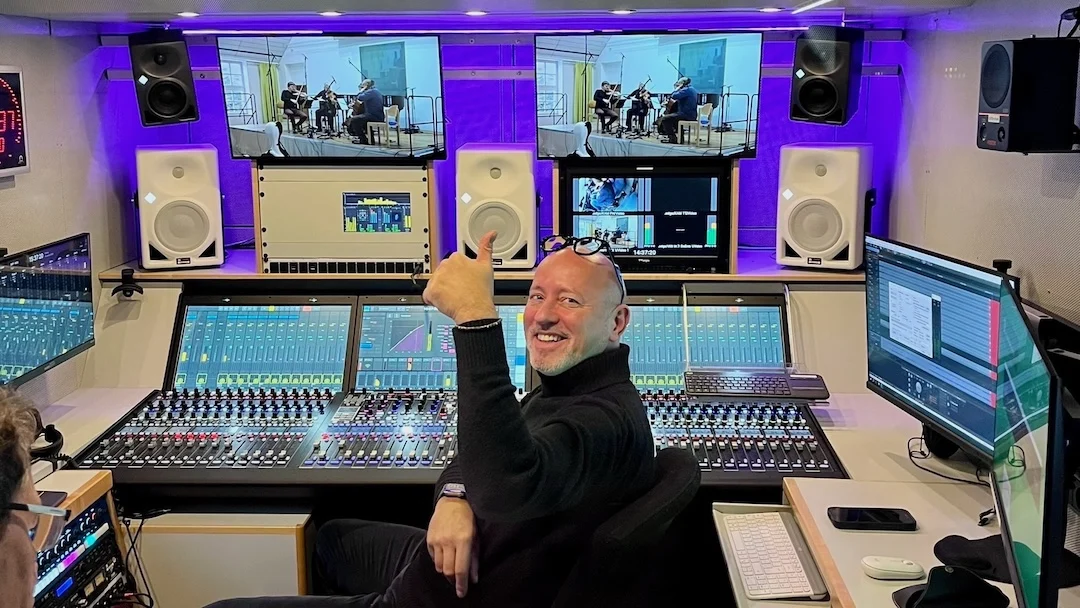
RASTATT, GERMANY — In a move that signals a definitive shift in the landscape of mobile media production, the prominent German public broadcaster Bayerischer Rundfunk (BR) has officially unveiled its newly redesigned outside broadcast (OB) vehicle, Ü5. While the vehicle may share the physical dimensions of its predecessor, its internal architecture represents a radical departure from traditional broadcast engineering. By implementing a fully software-based production environment powered by Lawo’s HOME-native applications and SMPTE ST 2110 networking, BR has transformed a 2007-era chassis into one of the most advanced mobile audio facilities in Europe.
This transition from hardware-centric to software-defined infrastructure marks a milestone for BR, providing the flexibility required to handle the diverse demands of modern media, from high-stakes sports coverage to the nuanced requirements of live orchestral performances.
I. Main Facts: A Paradigm Shift in Mobile Production
The core of the Ü5’s transformation lies in its move away from dedicated, proprietary hardware processing toward a virtualized, server-based environment. At the heart of the audio control room is the Lawo mc²56 MkIII production console, featuring a 48-fader surface designed for high-density workflows. However, unlike traditional consoles where the "brain" is a dedicated hardware frame filled with proprietary cards, the Ü5’s audio processing is managed by the HOME mc² DSP App.
This application runs on standard industrial CPU servers, allowing for a level of scalability and agility previously unattainable in the confined space of an OB van. The vehicle’s technical suite is further bolstered by:
- Lawo Power Core Gateways: Handling onboard and stagebox I/O.
- HOME Multiviewer and Stream Transcoder Apps: Providing essential monitoring and signal conversion within the software layer.
- Lawo .edge Interface: Facilitating seamless SDI video connectivity and high-density audio embedding/de-embedding.
- SMPTE ST 2110 & AES67 Standards: Ensuring full interoperability across the IP network for all audio, video, and control data.
The Ü5 is designed to be a "multi-tool" for BR, capable of transitioning between sports broadcasts, large-scale concert productions, and complex cultural events like open-air festivals with minimal reconfiguration time.
II. Chronology: From 2007 Chassis to 2026 Innovation
The journey of the Ü5 is a testament to the longevity of high-quality mechanical engineering paired with the rapid evolution of digital technology. To understand the significance of this upgrade, one must look at the vehicle’s timeline:
2007: The Original Build
The Ü5 originally entered service nearly two decades ago. At the time, the vehicle was equipped with the Lawo mc²66, a legendary hardware-based console that served as the industry standard for large-scale remote production. For 15 years, this setup handled the rigors of the road, but as the industry moved toward IP-based workflows and 4K/UHD video, the limitations of fixed hardware began to surface.
2022: The Conceptual Phase
Bayerischer Rundfunk engineers began the conceptual phase for a successor to the aging Ü5 infrastructure. The primary challenge was whether to commission a brand-new vehicle or "retrofit" the existing one. Given the excellent condition of the 2007 chassis and body, BR made the strategic—and sustainable—decision to retain the vehicle’s physical shell while gutting the interior to make room for a "clean-sheet" technical redesign.
2024–2025: Engineering and Integration
During this period, the shift from hardware-reliant DSP to the HOME-native software environment was finalized. This era saw the testing of the SMPTE ST 2110-compliant IP infrastructure, ensuring that audio, video, and control data could coexist on a shared high-speed network without latency or synchronization issues.
July 2026: Official Launch
The Ü5 officially re-entered service in mid-2026, debuting its software-defined architecture. This launch represents the culmination of four years of planning and marks BR’s first mobile platform to operate entirely on the ST 2110 standard.
III. Supporting Data: The Technical Architecture of the Ü5
The technical specifications of the Ü5 reveal the sheer power of software-defined processing. By leveraging the HOME mc² DSP App, BR has bypassed the physical limitations of rack space that usually constrain OB vans.
Processing Power and Scalability
The HOME mc² DSP App is licensed to provide a staggering amount of throughput. Within the Ü5, the system supports:
- 384 Processing Channels: Allowing for complex mixing of massive ensembles or multi-language sports broadcasts.
- 1,280 Inputs/Outputs: Managed through a virtualized routing matrix that replaces thousands of pounds of traditional copper cabling.
- Standard CPU Integration: Because the DSP runs on standard servers, BR can upgrade the "brain" of the truck by simply updating software or swapping out a server, rather than replacing an entire console core.
The Three-Workstation Workflow
The interior layout of the Ü5 has been optimized for collaborative production. The vehicle features three distinct primary workstations:
- Main Audio Engineer Position: Centered around the 48-fader mc²56 MkIII.
- Balance Engineer Position: A secondary station for fine-tuning levels and monitoring specific mix elements.
- Technical & Recording Workstation: Equipped with a Lawo crystal controller. This position allows for independent control of recording parameters and technical monitoring, though it shares the same centralized DSP engine as the main console.
Networking and Interoperability
The use of the .edge interface is critical for the Ü5’s versatility. It provides the bridge between the legacy SDI world and the modern IP world. With high-density SDI-to-IP conversion, the Ü5 can plug into any existing stadium or concert hall infrastructure, regardless of whether the venue has upgraded to IP or is still operating on baseband SDI.
IV. Official Responses: The Engineer’s Perspective
The success of the Ü5 project is largely attributed to the vision of Bayerischer Rundfunk’s technical team. Nicolas Anselm-Rasor, a media engineer at BR, emphasized that this project was far more than a simple equipment swap.
"This was not a conventional retrofit project but rather a complete technical redesign within the existing vehicle," Anselm-Rasor explained. "Ü5 is Bayerischer Rundfunk’s first mobile production platform to operate entirely on SMPTE ST 2110 and to be based on a software-defined architecture."
Anselm-Rasor highlighted that the decision to move to a software-defined model was driven by the need for future-proofing. By decoupling the software (the DSP and mixing logic) from the hardware (the servers and fader surfaces), BR is no longer tied to the life cycle of a specific chip or proprietary processor. If the production requirements grow in two years, they can simply adjust the software licensing or add server capacity.
Lawo, the Rastatt-based technology partner, also noted that the Ü5 represents a "lighthouse project" for the industry. The integration of the HOME Multiviewer and Stream Transcoder Apps directly into the production environment demonstrates how traditional "outboard" gear—like multiviewers and format converters—is now being absorbed into a unified software ecosystem.
V. Implications: The Future of the Outside Broadcast Industry
The successful deployment of the Ü5 has significant implications for the global broadcast industry, particularly regarding sustainability, economics, and operational agility.
1. Sustainability through Modernization
The Ü5 project proves that the life of an OB van does not have to end when its technical gear becomes obsolete. By reusing a 2007 chassis, BR significantly reduced the environmental impact and capital expenditure associated with manufacturing a new vehicle body. This "modernization" model is likely to become a blueprint for other public and private broadcasters looking to meet ESG (Environmental, Social, and Governance) goals.
2. The Death of the "Hardware Core"
For decades, the core of an OB van was a massive, heat-generating hardware frame. The Ü5 signals the end of this era. As software-defined DSP becomes the norm, the physical footprint of the "machine room" will continue to shrink, allowing for more ergonomic workspaces for operators or the inclusion of more production staff within the same vehicle dimensions.
3. Agility in Production Formats
Because the Ü5 is based on ST 2110 and software apps, it can be reconfigured for different tasks almost instantly. A preset for a Bundesliga football match can be swapped for a Bavarian Radio Symphony Orchestra configuration with the touch of a button, adjusting everything from the routing tables to the DSP channel count and the multiviewer layouts.
4. Remote Production (REMI) Ready
While the Ü5 is a fully self-contained unit, its ST 2110 backbone makes it natively ready for remote production. The vehicle can easily act as an edge-processing hub, sending streams back to a central studio in Munich while maintaining low-latency control, a workflow that is becoming increasingly essential in the era of decentralized media production.
Conclusion
Bayerischer Rundfunk’s Ü5 is more than just a new truck; it is a statement of intent. By embracing Lawo’s software-defined ecosystem, BR has ensured that its mobile production capabilities will remain at the cutting edge for the next decade and beyond. As the industry watches the Ü5 navigate the busy 2026 summer season of concerts and sports, it is clear that the "software revolution" in broadcasting has moved out of the laboratory and onto the open road.