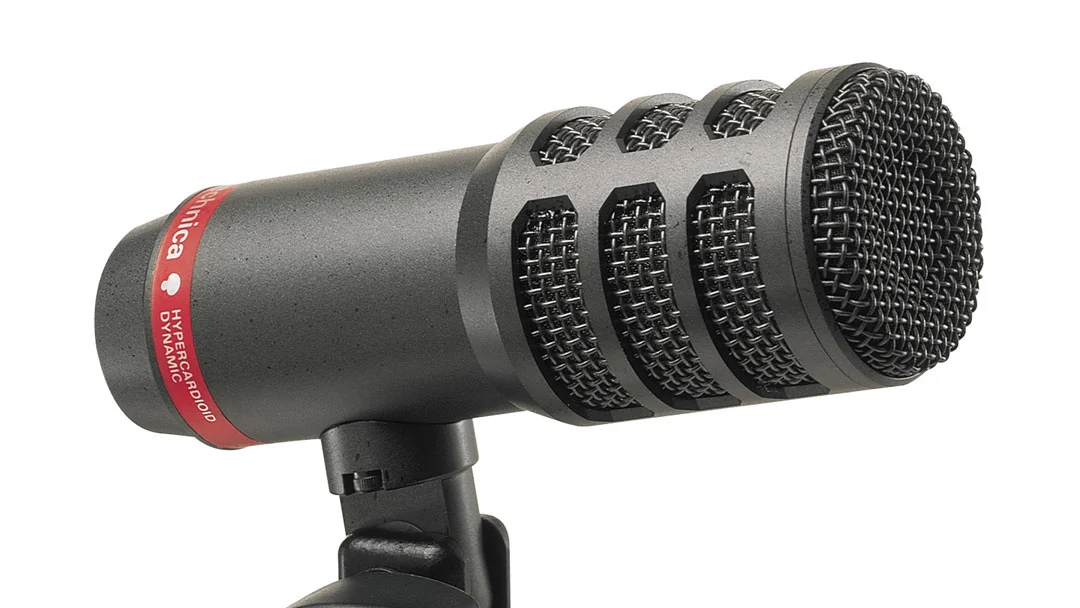
STOW, OH — October 2, 2026 — In an era defined by rapid technological turnover and the relentless pursuit of digital emulation, Audio-Technica has made a bold, counter-intuitive move that will resonate deeply with audio engineers, studio owners, and veteran drummers worldwide. The company has officially announced the re-release of its legendary ATM25 hypercardioid dynamic instrument microphone—a tool that has been absent from the active catalog for years but remains a staple in high-end studio inventories across the globe.
By choosing to bring back the "original" design rather than updating or "improving" it, Audio-Technica is betting on the enduring value of analog heritage. The ATM25, a microphone that defined the sound of kick drums and aggressive percussive transients for decades, is once again available to a new generation of sound professionals who have until now been forced to scour the secondary market for functioning units.
The Core Facts: Why the ATM25 Matters
The ATM25 is not merely another dynamic microphone; it is widely considered a "desert island" mic for percussion. At its core, the ATM25 is a hypercardioid dynamic microphone engineered specifically to thrive under extreme sound pressure levels (SPL). Its claim to fame lies in its unique ability to capture the "punch" of a kick drum while maintaining a warm, full-bodied low-frequency response that never feels thin or brittle.
The microphone’s hypercardioid polar pattern is its most critical feature. By narrowing the pickup area, the ATM25 provides exceptional off-axis rejection, allowing engineers to isolate a kick drum from the bleed of cymbals, snare wires, and the surrounding room environment. This tightly focused capture is the reason the ATM25 became a "secret weapon" for studio engineers throughout the 1990s and early 2000s.
Beyond the kick drum, the ATM25 has historically been the go-to for floor toms, bass guitar cabinets, and brass instruments. Its rugged all-metal construction, paired with a sophisticated multilevel grille, makes it a reliable workhorse for both the high-stakes environment of a professional tracking session and the punishing conditions of a touring stage.
A Chronology of a Classic
To understand why the re-release of the ATM25 is a significant event in the pro-audio industry, one must look back at its origins.
1983: The Birth of a Legend
The ATM25 was first introduced in 1983, a time when the recording industry was transitioning from large-format tape machines to the dawn of digital recording. In this environment, engineers needed microphones that could handle the intense transients of drum kits without overloading the preamps or distorting the signal path. The ATM25 was designed to address this need, quickly becoming a fixture in Japanese studios and eventually gaining a cult following in the United States and Europe.
1990s–2000s: The Golden Era
During this period, the ATM25 achieved near-ubiquitous status. It was the "go-to" kick drum mic for many of the world’s top rock and metal engineers. Unlike many of its competitors, which often favored a heavily "scooped" sound (boosting lows and highs while cutting mids), the ATM25 was praised for its mid-range clarity. This allowed the "beater" of the kick drum to cut through a dense mix, ensuring that the instrument could be heard clearly even on smaller speakers.
The Discontinuation and the "Secondary Market" Drought
As production ceased, the ATM25 became one of the most sought-after "used" microphones on platforms like Reverb and eBay. Prices for clean, working units with the original stand clamp began to climb, signaling that the demand for the microphone had not waned—it had merely become frustrated by a lack of supply. For years, engineers were forced to gamble on aging components, often needing to replace capsules or repair cables, simply because no modern alternative could replicate the exact frequency curve of the original ATM25.
2026: The Return
Following years of feedback from the professional audio community, Audio-Technica has listened. By returning the ATM25 to the assembly line, the company is bridging the gap between the vintage sound of the 80s and the modern demands of 2026.
Supporting Technical Data: The Engineering Behind the Sound
What makes the ATM25 technically superior for its intended applications? The answer lies in its balanced frequency response and its ability to handle "close-up" miking.
- High SPL Handling: The ATM25 is specifically designed to handle extreme sound pressure levels, making it ideal for the "impact" stage of a drum hit.
- Hypercardioid Pattern: This directional characteristic is essential for modern, multi-mic setups. In a professional recording studio, controlling "bleed" is the primary challenge. The ATM25’s ability to reject sound coming from the sides of the capsule is mathematically superior to many standard cardioid dynamic mics, allowing for a cleaner "dry" signal that is easier to compress and equalize during the mix stage.
- Construction: The unit features a robust, all-metal body. In a live sound context, where a microphone might be hit by a drumstick or subjected to the vibration of a stage, this durability is non-negotiable.
- Versatility: While it is synonymous with kick drums, the ATM25 has also seen successful use in broadcast. Its warm, proximity-effect-rich response makes it an excellent choice for close-up voiceover and radio work, where a deep, authoritative tone is required.
Official Responses: "We’ve Changed Nothing"
In an industry that usually demands "new and improved" iterations, Audio-Technica has taken a refreshingly transparent stance. Gary Boss, Senior Marketing Manager for Audio-Technica U.S., was emphatic about the nature of this re-release.
"We’ve changed nothing," Boss stated in a recent press briefing. "This is the classic ATM25, made in Japan, following our original design."
This statement is likely to please purists. In the world of high-end audio, "updates" often result in a change of manufacturing location or a change in component sourcing, which can alter the sonic profile of a classic product. By committing to the original design and keeping production in Japan, Audio-Technica is ensuring that the 2026 model will sound indistinguishable from the units that graced the studios of the late 20th century. This approach effectively eliminates the risk for engineers who have been waiting for a "new" version of a known quantity.
Implications for the Pro-Audio Industry
The re-release of the ATM25 has several implications for the broader audio industry.
The End of the "Vintage Premium"
The secondary market for vintage microphones has long been inflated by rarity. With the re-introduction of the ATM25, the "collector’s premium" on used units will likely stabilize or decline. This democratizes access to high-quality audio tools, allowing independent producers and home studio owners to acquire a professional-grade kick drum microphone at a competitive, new-product price point.
The Value of "Analog Heritage"
This move reinforces a growing trend in the music technology space: the appreciation of classic, non-digital, non-modeled hardware. As AI-based microphone modeling and digital signal processing continue to evolve, there remains a persistent demand for the physical, hardware-based "character" that only a well-designed dynamic microphone can provide. Audio-Technica’s decision suggests that they recognize the long-term value in their own history.
Impact on Future Design
By bringing back the ATM25, Audio-Technica sets a benchmark for its own future product development. If this re-release is successful—as many industry analysts predict it will be—it could lead the company to re-examine other "legacy" products in their archives that have been discontinued but remain highly respected by the engineering community.
Conclusion
The return of the Audio-Technica ATM25 is more than just a product launch; it is a celebration of a sound that has helped shape the history of recorded music. By refusing to compromise on the design and committing to the original, high-quality manufacturing standards that first made the microphone a success in 1983, Audio-Technica has provided a valuable service to the global community of sound engineers. Whether it is being used to capture the punch of a kick drum in a world-class studio or the raw energy of a live bass cabinet on tour, the ATM25 is back to prove that when a design is perfect, it never truly goes out of style.