"We wouldn’t teach reading in a classroom without lights. Why then do we teach in acoustical darkness?"
— John Erdreich, PhD
In the pursuit of educational excellence, school districts spend billions on digital infrastructure, ergonomic furniture, and curriculum reform. Yet, a fundamental environmental variable remains chronically overlooked: the sonic landscape of the classroom. While we prioritize visual clarity, we often neglect "acoustical clarity," leaving students to navigate an environment where sound reflections and background noise actively impede the learning process.
The State of Our Schools: Defining the Problem
For many students, the classroom experience is defined not just by the quality of instruction, but by the struggle to decipher it. In a typical, untreated room, a student might miss as many as one in four words spoken by their teacher. This phenomenon, often described as "acoustical darkness," is not merely a nuisance—it is a significant pedagogical hurdle.
Modern classrooms are rarely designed with human hearing in mind. They are frequently constructed from hard, reflective materials—concrete, glass, and tile—that cause sound waves to bounce repeatedly. This results in reverberation, where words overlap and blur, creating a "muddy" audio environment. In such spaces, the brain must work double-time to fill in the missing gaps, leading to cognitive fatigue, reduced information retention, and heightened stress levels.
A Century of Overlooked Science: Chronology of the Crisis
The struggle for better classroom acoustics is not a new discovery; it is a long-standing challenge that has been documented for over a century.
- Early 1900s: Pioneers in architectural acoustics, most notably Wallace Clement Sabine, began to quantify the relationship between room volume and sound absorption. Despite these early breakthroughs, school design continued to prioritize cost-effective, durable, and hard-surface materials.
- The Mid-20th Century: As classrooms became larger and more crowded, the impact of "noise pollution" in schools became a recognized public health issue, yet policy shifts remained slow and localized.
- 2002: The Acoustical Society of America (ANSI) formalized the Standard for Classroom Acoustics, providing clear guidelines for background noise levels and reverberation times.
- 2012: The conversation reached the mainstream when Julian Treasure’s TED Talk on "The Invisible Architecture of Sound" brought the concept to a global audience, highlighting how sound shapes our well-being and productivity.
- Present Day: Despite these standards, many educational facilities remain "unfit for purpose." While new construction often includes basic acoustic requirements, the vast majority of existing schools rely on outdated designs that actively work against the student’s ability to process complex information.
Supporting Data: The Cost of Noise
The correlation between poor acoustics and academic performance is supported by decades of quantitative research.
According to ANSI standards, an ideal classroom should have a reverberation time of approximately 0.7 seconds. In reality, many untreated classrooms experience reverberation times as high as 1.9 seconds—nearly triple the recommended threshold. This delay creates a "smearing" effect on consonants, which are essential for speech intelligibility.
The consequences are profound:
- Cognitive Overload: When children—particularly those in early developmental stages—must strain to hear, they have less mental energy available for higher-level cognitive tasks like synthesis and analysis.
- Vocal Health Crisis: Teachers are disproportionately affected by poor room acoustics. Studies indicate that educators are 32 times more likely to suffer from vocal strain and long-term damage than other professionals. In an effort to "cut through" the reverberation, teachers raise their voices, leading to a feedback loop of increased noise and persistent injury.
- The Equity Gap: Poor acoustics do not affect all students equally. Those with learning disabilities, Auditory Processing Disorder (APD), or those using hearing aids face a vastly more difficult barrier to entry. For these students, background noise is not just an annoyance; it is an exclusion mechanism.
The Fallacy of Amplification
A common misconception among school administrators is that "more sound is better." In an attempt to solve the intelligibility crisis, many schools install microphone and speaker systems. However, experts in acoustics argue that amplification without treatment is a counterproductive, "band-aid" solution.
If a room is highly reflective, a speaker system simply amplifies the noise, the echoes, and the ambient hum of HVAC units. Instead of clarifying the teacher’s voice, the system increases the overall sound energy, making the room feel louder and more chaotic. Without proper sound absorption, the microphones pick up the very reverberation that needs to be suppressed, effectively compounding the problem. As the adage goes: "If you want to clear the water, you don’t turn up the speed of the pump; you clean the filter."

Acoustic Treatment: A Sustainable Solution
The solution lies in sound absorption. By installing strategically placed acoustic panels on walls and ceilings, schools can effectively "capture" sound energy before it has a chance to reflect.
The Engineering of Silence
Primacoustic and similar firms focus on reducing reverberation time to target levels. The process is remarkably efficient: covering as little as 17–25% of a room’s wall surface can bring a classroom within the recommended 0.7-second reverberation threshold.
This is not a cosmetic change; it is an environmental optimization. When noise is dampened, the room becomes a "critical listening space." The results are immediate:
- Improved Comprehension: Students no longer need to exert extra effort to filter out unwanted noise.
- Behavioral Benefits: Studies have shown that when noise levels are managed, student behavior improves significantly. A quieter room fosters a calmer, more focused atmosphere.
- Teacher Longevity: By reducing the need to compete with ambient noise, teachers can speak at a natural, conversational volume, drastically reducing the incidence of vocal cord pathologies.
Implementation: Flexibility and Aesthetics
Modern acoustic solutions have moved well beyond the industrial look of early studio foam. Today’s treatments are designed to be part of the classroom’s aesthetic.
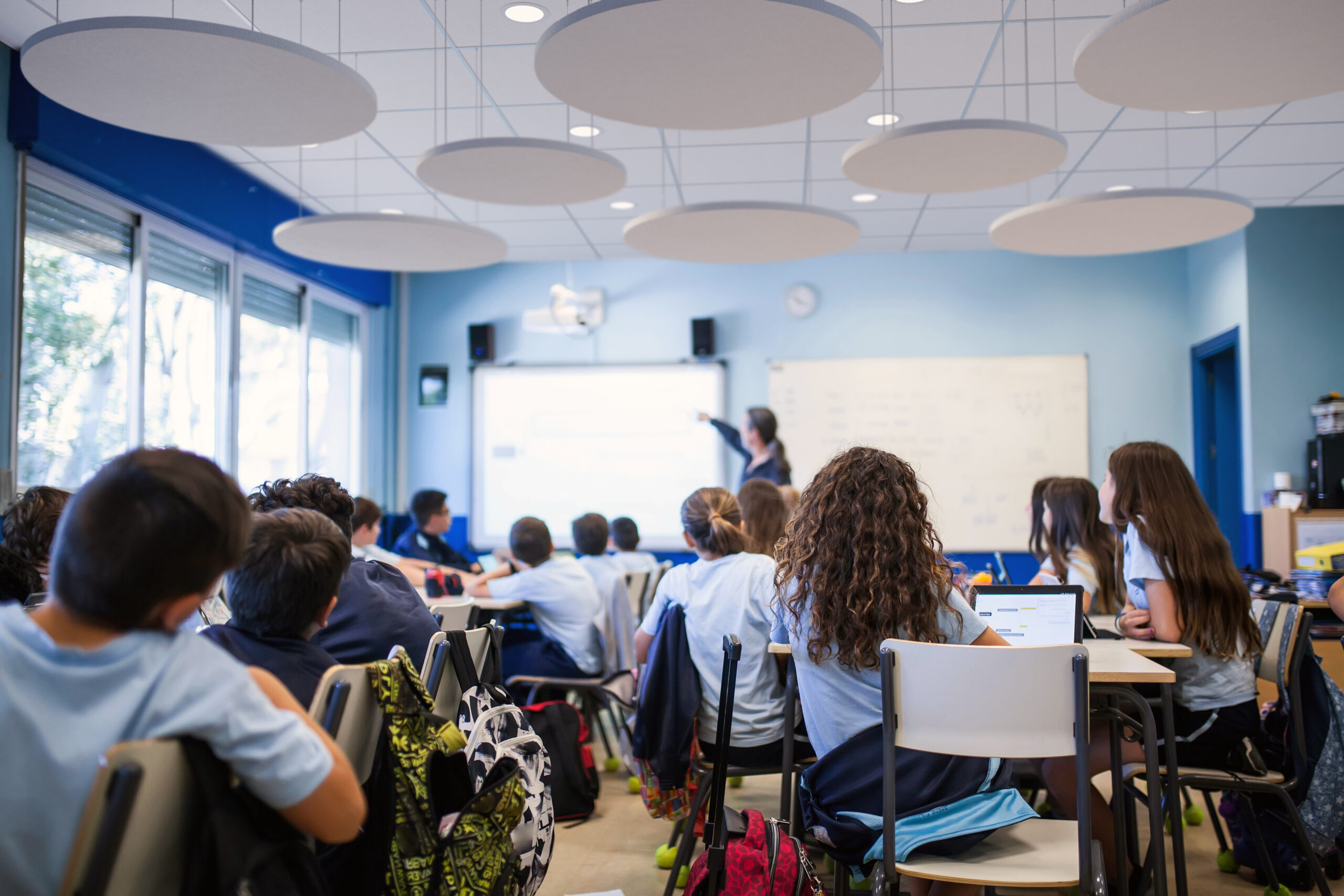
For schools with limited wall space, ceiling-mounted "clouds" and T-bar acoustic tiles offer a high-performance, unobtrusive solution. For those seeking to integrate technology with environment, custom-printed panels allow for the inclusion of educational graphics, school branding, or high-resolution photography. This "invisible" approach—where the treatment becomes part of the decor—ensures that the learning environment remains welcoming while functioning at a professional acoustic standard.

Future-Proofing Education
The investment in acoustic treatment is fundamentally a long-term strategy. Unlike digital hardware that may become obsolete in five years, high-quality acoustic panels are durable and, once installed, require virtually no maintenance.
As we look toward the future of education, the integration of "sonic health" is becoming a critical component of school design. By prioritizing the ability to be heard, we create environments where students are not merely present, but are actively engaged in the learning process.
How to Get Started: A Call to Action
If you are an educator or administrator concerned about the acoustics of your facility, the first step is an audit of your current space. Is there excessive echo? Is there persistent background noise from ventilation?
Primacoustic provides specialized technical support to help school districts assess their specific needs, navigate the technical requirements of the ANSI standards, and design solutions that fit within existing budget constraints. Through consultation and bespoke installation, it is possible to transform any classroom into a high-performance space for learning.
Key Takeaways for Decision Makers:

- Evaluate: Don’t assume the room is fine just because it looks clean.
- Prioritize Absorption: Focus on panels that manage reflection, not systems that simply add volume.
- Think Long-term: Acoustic treatment is a permanent capital improvement, not a temporary gadget.
- Be Inclusive: Remember that the most vulnerable learners stand to benefit the most from a quiet, clear room.
By treating the "invisible architecture" of our classrooms, we can finally turn off the darkness and shed light on the true potential of our students. To learn more about how you can improve your facility’s learning outcomes, visit Primacoustic.com.
References and Further Reading
- The Essex Study: Optimised Classroom Acoustics for All – A foundational analysis on how sound management impacts student performance (Available at ndcs.org.uk).
- Classroom Acoustics for Architects – The official technical guide provided by the Acoustical Society of America regarding standards for educational facilities (acousticalsociety.org).