
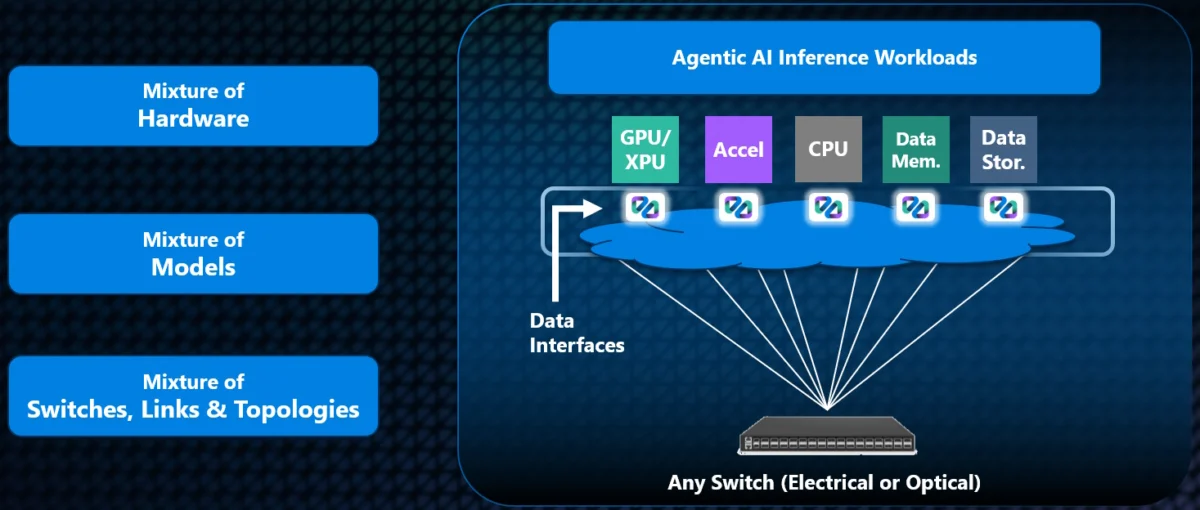
The evolution of computing has been nothing short of a frenetic sprint. From the era of mainframes in the 1980s—where machines existed in splendid isolation—to the hyper-connected, AI-driven landscape of 2026, the progress has been exponential. Yet, as we stand on the precipice of the "Agentic AI" era, the industry is hitting a structural wall. The bottleneck is no longer just the processor; it is the data interface—the "plumbing" that connects our most powerful compute resources.
Delos Data, a company born from the expertise of industry veterans Ed Doe and Dan Daly, is moving to address this with its "Nonstop AI" initiative. By shifting the paradigm from static, monolithic server racks to a fluid, disaggregated, and resilient infrastructure, Delos is fundamentally changing how we define high-performance computing.
A Historical Retrospective: From Dial-up to Digital Intelligence
To understand the magnitude of the current AI infrastructure shift, one must look back at the milestones that defined the last four decades. In 1980, the author’s career began in the trenches of mainframe CPU design. At that time, personal computing was a nascent, isolated hobby. The arrival of the Mosaic browser in 1993 brought the internet into the public consciousness, turning the "@" symbol from an obscure character into a global standard.
By the mid-90s, the web began to "move." The emergence of animated GIFs around 1995 and the arrival of postage-stamp-sized streaming video in 1997 felt, at the time, like the pinnacle of engineering achievement. We could not have imagined the high-definition, real-time video conferencing that is now a mundane feature of our daily professional lives.
The 2000s introduced "The Cloud"—a term that initially confused many before becoming the bedrock of the modern economy. By 2015, "Edge Computing" began to enter the lexicon, signifying the decentralization of intelligence. Today, we take for granted that compute power can be harnessed anywhere, from massive hyperscale data centers to the tiny, power-efficient chips in our pockets. However, the next leap—Artificial Intelligence—requires a degree of sophistication that exceeds the design patterns of the last twenty years.

The AI Pie: Hardware, Software, and the Missing Link
As we focus on AI, specifically within the cloud, the industry has spent billions optimizing the "slices" of the AI pie.
- Software Models: We have seen an explosion in Large Language Models (LLMs), predictive engines, and now, Agentic AI.
- Hardware Evolution: The industry is pouring capital into high-performance GPUs, NPUs, and custom AI accelerators.
- The Overlooked Component: Despite these massive investments, the data interface—the vital connection between processors, memory, and the network—has remained largely unchanged. These legacy interfaces were designed for workloads that look nothing like the dynamic, high-bandwidth demands of today’s AI agents.
Agentic AI: A Paradigm Shift in Processing
A critical distinction is emerging between "Consumer Inference" and "Agentic Inference." In consumer inference, the human-in-the-loop acts as a speed governor; the AI processes a prompt, waits, and receives another. It is inherently slow.
Agentic AI, however, functions at electronic speeds. An agent may autonomously invoke multiple models, interrogate vast databases, and trigger other agents, all without human intervention. This shift is expected to trigger a 300x increase in token processing volume by 2030. In this environment, the data interface can no longer be an afterthought; it must be the core of the infrastructure design.
The Delos Approach: Nonstop AI and MoXI
At the heart of the Delos Data strategy is the concept of Nonstop AI. The philosophy is simple yet radical: at the scale of modern data centers, hardware failure is not an aberration—it is a statistical certainty. A system cannot be considered "high performance" if a single switch or accelerator failure brings the entire workload to a halt.
The "Mixture of X" (MoXI) Architecture
The industry is moving away from homogeneous racks where every server is a clone of the next. Modern AI workloads are heterogeneous; some demand raw GPU power, others require massive memory bandwidth or high-speed storage. Delos proposes a "Mixture of X" (MoXI) infrastructure. This allows designers to compose "virtual pods"—collections of specific, disparate resources—that match the exact needs of a workload, rather than forcing a "one-size-fits-all" hardware configuration.

Official Product Suite: The Delos Ecosystem
Delos Data is formalizing this vision through a comprehensive portfolio, officially unveiled at the 2026 AI Infra Summit.
1. Delos Apollo (The Data Interface)
Apollo is the keystone. It acts as a universal translator, traffic cop, and plumbing system between endpoints (GPUs, XPUs, memory) and the network. It is available in three distinct form factors:
- I/O Chiplets: 30+ Tbps for high-performance co-packaging.
- Near-Packaged Optics: 10+ Tbps for high-density interconnects.
- Card Implementation: 400+ Gbps for standard storage and CPU connectivity.
2. Delos Mosaic
Software visibility is often the missing piece in large-scale infrastructure. Mosaic provides the observability layer, allowing operators to see if an expensive GPU is idling while waiting for data. Crucially, it integrates with existing software stacks, meaning companies don’t have to overhaul their entire ecosystem to gain these insights.
3. Delos Morpheus Platform
Before a company spends millions on hardware, they need to know if their architecture will work. Morpheus allows for pre-silicon simulation and cluster-level performance modeling, enabling "co-design" where the infrastructure is built specifically for the expected workload.
4. Delos Asterion Server
Asterion serves as the physical manifestation of the Nonstop AI philosophy. It is not a proprietary "black box" but a disaggregated system designed to let customers bring their own compute and memory, connecting them via the Apollo interface. This enables true resource pooling, where assets aren’t "stranded" in a specific rack, but accessible across the entire data domain.

Implications for the Future of Infrastructure
The implications of the Delos Data model are profound. By decoupling compute from storage and networking through an intelligent interface, data centers can achieve higher utilization rates and, more importantly, greater resiliency.
In the era of Agentic AI, where autonomous systems run for days or weeks without human oversight, the ability to "work around" a failed link or a dying accelerator in real-time is the difference between a successful enterprise and a costly, stalled project. As the industry moves toward 2030, the ability to build for failure rather than hoping for perfection will likely become the standard for all major AI players.
The "Nonstop AI" era is here. As the industry gathers at the AI Infra Summit to witness the rollout of the Apollo and Morpheus platforms, it is clear that the focus of innovation is shifting. The smartest companies will no longer just be the ones with the fastest processors; they will be the ones with the most robust, flexible, and resilient plumbing. In the world of AI, the infrastructure that never stops is the infrastructure that will win.