By James | Headfonics
Disclaimer: This review sample was provided in exchange for an honest, independent evaluation. Headfonics maintains zero affiliate links or corporate partnerships with Sony. Special thanks to Sony for their ongoing support of our coverage.

Main Facts: The Sony IER-M500 at a Glance
Sony has long held a legendary status in the professional audio landscape, yet it has been quite some time since the Japanese audio giant released a dedicated, accessible in-ear monitor engineered explicitly for stage professionals. Enter the Sony IER-M500, a specialized single dynamic driver in-ear monitor priced at an aggressive $119.99.
Eschewing the typical consumer-grade audiophile tuning curves designed for relaxed home listening, the IER-M500 is built from the ground up for the rigors of live performance, studio tracking, and mobile use. Featuring a compact 5mm dynamic driver, a robustly sealed injection-molded plastic housing, sweat-resistant recessed MMCX connections, and an innovative system of swappable ergonomic ear fins, the M500 targets musicians, DAW operators, and active prosumers who demand uncompromising reliability under pressure.

Key Highlights:
- Driver Configuration: Single 5mm dynamic driver (16Ω impedance, 103 dB/mW sensitivity).
- Price Point: $119.99 USD.
- Target Audience: Live stage performers, bassists, drummers, and practicing musicians.
- Standout Inclusions: Proprietary Triple-Comfort hybrid silicone/polyurethane foam tips and five distinct sizes of physical ear fins for high-stability workouts or stage choreography.
Chronology and Market Context: Sony’s Return to Accessible Pro-Audio
The trajectory of in-ear monitoring has undergone a seismic shift over the past decade. What was once an exclusive domain dominated by custom-molded multi-driver Balanced Armature (BA) systems costing upwards of a thousand dollars has slowly democratized. However, affordable universal-fit IEMs frequently compromise on build integrity, physical security during high-movement sets, or long-term fatigue resistance.

Sony’s historical footprint in professional monitoring—epitomized by studio mainstays like the iconic MDR-7506 over-ear headphones—is built on utilitarian durability and analytical accuracy. With the introduction of the IER-M500, Sony bridges the gap between high-end stage reliability and consumer accessibility.
Initial development of the M500 focused heavily on solving a common live-stage dilemma: keeping IEMs locked securely in the ear canal during vigorous physical performance without resorting to expensive custom molds. By adapting concepts typically found in sports-oriented True Wireless Stereo (TWS) earphones—namely, flexible, interlocking stabilization fins—Sony has engineered a stage monitor that refuses to dislodge, regardless of how aggressively a performer moves across the stage or hits the gym.

Supporting Data: Design, Ergonomics, and Technical Architecture
Engineering for the Stage: Build Quality and Shell Design
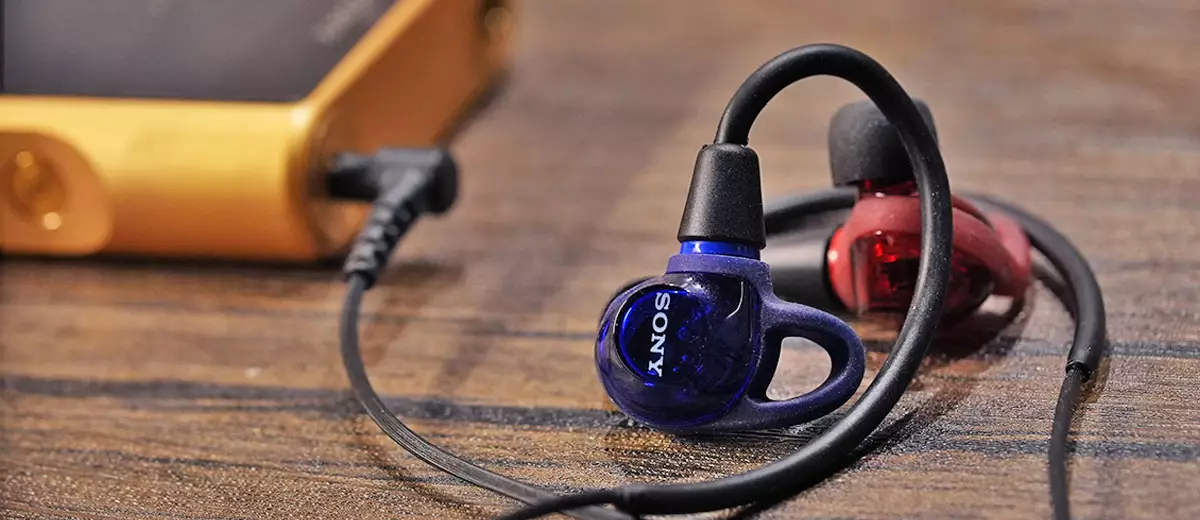
At first glance, the IER-M500 presents an understated, highly functional aesthetic. The review unit arrived in a nostalgic, professional-grade color scheme: transparent red for the right channel and transparent blue for the left. This deliberate color-coding allows audio engineers and performers to instantly identify channels under dim stage lighting. For users desiring a more discreet everyday look, Sony also offers clear and transparent black variants.
Weighing next to nothing, the housing sits flush against the outer ear, eliminating the awkward protrusion common with bulky multi-driver architectures. The injection-molded plastic shell is exceptionally rigid, showing seamless molding and zero visible glue residue.

Crucially, the MMCX sockets are deeply recessed into the chassis. This engineering choice serves a dual purpose: it significantly reduces strain on the pins during active movement and creates a tight environmental seal against sweat and moisture ingress.
The Ear Fin Stabilization System
Perhaps the most distinctive physical feature of the IER-M500 is its proprietary swappable ear fin system. Sony includes five different sizes of these rubberized fins in the box. The larger variants feature pronounced hooks designed to anchor themselves securely into the concha of the ear.

Unlike traditional over-ear cable hooks alone, these fins distribute retention forces evenly across the outer ear anatomy. The result is a rock-solid, stable fit that remains comfortable even after hours of continuous wear.
Stock Cable and Accessories
The IER-M500 ships with a robust, 1.6-meter detachable cable terminated in a standard 3.5mm single-ended plug. Built with a professional prosumer workflow in mind, the extra cable length is a welcome inclusion; it easily reaches bodypack receivers worn on a lower back belt or plugs directly into an audio interface on a deep studio desk without requiring an auxiliary extension cable.

Inside the packaging, users will find:
- 4 pairs of Sony’s acclaimed Triple-Comfort ear tips (silicone core with a rinsible polyurethane foam outer layer, valued independently at over $30).
- 4 pairs of standard silicone tips (Sizes: SS, S, M, and L).
- 5 sizes of interchangeable ear fins.
- A sturdy cable management clip.
Note: While the included soft carrying pouch is of high quality, a hard protective case would have been a more appropriate inclusion for professional gear intended to withstand the abuse of touring.

Sound Impressions: Acoustic Analysis and Performance
Testing the IER-M500 involved a diverse array of source gear, including the Sony WM1Z, FiiO BTR15, Lotoo PAW Gold Touch, and the RME ADI-2 Pro interface.
Frequency Response & Timbral Overview
Driven by a remarkably compact 5mm dynamic driver, the IER-M500 defies expectations regarding scale and authority. It features an M-shaped frequency tilt with a pronounced, authoritative bass emphasis.

- The Low End: The bass is full-bodied, punchy, and surprisingly fast. It delivers a healthy sub-bass lift that provides excellent physical feedback. Drummers and bassists will immediately appreciate how effortlessly rhythm sections cut through ambient stage bleed. Low-frequency transients maintain a clean, articulate edge even when driven straight from a basic laptop headphone jack.
- The Midrange: Vocals possess a natural body and solid acoustic projection. Rather than being pushed aggressively forward into the listener’s face, they sit harmoniously in line with backing instrumentation. While complex, multi-layered mixes require a touch of active listening to extract micro-details, pairing the M500 with a clean, high-resolution DAC sharpens spatial separation significantly.
- The Treble: Engineered explicitly for fatigue-free live monitoring, the high frequencies feature a controlled, steep roll-off. This tuning philosophy successfully tames harshness, piercing sibilance, and abrasive high-pitched vocals. While acoustic string instruments and woodwinds lose a degree of ultimate air and brilliance, the smooth treble prevents ear fatigue during marathon mixing or performance sessions.
Staging and Dynamics
Because of the upper-frequency roll-off, the soundstage feels intimate and focused—reminiscent of a well-treated studio tracking room or small live venue. Width is sufficient, but depth is relatively compact. However, dynamic expression remains a strong suit; the energetic, textured low-end preserves a compelling sense of rhythmic drive and musical momentum.
Furthermore, the IER-M500 responds exceptionally well to equalization. Users can boost the upper-midrange for enhanced vocal presence without introducing noticeable harmonic distortion.

Comparative Analysis: How Does It Stack Up?
Sony IER-M500 vs. Westone Audio AM Pro X20
The Westone Audio AM Pro X20 utilizes a dual-Balanced Armature configuration paired with a specialized StageSense acoustic vent designed to let roughly 12 dB of ambient environmental noise bleed into the ear.
- Design & Fit: Both monitors are exceptionally lightweight and secure, but their philosophies diverge sharply. The Westone prioritizes ambient awareness so performers can interact easily with crowds, whereas the Sony IER-M500 emphasizes passive noise isolation and physical locking via its ear fins.
- Sound: The X20 leans brighter, offering faster transient response, greater air, and heightened vocal clarity at the expense of isolation and bass weight. The Sony delivers a far more cohesive, authoritative bass response with a smoother, sibilance-free treble presentation. For bassists and drummers needing physical punch, the Sony wins; for vocalists requiring maximum air and spatial transparency, the Westone holds an advantage.
Sony IER-M500 vs. Earsonics SWITCH 300 PRO
The French-designed Earsonics SWITCH 300 PRO relies on a three-BA driver array and features an integrated impedance adjustment system allowing users to toggle between three distinct tonal profiles ("Tight," "Standard," and "Warm").

- Design & Fit: Both are compact and comfortable, though Earsonics employs a thinner nozzle design and a transparent shell showcasing internal crossovers.
- Sound: The SWITCH 300 PRO extracts superior midrange detail and instrument separation thanks to its multi-BA architecture. However, it lacks the effortless, organic air and tactile punch of the Sony’s dynamic driver low-end. The Sony presents a darker, more natural timbre that requires less effort to enjoy casually, whereas the Earsonics scales higher with premium source gear but can sound slightly clinical.
Implications: The Verdict for Musicians and Audiophiles
The Sony IER-M500 represents a fascinating pivot from Sony’s consumer-centric portfolio into the gritty, utilitarian world of professional stage monitoring.
By prioritizing a darker, bass-forward signature equipped to cut through loud floor monitors, Sony has crafted an invaluable tool for bassists, drummers, and live vocalists who need reliable rhythm cues. For general music consumption, the IER-M500 shines brightest with rock, heavy metal, electronic, and bass-centric genres. While it lacks the extreme treble extension required for classical string arrangements, its smooth, controlled tonality completely eliminates listener fatigue.

Combined with a rugged build quality, innovative ear fin stabilization, and high-value Triple-Comfort tips at a price point of just $119.99, the Sony IER-M500 punches well above its weight class. It succeeds not only as a dependable stage workhorse but as an exceptional, durable daily driver for workouts, mobile commuting, and home practice sessions.