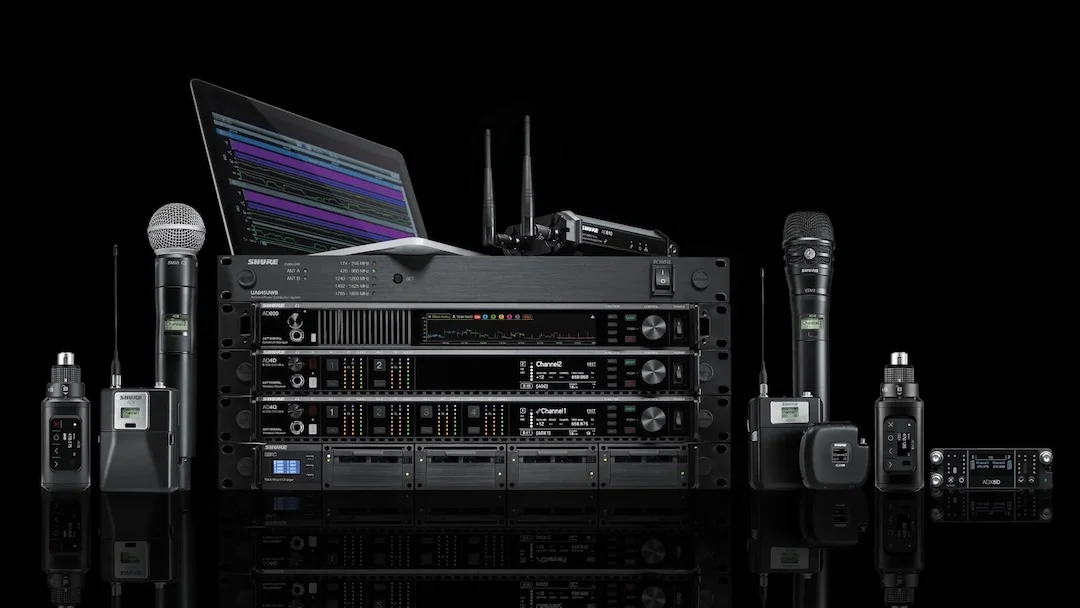
NILES, IL – In the high-stakes world of professional live sound, where the margin for error is non-existent and the complexity of signal management grows with every passing year, Shure has once again set a new benchmark for reliability. On October 8, 2026, the audio technology giant officially released firmware update v1.6 for its flagship Axient Digital Wireless System.
Designed specifically to address the logistical nightmares inherent in large-scale productions—ranging from sprawling music festivals and multi-stage convention centers to expansive televised parades—the update introduces two pivotal features: Channel Linking and Preferred Access Point. These additions represent more than just a minor software patch; they are a strategic response to the evolving needs of audio engineers who operate in increasingly congested RF (radio frequency) environments.
The Core Innovations: Engineering for Scale
The modern production landscape has shifted. Where once a single stage required a few dozen wireless channels, today’s major spectacles require hundreds, often distributed across massive physical footprints. Managing these systems—ensuring that frequency coordination, encryption, and transmitter registration remain synchronized across a distributed network of receivers—has historically been a labor-intensive, manual process prone to human error.
Channel Linking: Efficiency Through Synchronization
The primary highlight of the v1.6 firmware is the introduction of Channel Linking. This feature is compatible with a wide array of the Axient Digital hardware ecosystem, including the AD4Q (four-channel), AD4D (two-channel), ADX5D (portable receiver), and the ANX4 scalable receiver when operating in Axient Digital mode.
Under previous firmware iterations, engineers managing redundant systems or large, multi-receiver racks often had to manually input data into each individual channel. If a frequency change was required due to localized interference, the technician would have to replicate that change across every receiver assigned to that specific transmitter or redundant pair.
With Channel Linking, the process is transformed. Once channels are linked, a "primary" channel acts as the master controller. Any modification made to the primary channel—whether it be frequency selection, transmitter registration, encryption settings, or even channel naming—is instantly mirrored across the secondary channels. This not only significantly reduces setup time but also eliminates the "mismatch" errors that can occur when a technician forgets to update a redundant receiver during a high-pressure production transition.
Preferred Access Point: Mastering the ShowLink Environment
For years, Shure’s ShowLink technology has been the gold standard for remote control of transmitters. By using a 2.4 GHz diversity link, engineers can adjust transmitter parameters—gain, frequency, and RF power—in real-time, without interrupting the audio signal. However, in massive venues utilizing multiple AD610 ShowLink access points, the system historically relied on automated handshakes to determine which access point a transmitter should talk to.
While usually effective, this automation could lead to unpredictable behavior in complex, distributed antenna deployments. If a transmitter drifted between the coverage zones of two different access points, the connection could occasionally become unstable.
The new "Preferred Access Point" feature hands control back to the operator. Engineers can now manually assign specific transmitters to a "preferred" access point. This ensures that a wireless microphone used on the main stage will always prioritize the access point located directly above that stage, rather than attempting to connect to a weaker, more distant unit located in the backstage area or a secondary hall. This predictability is vital for large-scale venues where signal propagation is impacted by steel structures, human interference, and complex architecture.
A Chronology of the Axient Digital Evolution
To understand the significance of the v1.6 update, one must look at the trajectory of the Axient Digital platform since its inception.
- 2017: The Launch. Shure unveiled Axient Digital, marking the end of the analog/digital hybrid era for their high-end gear. It promised unprecedented signal stability and spectral efficiency.
- 2019-2021: Expansion. The introduction of the ADX series transmitters and the ADX5D portable receiver brought Axient-level performance to the broadcast and film markets, necessitating more robust remote management software.
- 2023: The Networking Push. Shure began focusing heavily on integration with third-party control protocols, acknowledging that wireless systems do not live in a vacuum but must exist within a larger IP-based network.
- October 2026: The v1.6 Update. By addressing the specific friction points of "management at scale," Shure has signaled a pivot from simply "better audio" to "better workflow management." The v1.6 update is the culmination of years of feedback from stadium-tour audio leads and broadcast frequency coordinators.
Supporting Data: Why "Large-Scale" Matters
In the context of the RF spectrum, the "noise floor" is rising. The continued repurposing of spectrum by government and cellular providers has squeezed the available space for professional wireless audio.
According to industry white papers regarding wireless coordination:
- Spectrum Density: Modern large-scale events can now see upwards of 200 channels of wireless audio operating simultaneously in a single venue.
- Error Rate Mitigation: Studies have shown that approximately 40% of wireless failures in live environments are caused by "operator error" during high-pressure setup or patching.
- Deployment Time: In a professional testing environment, the implementation of Channel Linking was found to reduce the initial configuration time of a 48-channel rack by approximately 35% compared to manual per-channel entry.
These statistics underscore the economic necessity of the v1.6 update. For a production company running a major tour, shaving hours off the daily load-in process translates directly to labor cost savings and increased reliability.
Official Perspective: The Voice of Shure
While Shure’s engineering team rarely gives interviews regarding specific lines of code, the company’s broader philosophy on the Axient platform has remained consistent.
"Our mission with the Axient Digital ecosystem has always been to provide a safety net for the engineer," says a representative from Shure’s product development team. "We recognize that the engineer is often dealing with dozens of variables at once. If we can make the wireless system behave in a more predictable, logical way, we allow the engineer to focus on the mix, rather than the hardware. Features like Channel Linking aren’t just about convenience—they are about system integrity."
Industry reaction has been swift and positive. Early adopters among major concert touring professionals have noted that the "Preferred Access Point" feature effectively solves the "handover" issue that has plagued large, multi-hall convention centers for years.
Implications for the Industry
The release of Axient Digital v1.6 has immediate implications for several sectors of the professional audio industry:
1. The Touring and Live Events Sector
For touring professionals, the update is a game-changer for redundant RF systems. Many tours run a primary and a backup transmitter for every lead vocalist or instrument. The ability to link these channels means that if a frequency needs to be changed mid-show due to an unexpected interference event (such as a local news crew or mobile broadcast unit), the engineer can change one frequency, and both the active and standby units will update simultaneously, ensuring no gap in the safety net.
2. The Broadcast and Television Sector
In broadcast, particularly with the ADX5D portable receiver, the ability to manage connections in crowded studio environments is paramount. By locking transmitters to preferred access points, production teams can ensure that their wireless cameras and microphones remain glued to their local receivers, even when moving through corridors or areas where overlapping access points might have previously caused "flapping" connections.
3. The Future of IP-Based Wireless
This update hints at a future where Shure hardware becomes even more "software-defined." As hardware manufacturers move toward an IP-centric model, the ability to push firmware updates that fundamentally change how devices interact with one another (rather than just fixing bugs) will become the primary way that equipment remains relevant over a ten-year lifespan.
Conclusion: A New Standard for Workflow
The v1.6 update for Shure’s Axient Digital Wireless System is a testament to the fact that the most valuable innovations are often the ones that make complex systems feel simple. By focusing on the administrative hurdles of wireless deployment—channel synchronization and access point management—Shure has solidified the Axient Digital platform’s position as the industry standard.
For audio professionals looking to implement these features, the update is currently available for download via the Shure Update Utility desktop application. As the industry continues to push the boundaries of what is possible in large-scale production, Shure has ensured that the underlying wireless infrastructure is not just capable of keeping up, but is actively leading the way in efficiency and reliability.