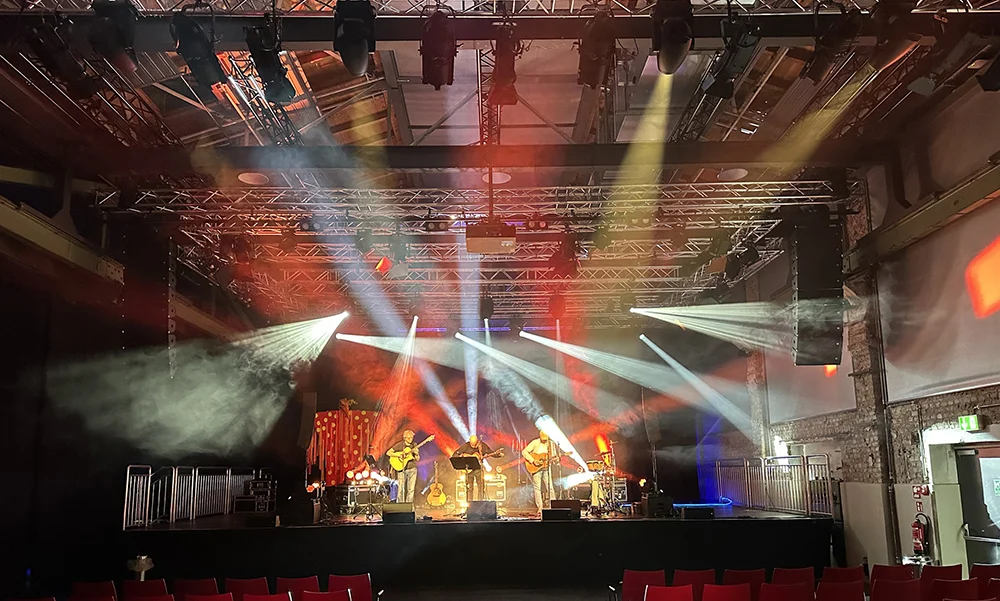
The town of Gummersbach, Germany, has long held a unique jewel in its cultural crown: Halle 32. Located on the former grounds of the L. & C. Steinmüller industrial complex, this historic production hall has been meticulously repurposed into a vibrant, multi-functional event space. Since its opening in 2013, it has served as the heartbeat of the local arts scene, hosting everything from intimate literary readings and theatrical plays to grand orchestral performances and high-decibel heavy metal concerts.
However, the architectural beauty of a repurposed industrial hall often presents a formidable challenge for audio engineers. With its unique geometry and structural constraints, Halle 32 required a sonic upgrade that could reconcile its aesthetic charm with the rigorous demands of modern sound reinforcement. The solution, recently implemented, centers on a state-of-the-art system by CODA Audio, marking a new chapter in the venue’s technical evolution.
The Challenge of History: Defining the Acoustic Landscape
When the management of Halle 32 decided it was time to modernize their sound infrastructure, they opted for a manufacturer-neutral tender process. The goal was simple yet ambitious: to achieve consistent, high-fidelity coverage for a capacity ranging from 1,000 to 1,500 patrons, depending on the specific event configuration.
Audio specialist Sascha Klein of Klein-Klang was commissioned to lead the endeavor. His task was to evaluate a wide spectrum of audio solutions, ranging from traditional point-source designs to modern line arrays. This wasn’t merely a paper exercise; Klein performed detailed simulations, followed by exhaustive trial listening sessions to ensure that the theoretical prowess of the equipment translated into real-world performance.
"Due to the spatial geometry of the room, it was clear that not every sound concept could work equally well," Klein noted during the evaluation phase. The venue’s primary acoustic hurdle—a relatively low ceiling—dictated a specific requirement: the system needed significant headroom to project audio energy effectively across the length of the hall without creating problematic reflections or "dead zones."
A Strategic Selection: Why CODA Audio?
The selection process was exhaustive, weighing acoustic transparency against practical considerations such as rigging flexibility, ease of handling, and overall budget. After comparing multiple industry-leading brands, CODA Audio emerged as the clear winner.
The rationale behind the selection was multi-faceted. First and foremost was the system’s ability to maintain controlled directivity over long distances, a necessity given the narrow and elongated nature of the hall. Furthermore, the compact physical footprint of the CODA hardware allowed for a powerful setup that remained visually inconspicuous, preserving the industrial aesthetic of the venue.
"Handling was also a critical factor," explains Klein. "Given that the hall deploys different stage positions and various event formats, it was vital that the array positions could be adapted quickly and easily to meet shifting production demands." The efficiency of the rigging system, combined with the natural, dynamic reserve of the loudspeaker components, made the CODA Audio solution uniquely suited to the venue’s operational needs.
Technical Specifications: The Anatomy of the New System
The heart of the new system is the CODA Audio ViRAY, a dual 8-inch, 3-way line array that offers exceptional performance-to-size ratio. The installation consists of nine ViRAY elements per side, flown in a Left/Right configuration. To ensure optimal coverage, each array utilizes a hybrid dispersion pattern: six units are configured at 80 degrees for long-throw projection, while the bottom three units utilize 120-degree dispersion to ensure wider coverage for the front-of-house area.
Low-frequency reproduction is managed by six SCP dual 18-inch subwoofers. To mitigate the natural acoustic challenges of the stone-heavy hall, these subwoofers are deployed in a cardioid configuration, which directs low-end energy toward the audience while minimizing unwanted reflections behind the stage and off the walls.
For near-field reinforcement, the system utilizes four HOPS7-Pro units, ensuring that the front rows receive the same level of sonic clarity as those further back. For the rear of the hall, two HOPS12i-Pro units function as delay speakers, maintaining timing and frequency consistency across the entire audience footprint. The entire ecosystem is powered and managed by CODA Audio’s proprietary LINUS DSP amplification platforms, which provide seamless integration and remote monitoring capabilities.
Expert Perspectives: The Installation Process
Markus Gorges, a key member of the installation team, reflects on the difficulties inherent in such a historic structure. "The stone construction of this long and narrow venue made the installation challenging, but we knew we could rely on CODA Audio," Gorges states. "These compact systems have a very ‘natural’ sound characteristic. The treble range, in particular, is incredibly clear and transparent. Visitors are consistently amazed at how visually inconspicuous such a powerful system can be."
The installation was not just about the hardware, but about creating a workflow that would empower the venue’s technical staff. The feedback from visiting engineers has been immediate. One FOH (Front of House) technician working on a major musical production was reportedly stunned by the low-end performance of the system, noting that the ViRAY arrays were capable of producing significant, punchy low-frequency energy even when the subwoofers were powered down.
Operational Implications: Flexibility as the New Standard
The successful implementation at Halle 32 serves as a case study in how modern audio technology can respect, rather than clash with, historic architecture. By utilizing high-output, compact arrays, the venue has eliminated the need for bulky, obtrusive speaker stacks that previously cluttered the sightlines of the stage.
Furthermore, the "cardioid" subwoofer configuration has had a transformative impact on the stage environment. By canceling out rear-facing low frequencies, performers on stage experience a cleaner, more controlled sound environment, reducing the amount of "mud" that typically builds up in industrial, reflective venues. This is particularly important for the diverse range of events hosted at Halle 32, where the acoustic needs of a quiet literary reading vary wildly from those of an amplified rock concert.
Looking Ahead: The Future of Halle 32
The integration of the CODA Audio system represents a significant capital investment in the future of Gummersbach’s cultural infrastructure. By prioritizing sonic quality and operational efficiency, the venue management has ensured that Halle 32 will remain a premier destination for both regional and international touring acts.
The "manufacturer-neutral" approach taken during the procurement phase proved to be a masterstroke. By refusing to commit to a brand until the simulations and listening tests were complete, the team behind the project ensured that the technology served the room, rather than forcing the room to adapt to the technology.
As the venue continues to expand its programming, the flexibility of the new rig will prove invaluable. The ability to quickly reconfigure the array angles and the ease of the rigging hardware means that the technical team can pivot between event types with minimal downtime. This operational agility is what truly defines a world-class venue in the 21st century.
Conclusion
Halle 32 stands as a testament to the idea that industrial heritage and modern innovation are not mutually exclusive. Through the diligent work of Sascha Klein, the installation expertise of the local team, and the advanced engineering of CODA Audio, Gummersbach has secured a sonic future that is as rich and nuanced as its industrial past. Whether it is the soft inflection of a voice during a reading or the roar of a guitar cabinet during a metal show, the new system ensures that every note, word, and beat is delivered with clarity, power, and precision. The residents of Gummersbach can rest assured that their local landmark remains, quite literally, one of the best-sounding venues in the region.