Introduction: A Monumental Tradition
For over half a century, the steps of the Puerto Rico Capitol in San Juan have served as the hallowed grounds for Clamor a Dios ("Crying Out to God"), an annual interdenominational worship event that stands as a cornerstone of the island’s spiritual life. The 53rd edition, held on October 13, 2026, proved to be one of the most challenging and triumphant in the event’s storied history.
Despite an unyielding tropical downpour that tested the resilience of both the congregation and the equipment, the four-hour gathering of faith, music, and prayer proceeded with acoustic precision. The technical success of the event was orchestrated by JF Sound Corp., which deployed a sophisticated dBTechnologies VIO sound reinforcement system to ensure that every word of the messages and every note of the worship music reached the massive audience gathered on the Capitol grounds.
The Chronology: Weathering the Storm
The planning for Clamor a Dios 2026 began months in advance, with production manager Lizza M. Rivera coordinating the logistical complexities of hosting a large-scale event at a government landmark. The site—the north side of the Capitol—presents a unique set of acoustic challenges, characterized by a vast open space that demands significant throw and wide horizontal dispersion.
On the day of the event, the logistical plan faced an immediate test: the weather. As the crowd gathered, a heavy rain began to fall. In many live sound scenarios, such conditions would necessitate a pause or an early conclusion. However, the devotion of the congregation remained unshaken. Recognizing the commitment of the attendees, the production team at JF Sound Corp. prioritized the integrity of the signal chain and the safety of the electronics, ensuring that the audio system remained fully operational throughout the entirety of the four-hour broadcast and performance window.
The event commenced with high-energy worship music, designed to engage the audience despite the inclement weather. As the service transitioned into periods of prayer and long-form faith-based messages, the clarity of the audio remained paramount. The system maintained its coverage consistency from the first row to the back of the 300-foot-deep field, ensuring that the emotional resonance of the event was not lost to the elements.
Technical Specifications: The Anatomy of the System
The backbone of the audio experience was a complex, multi-layered design engineered by Juan Fuentes, who served as both system designer and front-of-house (FOH) engineer. The scale of the event required covering a 300-foot-wide outdoor area. To achieve this, Fuentes opted for a distributed line-array strategy utilizing the dBTechnologies VIO series.
The Main Arrays and Fills
The core of the system featured two-dozen VIO L1610 three-way line-array modules. These were divided into four distinct hangs. Two primary hangs were positioned to deliver the necessary SPL (Sound Pressure Level) and high-frequency throw required to reach the rear of the audience area. To address the 300-foot width of the grounds, two additional out-fill hangs were deployed, effectively widening the stereo image and ensuring consistent coverage for those positioned far to the left and right of the stage.
For the near-field, the team utilized four VIO L1608 three-way modules. These units provided critical front-fill, ensuring that the first few rows of the congregation experienced the same vocal intimacy and musical detail as those in the center. The low-end frequency response was managed by eight VIO S218 subwoofers, which provided a powerful yet controlled foundation for the worship band.
Stage Monitoring and Mixing
The stage environment was equally sophisticated. To maintain a clean visual profile while providing high-fidelity monitoring, four VIO X206 loudspeakers were flown from the stage truss as low-profile fills. For the performers, four VIO W12T active coaxial wedges provided precise, phase-coherent monitoring.
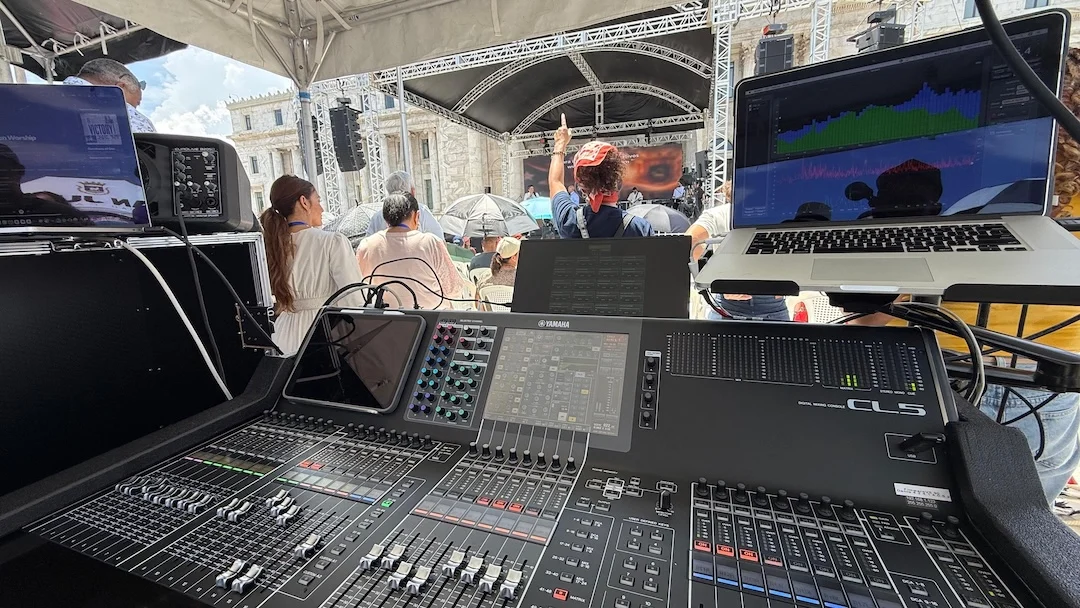
The mixing infrastructure was anchored by industry-standard consoles. At the FOH position, a Yamaha CL5 provided the processing power and intuitive interface required for managing a complex live mix. Monitor duties were handled by a Yamaha DM7, which allowed monitor engineer Luis Guzmán to create discrete, high-quality mixes for the worship leaders and musicians, ensuring they could perform at their best despite the challenging acoustic environment of an open-air rainstorm.
Official Perspectives and Technical Design Logic
In the aftermath of the event, the design team shared insights into the strategic choices that allowed the audio to succeed where others might have faltered.
"The site required both distance and considerable horizontal coverage, so we designed the system as four VIO L1610 hangs," explained Juan Fuentes. "The two main arrays carried the program to the rear of the audience area, while the out-fill hangs extended coverage across its full width. The VIO L1608s allowed us to cover the first rows with a compact system that integrated naturally with the larger arrays."
The decision to use the VIO series was based on the modules’ ability to handle high-output requirements while maintaining tonal balance. In a worship context, where the intelligibility of the spoken word is just as vital as the impact of the music, the VIO L1610’s three-way design offered the headroom necessary to cut through the ambient noise of the rain and the wind without causing listener fatigue.
The professional collaboration between the engineering team—including FOH assistant Carlos Alvalle and stage technicians Elias Pacheco and José Fuentes—was frequently cited as a critical factor in the event’s smooth execution. Under the guidance of production manager Lizza M. Rivera, the team functioned as a unified entity, demonstrating that technical precision is the invisible partner of public worship.
Implications for Future Outdoor Worship
The 53rd Clamor a Dios provides a compelling case study for the evolution of outdoor worship events. As congregations continue to grow and seek venues that allow for large-scale public gatherings, the demand for high-performance, weather-resilient audio systems will only increase.
The Role of Technology in Community Engagement
The ability of JF Sound Corp. to provide a concert-grade experience in a public, outdoor, and weather-threatened environment underscores the changing expectations of the worship community. Attendees now expect high-fidelity audio that can compete with the professional touring industry. The success of the VIO system deployment suggests that line-array technology, once reserved primarily for rock concerts and secular festivals, is now an essential tool for religious organizations aiming to reach thousands of people simultaneously.
Resilience and Reliability
Furthermore, the event serves as a testament to the reliability of modern active loudspeaker systems. The fact that the equipment performed flawlessly for four hours in a downpour is a testament to the robust engineering of the dBTechnologies VIO line. For event organizers and production companies in tropical climates like Puerto Rico, this reliability is a vital metric in risk mitigation.
Conclusion
The 53rd edition of Clamor a Dios was more than just a gathering; it was a demonstration of how modern audio engineering can support the human spirit. By bridging the gap between the monumental scale of the Puerto Rico Capitol grounds and the personal nature of a worship service, JF Sound Corp. ensured that the message of the day was delivered with clarity, power, and passion. As the sun set on San Juan that October evening, the lingering sound of the final hymn served as a reminder that when technology and purpose align, the result is an experience that resonates far beyond the final note.
The success of this year’s event sets a high bar for the 54th edition, proving that with the right team and the right technology, even the most challenging conditions can be overcome in the service of a collective goal.