BOSTON, MA – History is rarely a quiet affair. In the winter of 1773, the Old South Meeting House served as the epicenter of a political firestorm that would eventually ignite the American Revolution. Today, however, the challenge facing curators is not how to stir a revolution, but how to stir the imaginations of modern visitors within the confines of a fragile, 18th-century structure.
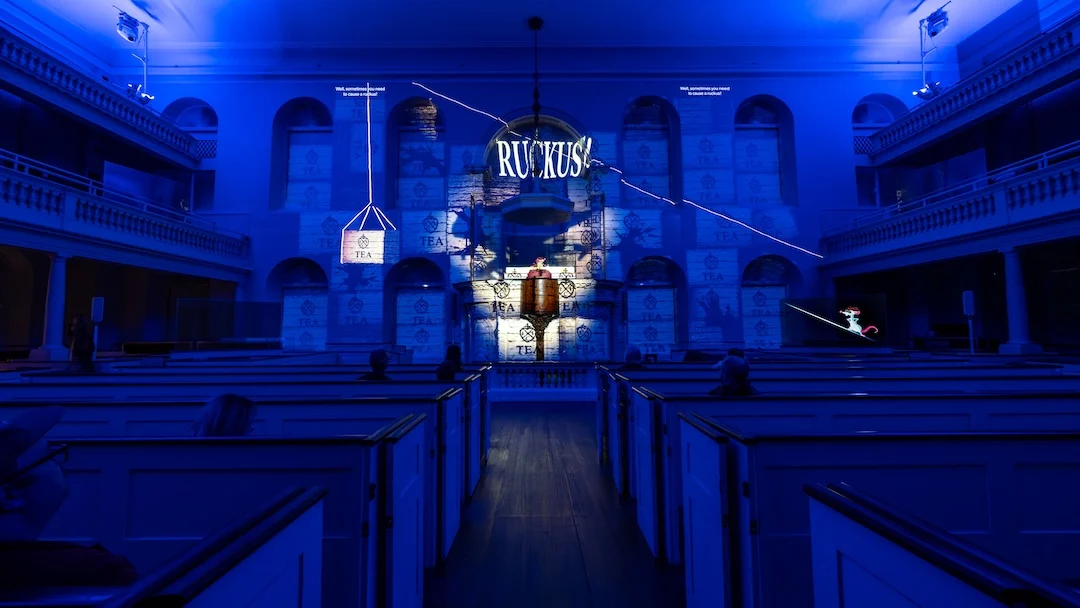
With the debut of Ruckus!, a cutting-edge experiential exhibit, the Old South Meeting House has bridged the gap between colonial antiquity and modern multimedia technology. By blending projected animations, dynamic lighting, and a sophisticated multichannel audio architecture designed by Electrosonic and 1 Sound, the site has transformed from a static landmark into a living, breathing theater of history.
The Genesis of Ruckus!: Reimagining the Revolutionary Experience
The Old South Meeting House, a centerpiece of Boston’s famed Freedom Trail, is more than a building; it is a monument to free speech and dissent. For the team at Revolutionary Spaces, the organization tasked with managing the historic site, the goal was to move beyond the traditional "museum visit" model. They envisioned an environment where visitors could feel the tension of the Boston Tea Party meetings—the shouting, the arguments, and the atmosphere of a populace on the brink of revolt.
Ruckus! was conceived as an immersive narrative tool. It utilizes the existing architecture of the meeting house—its high ceilings, wooden pews, and historic balconies—as a canvas. Through carefully mapped projections, the ghosts of the past are brought to life: historical figures, disgruntled merchants, and the voices of ordinary citizens who shaped the nation’s founding.
However, visual spectacle is only half the battle in a space notoriously difficult for acoustics. The challenge was to deliver a narrative-heavy, high-fidelity soundscape that could cut through the ambient reverberation of a timber-framed, cavernous room without physically altering or detracting from its historic character.
Chronology of the Audio Transformation
The journey to modernize the audio landscape of the Old South Meeting House was a multi-year project defined by careful planning and collaboration.
- Initial Assessment (2024): Revolutionary Spaces identified that their aging audio infrastructure was failing to meet the needs of contemporary visitors. High reverberation times made spoken-word clarity a struggle, particularly for non-native English speakers or those with hearing impairments.
- Design & Engineering (Early 2025): Electrosonic was brought on board to design a system that could handle the demands of Ruckus!. They turned to 1 Sound for high-performance, low-profile speaker solutions. The primary mandate was "invisibility"—the hardware needed to be powerful yet physically unobtrusive.
- Installation (Spring/Summer 2026): Engineers worked within the strict constraints of a protected landmark. Running cabling through century-old joists and mounting hardware without damaging original woodwork required a delicate, surgical approach to installation.
- System Calibration (August 2026): Following installation, the team conducted rigorous acoustic testing. They tuned the system to handle both the intense, dynamic sound effects of the exhibit and the varied requirements of live public forums, concerts, and theatrical productions.
- Grand Opening (September 14, 2026): The Ruckus! exhibit officially launched, marking a new chapter for the meeting house and setting a benchmark for how historic sites can integrate high-end technology.
Engineering for History: Supporting Data and Technical Specifications
To achieve a "seamless" auditory experience, Electrosonic deployed a distributed multichannel design. The primary objective was to ensure that a visitor in the back row of the balcony heard the same crisp, intelligible audio as a visitor in the front-row pews.
The system relies on a strategic layering of 1 Sound hardware:
- Main L/R Coverage: The core of the system utilizes Tower LCC84 loudspeakers. These cardioid line array columns are engineered to provide exceptional vertical control, directing sound exactly where it is needed while minimizing reflections off the ceiling and floor—a critical factor in a space with such high reverberation.
- Mid-Field and Side Fills: Tower LCC44 loudspeakers were integrated as side fills to maintain the "presence" of the soundstage as visitors move from the center aisle to the periphery of the room.
- Surround and Balcony Fill: The spatial aspect of the exhibit is supported by Level L35 flush-mounted loudspeakers, which provide localized surround sound. For the balcony, C4 loudspeakers were selected for their compact size and broad coverage, ensuring that the elevated seating area—previously a "dead zone" for audio—is fully integrated into the experience.
- Low-Frequency Foundation: To capture the weight of the "ruckus" occurring during the exhibit, SUB28 subwoofers were installed at the front left and right positions. These provide the necessary sub-bass frequencies to give the audio a visceral, physical impact.
By opting for a distributed, rather than centralized, audio design, the engineers were able to keep volume levels moderate while maintaining high intelligibility. This approach successfully mitigates the "echo chamber" effect common in large, historic assembly halls.
Perspectives from the Frontline: Official Responses
The project has garnered praise not only for its technical prowess but for its sensitivity to the site’s historical significance.
"Solving sound for a space like ours—a space that needs to maintain its architectural and historical integrity, and that is not designed for modern sound—is a tall order," noted Matthew Wilding, Senior Director of Interpretation & Future Projects for Revolutionary Spaces.
Wilding emphasized the transformative nature of the installation. "1 Sound worked with us to craft a state-of-the-art, multi-channel system that sounds absolutely incredible and is practically invisible. With our old system, there were parts of the building where you’d struggle to hear someone speaking clearly because of the reverberation. Now, every seat is a good seat, whether it’s for our new immersive show, a forum, a theater production, or a concert. 1 Sound completely transformed the audio experience in our historic site."
This sentiment is echoed by the installation partners. By choosing components that blended into the visual aesthetic of the Old South Meeting House, the technical team ensured that the technology remains a servant to the history, rather than a distraction from it.
The Broader Implications for Historic Preservation
The success at the Old South Meeting House serves as a case study for the museum and cultural sector. As cultural institutions struggle to remain relevant in an era of digital-first entertainment, the ability to create immersive, high-quality audio environments is no longer a luxury—it is a necessity.
1. Enhancing Accessibility
The improved clarity provided by the new system is a major victory for accessibility. For many visitors, especially those who struggle with hearing loss, historic sites can be frustratingly difficult to navigate. The high-intelligibility output of the 1 Sound system ensures that the narrative of the Revolution is accessible to all, effectively democratizing the history contained within the walls.
2. Multi-Purpose Utility
Perhaps the most significant takeaway for other heritage sites is the system’s flexibility. By investing in a high-end, multi-channel setup, the Old South Meeting House has effectively future-proofed its space. The system is equally capable of supporting the high-decibel requirements of a cinematic exhibit as it is the nuanced, natural reinforcement needed for a panel discussion on modern democracy.
3. Preserving the "Spirit of Place"
The project demonstrates that modern technology does not have to be an eyesore. Through the use of low-profile, high-output line arrays and flush-mounted speakers, the site managed to avoid the "tech-clutter" that often ruins the aesthetic of heritage buildings. It proves that with enough engineering foresight, a site can be "brought into the 21st century" without sacrificing the 18th-century atmosphere that visitors come to experience.
As the Old South Meeting House continues to host thousands of visitors annually, the Ruckus! exhibit stands as a testament to the idea that history is best understood when it is heard clearly. By combining the revolutionary spirit of 1773 with the audio engineering of 2026, Boston has once again proven that its historic sites are not merely relics of the past, but active participants in the ongoing dialogue of American life.