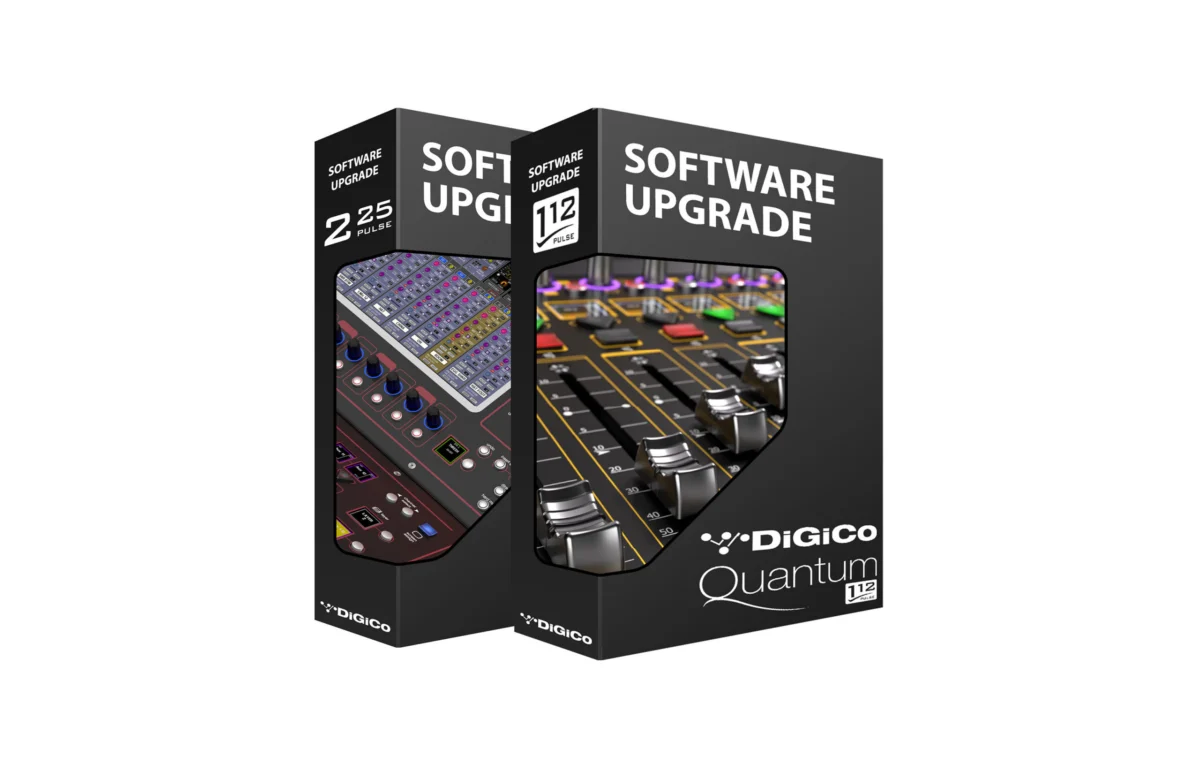
CHESSINGTON, UK — In a move that reaffirms its commitment to longevity and scalability in the professional live sound market, DiGiCo has officially unveiled a series of significant software enhancements for its popular Quantum112 and Quantum225 mixing consoles. Announced on October 22, 2026, these updates—collectively referred to as the "Pulse" upgrades—are designed to breathe new life into existing hardware, effectively increasing the processing headroom, channel counts, and routing capabilities of these compact yet powerful desks.
As the demands of modern live productions continue to balloon, with higher track counts for virtual soundchecks, complex monitor requirements, and the necessity for granular processing on every channel, DiGiCo’s latest move provides a strategic path forward for rental houses, touring engineers, and permanent installation facilities.
The Core Advancements: What’s New?
The Pulse software update is not merely a bug fix or a minor performance patch; it is a fundamental reconfiguration of how these consoles manage their FPGA-based architecture.
The Quantum112 Evolution
The Quantum112, previously a formidable mid-sized option, has received a substantial performance ceiling lift. Users who opt for the upgrade will notice:
- Input Channel Expansion: A jump from 80 to 96 input channels, providing extra room for expansive drum kits or orchestral layering.
- Bus Infrastructure: Aux/subgroup buses have been doubled from 24 to 48, allowing for far more complex monitor mixes and subgroup routing.
- Matrix Routing: The matrix capabilities have been expanded to a 12×12 configuration, up from 12×8, offering engineers more flexibility in zone control and broadcast output management.
- Advanced Processing: Mustard processing instances—the acclaimed channel strip modeling suite—have seen an increase from 20 to 24, while Nodal Processing, a hallmark of the Quantum series, has been boosted from 24 to 32 instances.
The Quantum225/225 DS Enhancement
The Quantum225 and its sibling, the Quantum225 DS, have been treated with a "channel-first" approach. Pulse-equipped units can now accommodate up to 120 input channels, a 25% increase from the previous 96-channel limit. This allows the 225 to compete effectively with larger-format consoles while maintaining its small footprint.
For legacy owners whose consoles have not yet been "Pulse-equipped," DiGiCo has provided a comprehensive upgrade path. For a list price of £2,295, non-Pulse Quantum225 owners can unlock the full potential of the Pulse architecture, gaining the 120-channel capacity, 48 buses, the 12×12 matrix, 36 Mustard processing instances, and 48 Nodal Processing instances.
A Chronological Perspective: The Road to Pulse
DiGiCo’s reputation has long been built on the longevity of its hardware. By utilizing FPGA (Field Programmable Gate Array) technology, the company ensures that its consoles do not become obsolete the moment a newer model hits the market.
Early 2020s: The Quantum Shift
The introduction of the Quantum engine marked a paradigm shift in DiGiCo’s design philosophy. Moving away from static DSP chips to massive FPGA arrays allowed for "Nodal Processing," which gave engineers the ability to process audio at the input, group, or auxiliary level independently.
2024-2025: Consolidation of the Compact Range
Following the release of the Quantum112 and 225, the industry saw an increased desire for "big console" features in "small console" frames. As touring productions became more streamlined due to logistics and transport costs, the ability to pack 100+ channels into a compact desk became the "Holy Grail" for system engineers.
October 2026: The Pulse Milestone
Today’s announcement represents the culmination of two years of software development. By optimizing the code that dictates how the FPGA manages data, DiGiCo has effectively "found" more processing power without requiring any physical hardware swaps. This approach—leveraging the latent potential of existing hardware—is a testament to the sophistication of the company’s engineering team.
Supporting Data and Technical Implications
To understand the weight of these updates, one must look at the mathematical reality of live sound production. A modern musical theatre production or a high-end touring pop show frequently utilizes upwards of 80 input sources. When you add in playback stems, click tracks, and audience microphones, the 80-channel limit of the original Quantum112 could quickly become a bottleneck.
Processing Efficiency
The inclusion of extra Mustard and Nodal processing is perhaps the most significant functional improvement. Mustard processing provides vintage-modeled compression and EQ directly on the channel strip. Previously, engineers might have had to pick and choose which channels received these premium effects. With the increase to 24 (Quantum112) and 36 (Quantum225) instances, the "musicality" of the desk is extended to a much wider array of sources.
The Value Proposition
From an investment standpoint, the Pulse upgrade is a "no-brainer" for the professional sector. At £995 for the Quantum112 update, the cost-per-channel added is significantly lower than the depreciation of a console swap. By extending the operational life of the desk by several years, DiGiCo has protected the assets of its global user base.
Official Perspectives: The Philosophy of Longevity
While DiGiCo typically allows its hardware to speak for itself, the industry response to this update has been overwhelmingly positive.
Industry analysts have noted that this approach contrasts sharply with the "disposable" nature of consumer electronics. A spokesperson for a major global rental house remarked: "In our business, a console is a five-to-ten-year asset. When a manufacturer provides a software update that effectively moves our inventory up a tier in performance, it directly impacts our bottom line and our ability to bid for high-end riders."
The company’s decision to offer a free upgrade for already Pulse-equipped Quantum225 units demonstrates a commitment to maintaining a standardized "fleet" for touring companies. By ensuring that all Pulse 225s can reach the 120-channel threshold without additional cost, DiGiCo ensures that an engineer walking into a venue with a rider for 120 channels can be confident that any Pulse-equipped 225 will meet the spec.
Implications for the Future of Mixing
The release of these updates has several broad implications for the pro-audio industry:
1. The Death of Planned Obsolescence
DiGiCo has set a standard that other manufacturers are now forced to emulate. As the gap between software and hardware continues to blur, customers are increasingly demanding "future-proofing." If a console can be improved via a download, the value of that console is inherently higher on the second-hand market.
2. The Rise of the "Compact Powerhouse"
We are witnessing a shift where the size of the console no longer dictates the size of the show. With the Quantum225 now capable of 120 channels and extensive nodal processing, the physical footprint of the front-of-house position can be significantly reduced. This is a massive boon for venues with limited floor space and touring acts looking to maximize truck space.
3. Workflow Standardization
With these updates, the Quantum workflow—already considered the industry standard for high-end touring—becomes more consistent across the product line. An engineer who spends their time on a flagship Quantum 7 or 8 can now step down to a Quantum 112 or 225 without feeling like they are sacrificing a significant portion of their processing capability. This creates a "universal language" of mixing that simplifies training and technical onboarding for production crews.
Conclusion: How to Access the Upgrades
For those currently operating these systems, the process is straightforward. DiGiCo has hosted the necessary software, along with the corresponding new versions of their offline editor/application software, on their official support portal.
It is highly recommended that users back up all show files and session data before performing the update. While the FPGA update process is inherently stable, the magnitude of the changes to the system architecture necessitates a full refresh of the console’s operating environment.
As we look toward the 2027 touring season, it is clear that DiGiCo’s Pulse update will play a pivotal role in the technical specifications of major productions. By choosing to empower the user rather than force a replacement cycle, DiGiCo has not only satisfied its existing customer base but has also solidified its position as a leader in sustainable, high-performance audio engineering.
For further details on technical specifications, compatibility lists, and step-by-step installation guides, audio professionals are encouraged to visit the official DiGiCo support portal. The era of the "Pulse" is here, and it promises to keep the Quantum range at the heart of the world’s most demanding stages for years to come.